
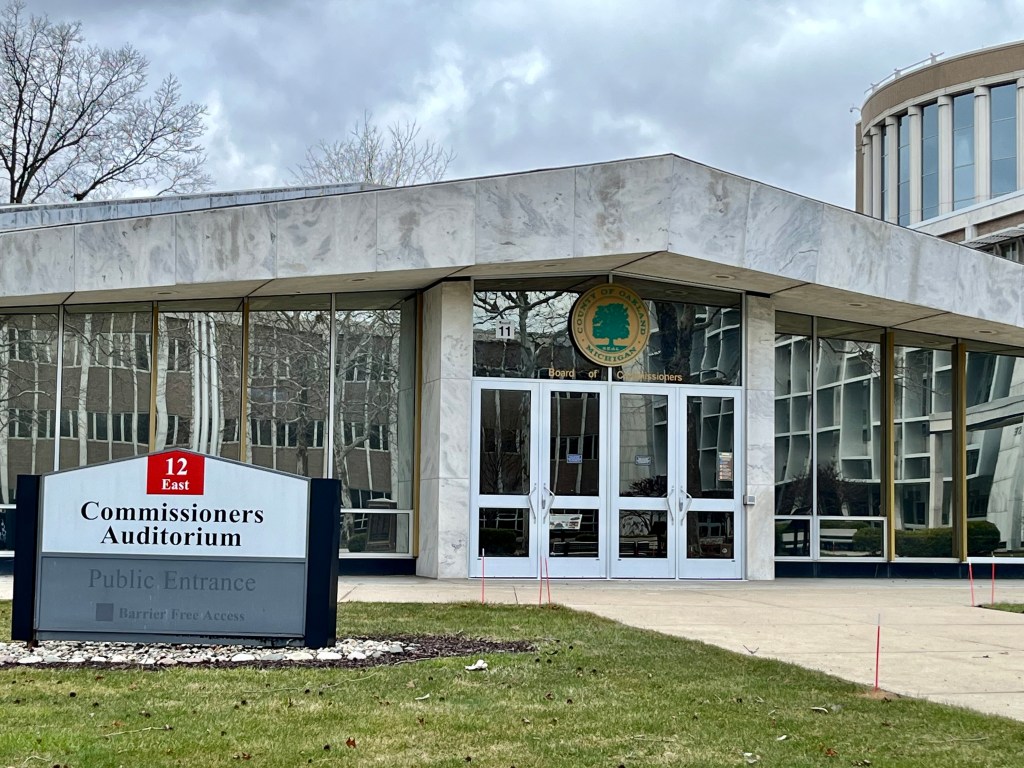
County commissioners last week passed a resolution that bars federal agents for U.S. Immigration and Customs Enforcement and the U.S. Border Patrol from county properties, but with several exceptions
The resolution notes the county has no authority over federal agents and that ICE agents can have access to county property if they have a judicial warrant. The resolution opposes federal agents using face masks during “civil immigration enforcement activities … except where face coverings are strictly required for verified public health or safety reasons.”
The resolution passed 10-6 with Democrats Ann Erickson Gault, Marcia Gershenson, Brendan Johnson, Penny Luebs, Gwen Markham, William Miller III, Angela Powell, Yolanda Smith Charles and David Woodward, and Republican Bob Hoffman voting for the measure.
Republicans Karen Joliat, Christine Long, Robert Smiley and Philip Weipert, and Democrats Charles Cavell and Kristen Nelson voted against the resolution. Republican Mike Spisz was absent from the meeting.
Commissioners also passed a resolution supporting three state Senate bills to impose transparency measures on ICE agents. The three bills aimed at ICE were introduced in August and sent to committee; they are not expected to come to a full Senate vote.
The commission added a subcommittee for community safety and civil rights, naming Powell chair and Markham, Smith Charles, Johnson and Luebs members. When Hoffman pointed out that no Republicans were named to the subcommittee, Woodward added Hoffman to the group. The first meeting will be scheduled in the near future but will not be livestreamed or recorded for public distribution.
The commission’s decisions came after dozens of residents attended county commission meetings to talk about ICE. Many spoke about fear that ICE agents are creating in the community. Some said they supported the agents, who they said were following the rule of law.
County Executive Dave Coulter applauded the commission’s actions, calling immigration enforcement across the country “aggressive and unchecked.”
ICE’s current tactics, which Coulter said should be “targeted efforts to remove dangerous criminals,” are instead leaving “too many of our neighbors in dread of being swept up regardless of their immigration status, simply based on how they look, the language they speak, or the type of work they do.”
In one recent case ICE detained Detroit residents Edwin Vladimir Romero Gutierrez and Angel Junior Rincon-Perez, documented immigrants and fathers working as Amazon Flex drivers in Hazel Park, on Feb. 2. Each man had upcoming court hearings as part of their appeals for asylum in the U.S. Advocates for the men said they have no criminal records.
Romero Gutierrez and Rincon-Perez are being held with more than 1,000 others at the North Lake Processing Center in Baldwin. As of Feb. 5, the center holds 1,419 detainees, according to TRAC, a non-partisan data repository at Syracuse University.
Coulter said he was concerned about ICE’s growing presence in Michigan and what it means for all people’s security and civil liberties.
Since 2023, the number of people detained by ICE nationwide has nearly tripled, from more than 26,000 in January 2023 to 72,551 at the end of January 2026, according to figures shared publicly by ICE.
Coulter promised to work “to ensure law enforcement activity in the county is transparent and accountable. People deserve nothing less.”
Cavell proposed four resolutions during the meeting:
• One used stronger language to bar ICE agents from county property and county employees from assisting agents.
• Another would bar the county sheriff’s office from entering into any federal agreement to work with ICE.
• A third called for commissioners to allocate $150,000 from the county’s general fund to area nonprofits to help eligible families affected by ICE activity, including $100,000 for food assistance and $50,000 for legal aid services.
• A fourth urged a new county authority, the Courts and Law Enforcement Management Information System (CLEMIS), to end a current contact with ICE and bar all future contracts.
CLEMIS was part of the county’s information-technology department and had agreements with local, county, state and federal law-enforcement and other agencies which allowed secure access to court and law-enforcement records. On Feb. 1, CLEMIS became an independent authority. While the county’s contracts will be terminated, the authority will create new contracts. It’s unclear if a contract with ICE will be inked.