
The Abridged version:
Openings to get into nursing school or to get a job once trained are difficult to find in the Sacramento region. Pay in the region is relatively high, but some trained nurses are forced to look elsewhere for a job.
The Sacramento region has 10 public or private schools with nursing programs that offer associate’s, bachelor’s or master’s degrees in registered nursing. Slots for required clinical training are also tough to find.
Student costs vary widely and can exceed $100,000 at a private nursing school. One program in the region helps high school and early college students know what they’re in for if they pursue a nursing career.
Elk Grove native Elijah Howe applied for 300 nursing jobs and early career training programs in the Sacramento region after receiving his nursing degree at a private college in San Diego in June 2024.
He didn’t get a single interview.
Howe, 25, wanted to come back to his hometown to start his career, with a goal of working in a hospital intensive care unit. Now he’s living in Austin, Texas, where he’s participating in a one-year training program for new graduates at a hospital system there.
“When I get this experience it will make me a better applicant to come back to Sacramento,” Howe said.
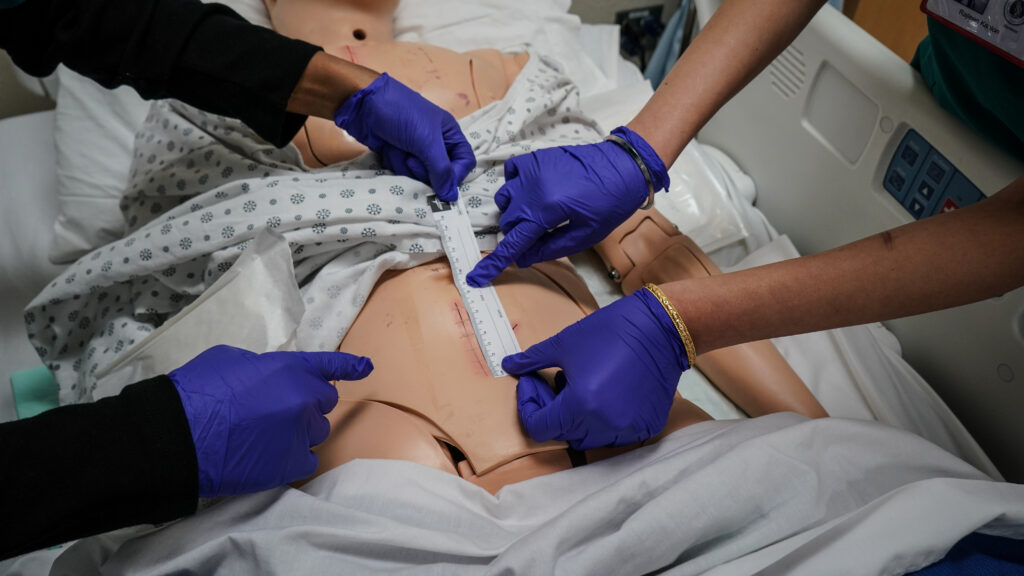 Sacramento State nursing students practice dressing a wound. (Martin Christian)
Pay rates lead to surplus
Howe is one of many with similar stories. While some areas of California are experiencing nursing shortages — especially in rural areas to the north, the Central Valley and the Central Coast — Sacramento has a surplus of nurses, according to the California Department of Health Care Access and Information.
Relatively high pay and presence of several major hospital systems make it a competitive job market. Registered nurses in the Greater Sacramento area were making between $52 and $81 an hour in 2022, according to a report from the Greater Sacramento Center of Excellence, a labor and market research arm of the state’s community college system. Licensed vocational nurses, who receive less training and education, were making between $29 and $37 an hour. Those pay rates are well above Sacramento’s living wage and are comparable to nursing pay rates in the Bay Area, where living expenses are typically higher.
More recent data from Indeed puts average base pay for a registered nurse at $61.64 an hour, 40% above the national average.
“Sacramento is one of the best places in the country to be a nurse,” said Bridget Parsh, a nursing professor at Sacramento State. “It’s not unusual for them to make $150,000 in this area.”
Despite strong wages in the region, the job can be stressful. Nurses at Kaiser Permanente in Northern California and Hawaii went on strike in late January over staffing levels, which have reduced patients’ timely access to care. Kaiser nurses returned to work this week.
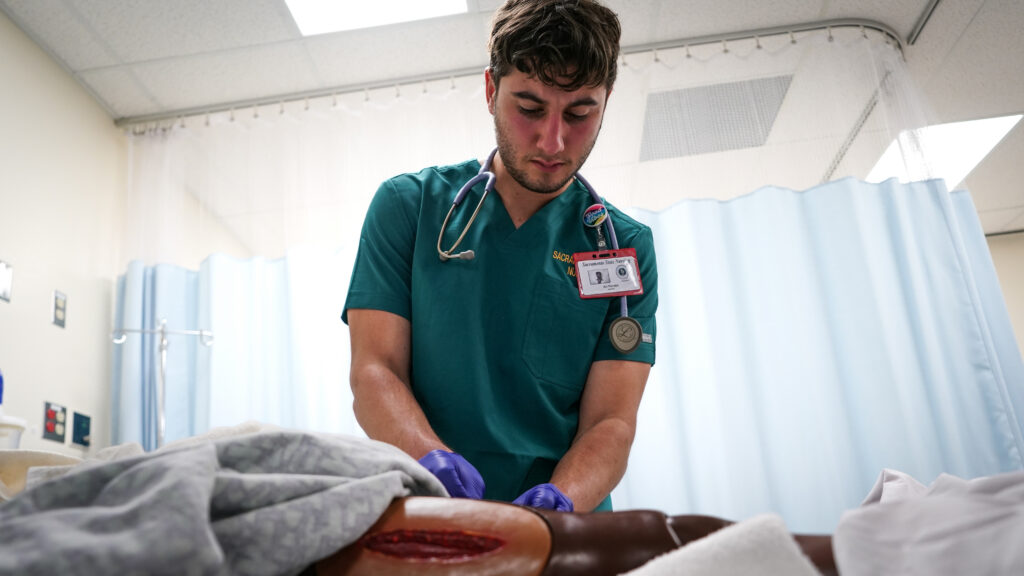 Sacramento State nursing student Ari Fendel practices dressing a wound. (Martin Christian)
Nursing school slots competitive
Before they can compete for jobs, aspiring nurses face the challenge of getting into nursing school. Perfect or near-perfect grades in prerequisite classes and high test scores are the norm for those who make it.
“It’s just as difficult to get into nursing school as it is to get into med school, and it’s sometimes more difficult,” said Piri Ackerman, associate dean of student affairs at the UC Davis Betty Irene Moore School of Nursing.
Sign Up for the Morning Newsletter
The Abridged morning newsletter lands in your inbox every weekday morning with the latest news from the Sacramento region.
The Sacramento region has 10 public or private schools with nursing programs that offer associate’s, bachelor’s or master’s degrees in registered nursing, according to the California Board of Registered Nursing. The region includes Sacramento, Yolo, El Dorado, Placer, Sutter and Yuba counties. Those schools had a total of 790 spaces in the 2023-24 academic year.
More than half of 1,854 qualified applicants to those programs weren’t accepted that year, the most recent year with available data. All Sacramento-area nursing program spaces have been filled each year going back to at least 2014, with rejection rates reaching nearly 70% in some years.
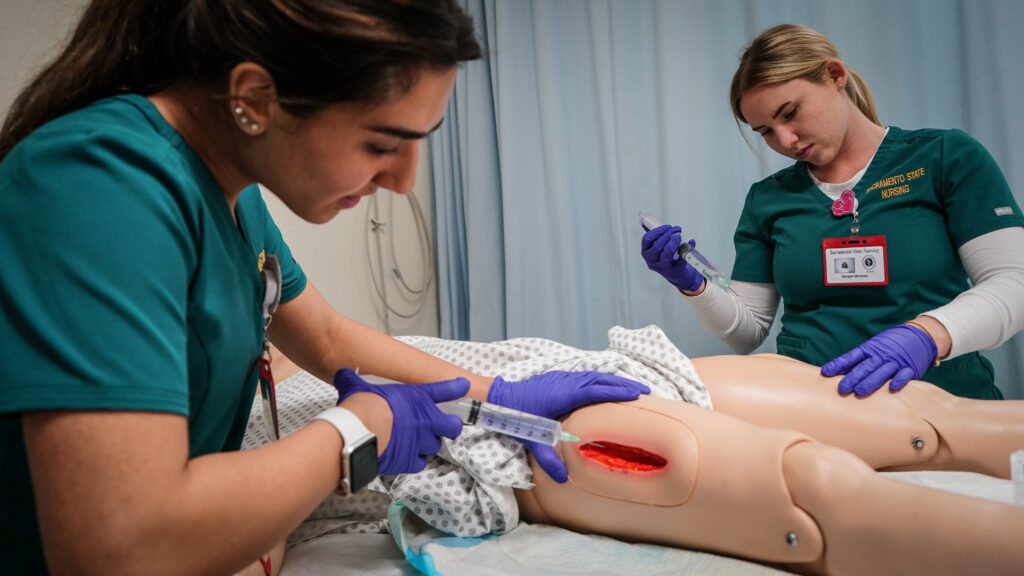
Students Tamana Popal and Morgan Mendoes practice irrigating an open wound. (Martin Christian)
Private school slots have increased
The number of spaces has grown from about 600 a year in 2020 to 790 now, according to the board. Growth is due to new or expanding private school programs in the past few years, while capacity at public schools like Sacramento State, Sierra College and Los Rios community colleges remains the same, according to the nursing board.
Increasing capacity at the nursing school level may seem like a good idea to meet demand from students and to create a supply of nurses who could close shortages in other parts of the state. But it’s not so simple.
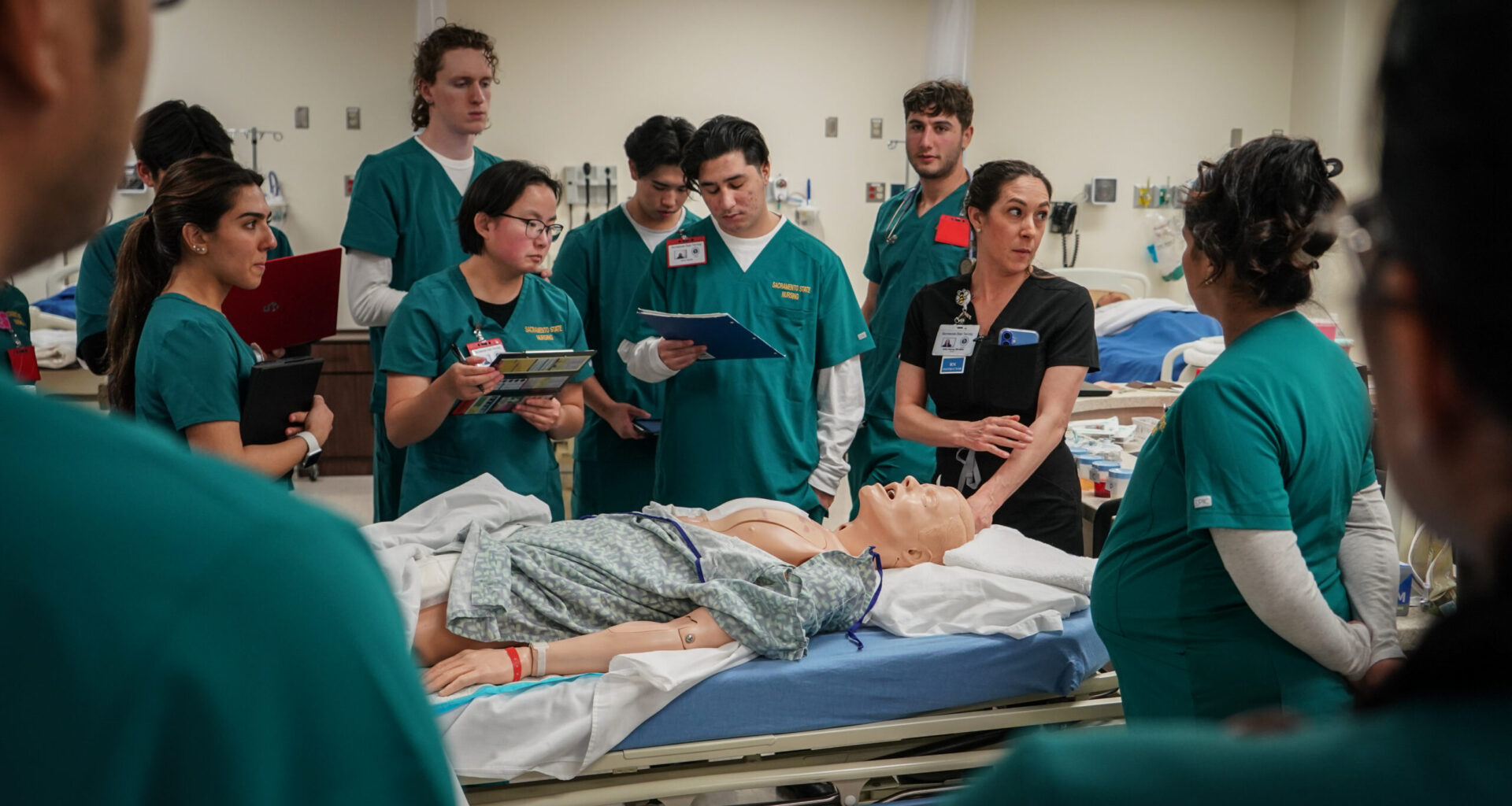
Sacramento State’s bachelor’s degree nursing program is one of the campus’s most expensive, said Tanya K. Altmann, chair and professor at the Sacramento State School of Nursing. It requires low student-to-instructor ratios and sophisticated labs on campus. Simulators for the labs — think of a computerized human dummy that can bleed, talk and respond to medical treatments — cost $150,000 each.
“Sacramento is one of the best places in the country to be a nurse. It’s not unusual for them to make $150,000 in this area.”
Bridget Parsh, nursing professor at Sacramento State
Clinical training spots limited
Even if the program could expand, each student must be placed in a hands-on, clinical setting to get the hundreds of hours of training they need to earn a degree and license. Those clinical placements are most often in hospitals, as well as public health clinics, schools or other medical settings.
The regional health systems, including Sutter Health, UC Davis, Kaiser Permanente and Dignity Health, partner with area schools and work well together, Altmann and Parsh said. But clinical spots are limited, and the increase in private school students is having an impact.
“I struggle every semester to find clinical spots for students,” Altmann said.
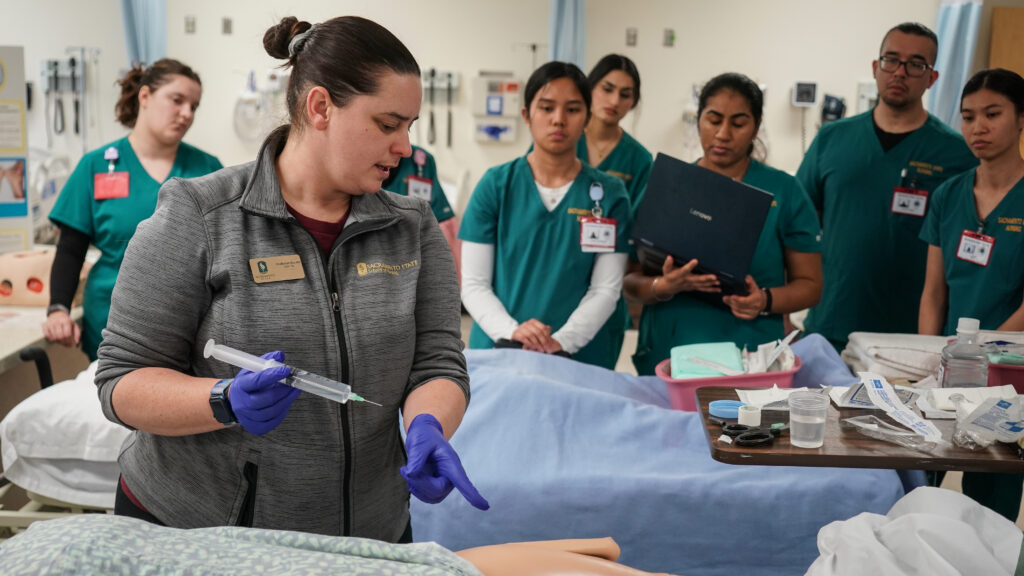 Sacramento State Professor of Nursing Amberly Hunter instructs a class of nursing students. (Martin Christian)
Since 2019, the Board of Registered Nursing has received 10 requests from schools that want to grow or open in Sacramento County, spokesman Vincent Miranda said. It approved a new master’s program at University of the Pacific and other new or expanding programs at California Northstate University, Unitek College, Sacramento City College, Chamberlain University and UOP. New programs or enrollment increases in Placer, Lassen, Butte and Shasta counties have also been approved.
But in May 2024, the board deferred a request from Marsha Fuerst School of Nursing to open a new campus in Citrus Heights and offer associate degrees in nursing for 135 students because they would displace current students in the region from clinical placements. In 2025, the board denied a request from Samuel Merritt University to increase its enrollment from 96 to 144, and from Arizona College of Nursing to open a new campus in Rancho Cordova with 144 students a year, for the same reason.
Student costs vary widely
Costs for students vary widely, with total costs for an associate nursing degree from Sacramento City College about $7,000 and a bachelor’s nursing degree from Sacramento State at $36,000, according to the nursing board. Private schools cost much more, with a bachelor’s degree from Chamberlain University in Rancho Cordova at $101,000 and an associate degree from Unitek at $55,000, for example.
Meanwhile, federal changes will reduce the amount of money nursing students can borrow from $50,000 a year and a total of $200,000 to $20,000 a year and a total of $100,000, Ackerman said. If students need to borrow more, they’ll face higher interest rates and more difficult loan terms.
Prepare for the nursing journey
Since 2022, Ackerman has run a program for high school and early college students ages 16-19 at UC Davis’ nursing school. The Summer Health Institute for Nursing Exploration and Success helps students understand the complexities of becoming a nurse.
In addition to learning about degree options and academic requirements, students get cardiopulmonary resuscitation certification and learn other skills like wound care during the two-week summer program. They also receive mentoring for résumé writing and interviewing. All participants so far have gone on to college, with 90% of them pursuing health care careers and 60% of them in nursing programs, Ackerman said.
Most of SHINE’s participants come from Cristo Rey High School, Benjamin Arthur Health Professions High School and McClatchy High School. Ackerman said the school is hoping to expand the program in the next few years.
“We’re not necessarily looking for the A+ students,” Ackerman said. “They are going to be fine. It’s those B and sometimes C students that we’re hoping that if we give them the information and the inspiration, they have the time to turn it around and actually get into nursing school.”
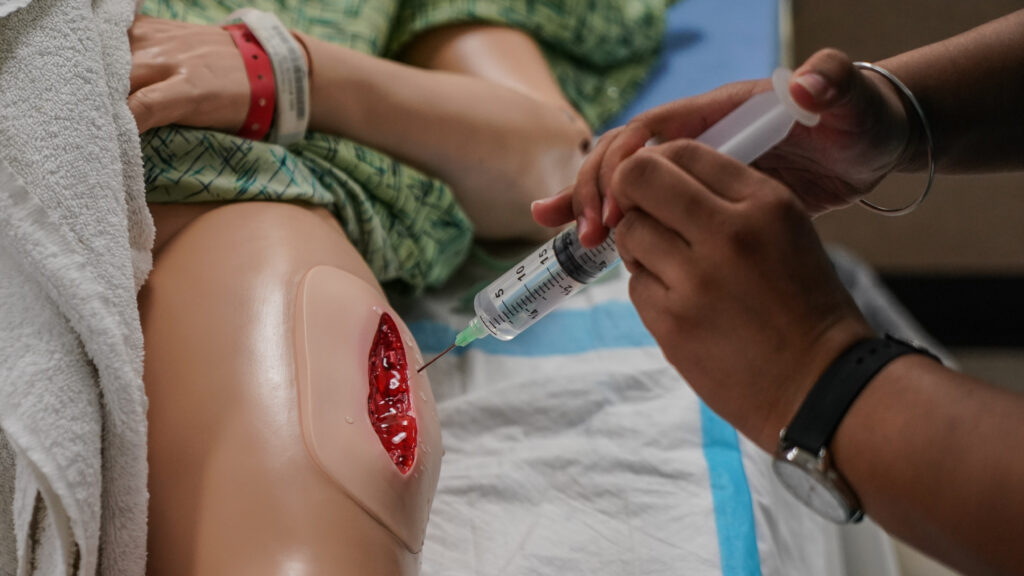 Sacramento State nursing students practice irrigating a wound. (Martin Christian)
Difficult job = 30% failure rate
Nursing is a difficult profession, with 30% of new nurses leaving after the first year on the job, Parsh said. Still, more than 500 first-year students at Sacramento State each year say they want to be nurses. The 160 students that make it to the nursing program each year have grade point averages above 3.9 and near-perfect scores on an exam called the Test of Essential Academic Skills. The program starts in the third year, so the pool of admitted students is a combination of Sacramento State students, transfers from other schools and community college students.
Cynthia Khatib is one of the students who made it through the Sacramento State program, graduating recently at age 50 to launch a new career following work in international relations and renewable energy. Like Howe, she applied to multiple jobs in the area — about 50 — with no luck. She’s about to move out of state for a job as a labor and delivery nurse.
“Nursing school was the most humbling thing I’ve ever done,” Khatib said. “It is all consuming, wonderful and horrifying all at the same time.”
Laura Mahoney is a regular contributor, writing Dollars and Sense for Abridged.