
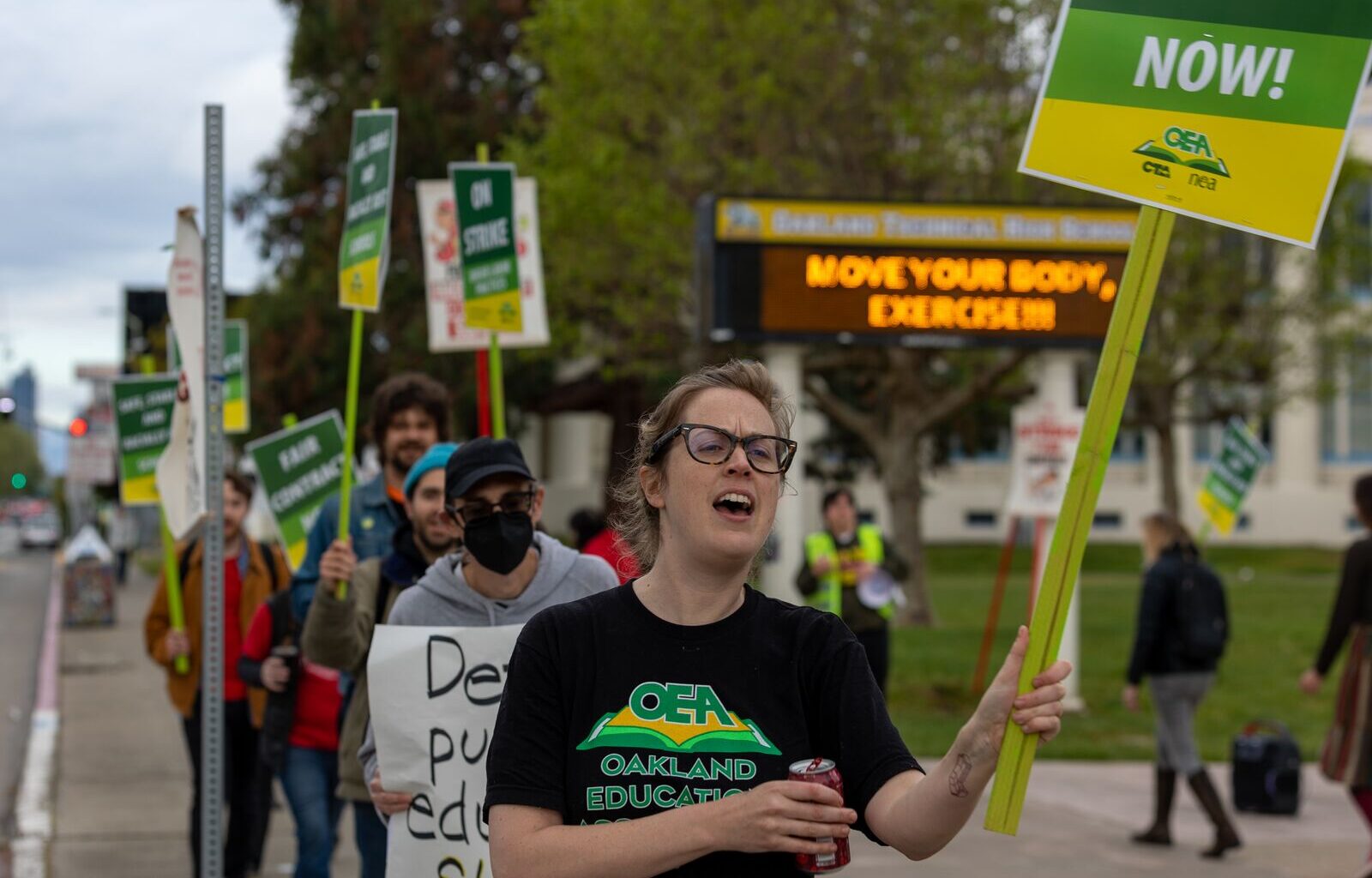
After more than 10 months of negotiations, a fact-finding phase, and two late-night bargaining sessions, Oakland Unified School District and the Oakland Education Association appear to be moving closer to a deal on a new contract for Oakland teachers.
But the district’s teachers voted to authorize a strike last Friday, Feb. 20, and if a deal isn’t reached, the union could call a strike at any time. The next bargaining session is planned for Thursday.
The school board held a special emergency meeting on Tuesday evening with a single agenda item — labor negotiations — and on Wednesday will vote on a slate of layoffs that will eliminate hundreds of positions for next year to address its looming deficit.
Any raises for teachers will require commensurate cuts to fund them.
The Oaklandside put together this guide to answer your questions about a potential strike — and the district’s massive deficit.
How much warning would we have for a strike?
Teachers’ unions generally have to give at least 48 hours notice before walking out. So the school district and families will have at least two days to prepare after the union calls a strike.
How long could a strike last?
The strike would last until the two sides can come to an agreement. In 2019 and 2023, OEA’s strikes each lasted for seven school days.
Will schools stay open?
We don’t know. During the seven-day strike in 2023, schools remained open, but it wasn’t school as usual, and students didn’t receive much instruction. During the recent strike in San Francisco Unified, schools shut down because the district didn’t have enough adults around to supervise kids.
Is it considered crossing the picket line to send my child to school?
Yes. While teachers unions can’t discourage families from sending their children to school, part of the power of a strike is its impact on school funding. Lower attendance rates mean less funding. In 2023, OUSD saw a 4% drop in attendance during the strike.
Students who missed school during the 2023 strike received an excused absence.
What are the sticking points in contract negotiations?
The big issue is wages, and the two parties started out very far apart, with the union asking for 14% over two years and the district initially offering 0.
OEA is also asking for smaller class sizes in the earliest grades. The union initially proposed caps of 20 students for transitional kindergarten, kindergarten, and first grade. In its most recent proposal Monday, OEA softened its request to a cap of 22 students for transitional kindergarten and 24 for kindergarten and first grade.
OUSD is still insisting on keeping class size limits the same as they’ve been — 24 for transitional kindergarten and kindergarten, 27 for first to third grade — but has offered to increase the compensation of teachers whose classes are larger than that by $1,200 to $2,000 per extra student, per semester.
What are the latest offers, and how much would they cost?
The OEA’s initial proposal asked for a 14% wage increase for all its members: 9% retroactive to 2025 and another 5% in 2026. In its latest ask, the union proposed a 14% raise only for the most senior teachers and 12% for everyone else over two years, plus an additional 5% raise for special education teachers, nurses, and early childhood educators.
OUSD initially offered no pay increase, citing its budget constraints. During the fact-finding period, the district made its first wage increase: 6.5% over two years, and 8% for the most senior teachers. In its latest proposal on Monday, OUSD raised that offer to a 7.5% raise for most teachers, a 9% raise for the top step, and a one-time 2% bonus to all members.
That leaves a 4.5-point gap between the two sides.
During the fact-finding period, the district representative said a 1% raise costs the district about $2.7 million for OEA members and $5 million total, since a raise for OEA triggers a raise for other district workers.
A 14% raise would cost OUSD about $70 million, while a 7.5% raise would cost about $37.5 million, not including any one-time bonuses.
The state-appointed fact-finder recommended that OUSD offer a 9% to 10% raise, plus an additional 2% increase for special education teachers.
Have the two sides agreed on anything?
According to OEA, the two sides have settled several tentative agreements, including those related to continuation schools, visual and performing arts classes, supports for immigrant students, affirmative action, and the terms of the contract.
The district agreed that the current contract will last from July 1, 2025 to June 30, 2027; assignments for early childhood educators will ensure that they don’t have to travel between too many school sites; visual and performing arts teachers will have a dedicated budget and storage space at school sites; and OUSD and OEA will work together to partner with legal organizations and hold workshops for immigrant families.
Is OUSD’s deficit $50 million or $100 million?
Since December, the OUSD board and senior leadership have been working to resolve a roughly $102 million deficit for the 2026-2027 school year. The exact number fluctuates because school budgets are based on projections that shift as new data comes in. The budget scenario the board adopted in December relies heavily on reductions at the district’s central office, which encompasses departments that run academics, finance, human resources, and facilities for Oakland’s schools. But school site cuts will still be deep.
The district hired a team from Hazard, Attea, Young and Associates to oversee the implementation of that broad budget proposal. Last month, the advisors presented a plan to reduce next year’s budget by $102.4 million. They said about $50 million in cuts had been identified so far. At the first February school board meeting, interim superintendent Denise Saddler said that “cuts the original gap in half.”
That remark has been widely misinterpreted. One bargaining team member told reporters that the district had somehow “found” $50 million in misallocated funds. That is not the case.
The $50 million in cuts that the district has already identified include slashing the central office by about $32 million. It also includes shifting funding for some roles and schools from the unrestricted general fund to more restricted resources, freeing up about $12.4 million; consolidating some transitional kindergarten classes into hubs, saving $1.5 million; reducing facilities maintenance by $1 million; and shrinking the space that school populations occupy on campuses, saving $1.6 million in custodial and security costs.
The proposal also lists pending cuts and revenue opportunities that the advisors expect will close the rest of the $102 million gap: $32 million in cuts to school site budgets, a $12 million reduction in the special education budget, and increasing attendance by 2% to bring in an additional $10 million through the state funding formula.
None of those plans cover the costs of raises for teachers.
Who is the district targeting for layoffs?
Tonight the school board is expected to approve a list of positions slated for elimination for the next school year to help it close the deficit. The report prepared for the school board meeting states that more than 400 roles will be on the list, including both vacant and filled positions.
The impacted job classes include assistant principals, counselors, social workers, teacher coaches, site-based substitute teachers, English immersion teachers, attendance specialists, case managers, custodians, literacy tutors, and program managers. Some roles are being reduced from full-time to part-time, while others are being eliminated entirely.
These layoffs are aligned with the budget proposal Saddler and her fiscal advisory team are in the process of implementing. Many of the roles are being cut because they were funded through outside grants or one-time money that is expiring. Approving layoffs is a required step in the budget process; all California school districts have a statutory March 15 deadline for issuing “pink slips” for the following school year.
The current budget plan does not include money for teacher raises. If the district comes to an agreement with OEA for more compensation, the board will have to make more cuts — or generate more revenue — to fund it.
In 2023, after the last strike, former superintendent Kyla Johnson-Trammell warned the board that it would need to be proactive in setting aside money for teacher raises ahead of the next round of bargaining in 2025. That did not happen.
How does Oakland teacher pay compare to other local districts?
After winning 10% raises during contract negotiations in 2023, Oakland teachers went from the bottom of the pay scale among Alameda County school districts to the middle of the group. Two years later, teachers elsewhere have again surpassed them in compensation, and pay for teachers in OUSD is again near the bottom in most metrics, the independent fact finder stated.
The fact finder wrote that the district could not afford OEA’s full wage demands and still retain its required minimum reserves of 3% of the general fund. But she found that the district’s then offer, of a 6.5% raise, “will not improve OUSD’s standing when compared to…neighboring districts” that the union identified.
We’ll be updating this story as negotiations develop. If you have more questions you’d like us to answer, email ashley@oaklandside.org.
“*” indicates required fields