
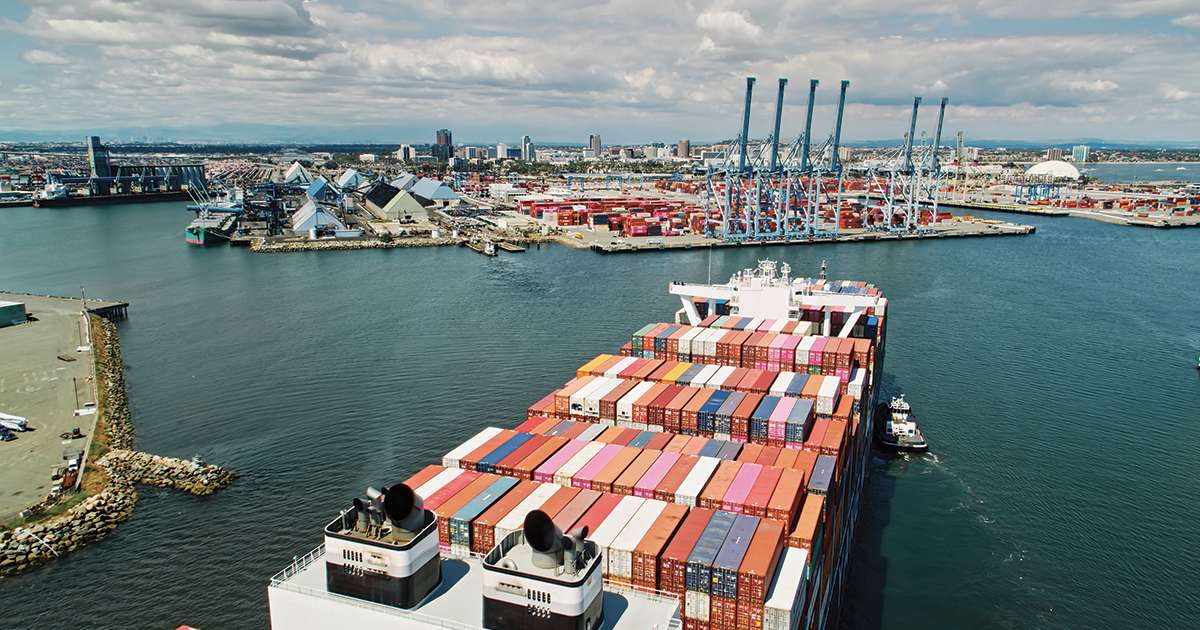
(halbergman/Getty Images)
February 26, 2026 9:08 AM, EST
Imports through California’s Port of Long Beach dropped 13% in January from last year, when shippers were rushing to move freight in anticipation of President Donald Trump’s tariffs.
Despite an 11% drop in total container units, CEO Noel Hacegaba told reporters that the Port of Long Beach was the most active port in the U.S. last month, beating its Southern California neighbor, the Port of Los Angeles.
“Our strong cargo volumes do not suggest we are not being affected by tariffs,” Hacegaba said Feb. 25, noting that last year’s iron and steel tonnage was down 32%.
Toys and sports equipment declined 15%, while there was also a 43% decline in synthetic fiber imports and a 21% drop in salt, sulfur and cement, he said.
Loaded import containers declined last month by 13.1% to 409,818 20-foot equivalent units, or TEUs. Export containers were nearly flat at 99,478, and empty containers moving through the Port of Long Beach fell 11.5% to 338,470, according to port data.
Uncertainty over the administration’s response to last week’s Supreme Court decision invalidating the key plank of Trump’s global tariffs adds to volatility and unpredictability in the supply chain, Hacegaba said.
U.S. Trade Representative Jamieson Greer said Feb. 25 that it could take “a couple months” for the administration to re-establish Trump’s tariff regime in ways that uphold existing agreements.
A 10% worldwide levy took effect Feb. 24, and in the ensuing 24 hours, the administration offered few details about how it would follow through on the president’s threat to raise the duty to 15% while honoring pacts with major trading partners.