
I’ll start with an excerpt from the brochure handed to me at the entrance to Anthony McCall’s “First Light.”
“The film exists only in the present: the moment of projection. It refers to nothing beyond this real time. It contains no illusion. It is a primary experience, not secondary: i.e., the space is real, not referential; the time is real, not referential.”
I’m starting here to save face, to suggest that the inadequacy of the following review results from the necessity of seeing McCall’s exhibition in person. A review is, by definition, a secondary experience.
“First Light” is, I think, a bit of a misnomer. The single most arresting part of the work was the pitch darkness. In truth, my friend and I ducked into Fort Mason Center for Arts & Culture’s Gallery 308 as much to see the exhibit as to escape the elements — one minute we were out in the loud, the cold, the wind, the light and the next we were stumbling, arms outstretched, in the still and cavernous dark.
The few people already inside shuffled around and spoke quietly, so we shuffled around and spoke quietly. When they left, we walked freely and talked loudly. Another pair stumbled in and, perhaps sensing that this was then a talking space, did the same. The room, and the people in it, were the whole thing. The work makes reference to little other than itself — there is nothing to “get.” This was a relief. In San Francisco, I am suspicious of anything with layers because peeling them back always seems to reveal a startup.
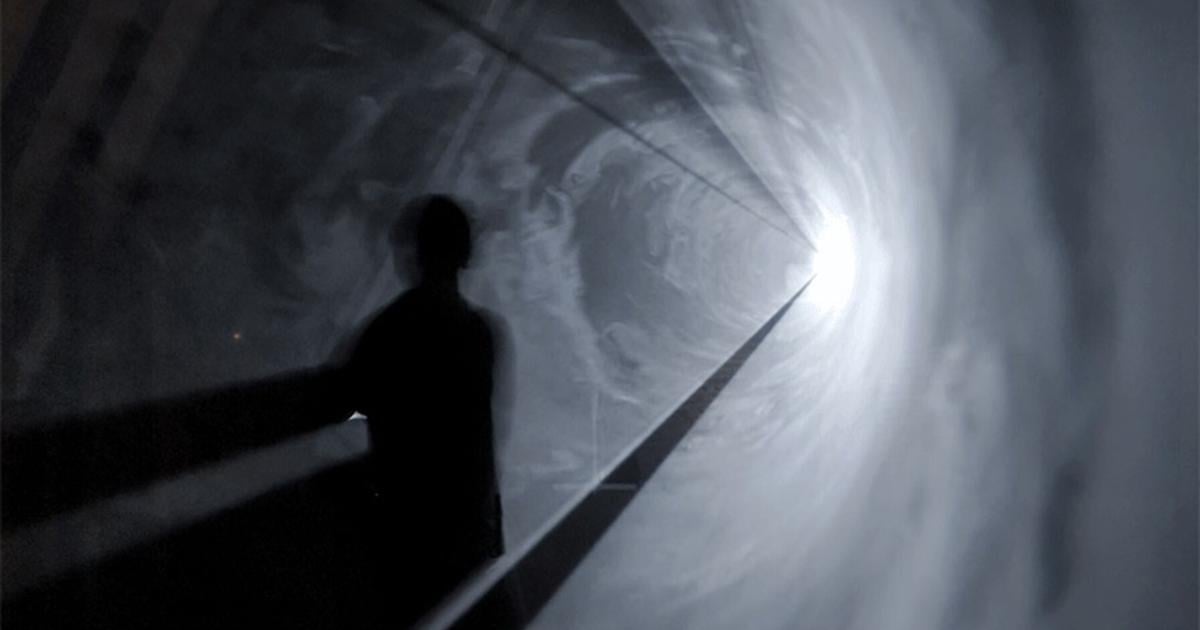
It is my obligation to tell you, at some point, what we were looking at. This is where I am struggling to make a secondary experience of a fundamentally primary one. There were three works on display: “Cone of Variable Volume,” “Conical Solid” and “Line Describing a Cone.” On one side of the room were three projectors, and across from them were three screens. The art that McCall intended to display was between the projectors and the screens: three beams of light, variably pulsing or flashing or tracing through clouds of theatrical haze. I include the below excerpt, again from the brochure, both because it captures the strangeness of an art piece that consists only of the hazy air through which it is beamed, and because I think it’s kind of funny.
“McCall’s first solid light works occurred within distinct viewing environments: dusty artist lofts or project spaces laced with second-hand smoke. As galleries cleaned up in the late 1970s, the work could only be seen as a two-dimensional image—and the artist stopped making work.”
I wish so badly that I could have seen these pieces as they were originally shown — seen the illuminated dust and smoke of living in an earlier, dirtier time period. Instead, I saw them in a clean, scentless, artificially smoky room. The dust was fake, not generated by living and moving and shedding and smoking, but pumped in with theater equipment.
I imagine that a child could enjoy this work a lot, as a plaything. I felt childlike myself, wobbling my cardstocky brochure through the beam of light to watch the smoke swirl, bobbing my head into and out of the cone of light: inside the magical realm, on the outside looking in.
We walked around the beams of light like they were real objects that could be bumped into. It felt somehow sacrilegious to walk straight through what was, with the lights on, a completely open room.
Walking out of the exhibition back into the daylight, past the same people we saw on the way in, felt like stepping out of a movie theater and realizing it’s still the middle of the day, or walking home from something new, like a first kiss. I recommend this display to anyone who just wants to see something they’ve never seen before.