
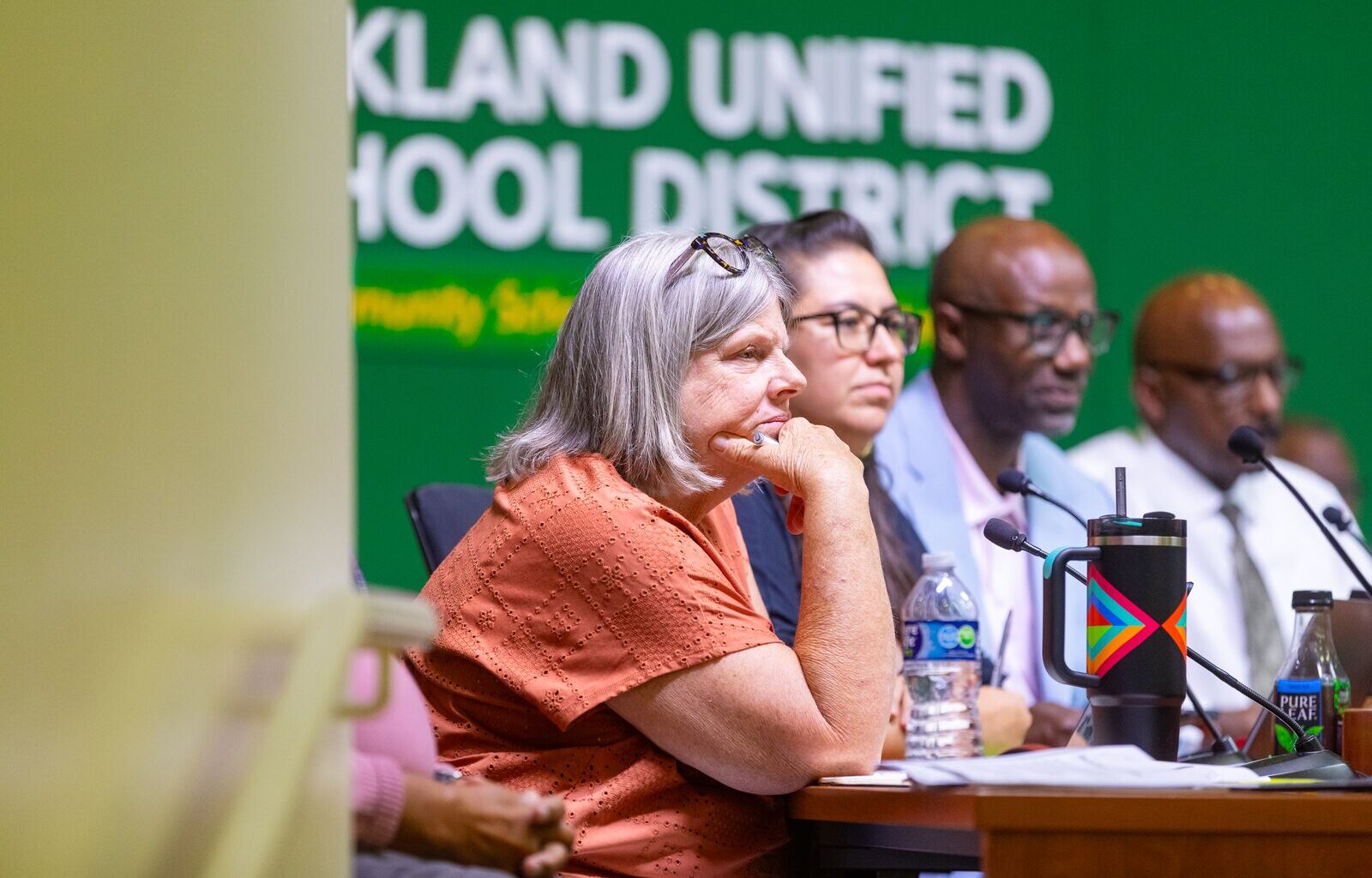
In the middle of tense contract negotiations with its teachers union, the Oakland Unified School District board approved layoffs of more than 400 positions on Wednesday night in an attempt to close a $100 million budget deficit. The layoffs will take effect on June 30 unless PTAs or the district find other funding to restore them.
The positions span the central office and school sites, and include student-facing roles that educators and parents say are essential to learning. Denise Saddler and her team of fiscal advisors did not make clear how much money the layoffs will save or how exactly they’re aligned with the financial stabilization plan they are implementing.
The school board had a March 15 statutory deadline to issue layoff notices for the next school year.
Beyond the 421 positions being completely eliminated, 144 more will have their hours reduced. Among school support staff, those roles include community school managers, case managers, custodians, literacy tutors, food service workers, instructional aides, noon supervisors, restorative justice facilitators, and family engagement specialists. Impacted credentialed roles include counselors, literacy and stem coordinators, nurses, social workers, site-based substitutes, English immersion teachers, and teachers on special assignment.
They also include network superintendents and assistant principals, two roles that are critical to school principals. At many schools, the cuts will mean school principals are the sole instructional leader left on campus – while getting less support from the central office.
Many of the positions were funded with one-time COVID relief funds that have expired, district leaders said.
Critics of the cuts expressed concern during the meeting’s public comments section that they seemed to have been carried out in a haphazard way, without a clear strategy behind them.
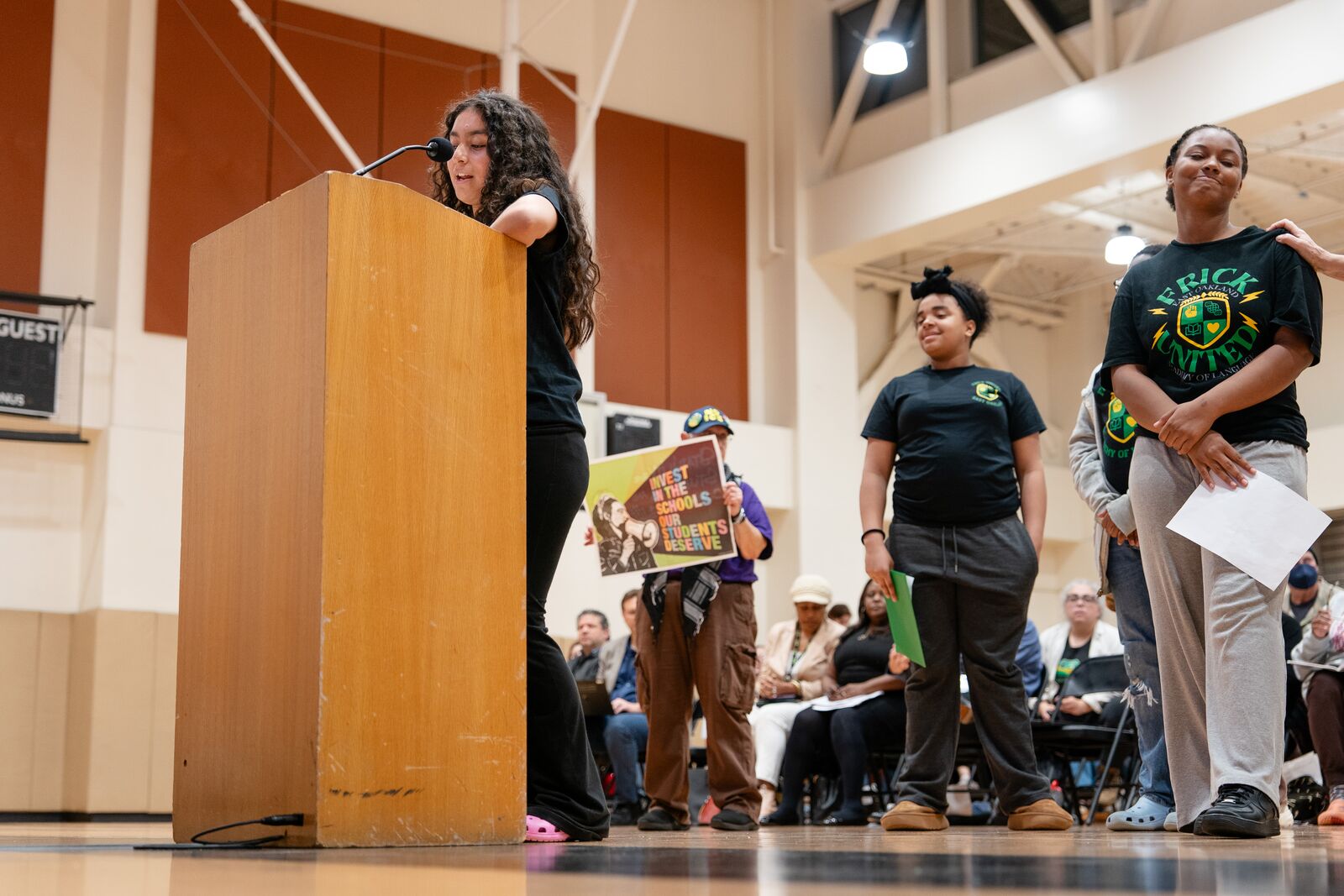 Malayha Kuykendall, a sixth grader at Frick United Academy of Language, urges the school board to vote against the layoffs as Ashley Vega, an eighth grader, is comforted during the Feb. 25, 2026, school board meeting. Credit: Jungho Kim for The Oaklandside
Director Patrice Berry, who voted against one slate of layoffs and abstained on the other, raised questions about how students would be served without those staff.
“A reduction in force of this scale and size will lead to significant and material changes,” said Berry, who represents District 5. “There will be services that we cannot provide, and I want to understand how we will fill those gaps. Are we going to absorb some of those services into other things and roles? Are we going to stop those programs and services?”
Principals urge the restoration of positions
Directors Rachel Latta, Jennifer Brouhard, VanCedric Williams, Valarie Bachelor, and Clifford Thompson all voted to approve the layoffs. Director Mike Hutchinson voted against them, and Director Berry voted against the classified reductions and abstained during the vote on certificated positions. The board passed an amendment requiring Saddler, if she identifies new sources of funding, come back to the board with recommendations on using those funds to restore student-facing positions.
Some school communities have turned to fundraising to try to keep some of their staff, but to succeed some PTSAs would have to raise hundreds of thousands of dollars on short notice.
Last month, 30 elementary school principals signed a letter to the board urging them to fully fund community school managers, who connect families with community resources; teachers on special assignment, who coach other teachers and provide professional development; attendance specialists, who monitor student attendance and help address chronic absenteeism; site-based substitutes, who are able to provide coverage when teachers are out; and noon supervisors, who look after students during lunch and recess and allow teachers to take their breaks.
“We stand to lose nine beloved faculty and an additional eight face significant reductions,” Ella Every-Wortman, a teacher at Frick United Academy of Language, said at the meeting. “This impacts the educational experience of our students. We’ve built a community school at Frick and we need every one of those staff to help students thrive.”
Latta said she recognized that they could upend how schools function.
“We haven’t presented a plan to tell people what school is going to look like in August,” she said. “What are the things that we are going to do to serve our students differently and to fill in the gaps that we ultimately can’t afford any longer?”
 Denise Saddler, interim superintendent of OUSD, listens to a speaker during the Feb. 26 school board meeting. Credit: Jungho Kim for The Oaklandside
Saddler, whose one-year term is up at the end of June, reminded the community of the parameters the board had set to guide how she and her team carry out budget cuts for next year: keep all schools open, shrink the central office first, reduce reliance on outside contracts, and focus on increasing enrollment and attendance. But she was candid that layoffs were still a necessity.
“Right now there’s not enough money we’re going to be receiving to maintain our current staff — that’s the real deal,” she said.
Saddler added that the central office is so small now that certain functions, like payroll, are going to take longer. And she broached school closures.
“We have the same number of schools that they had when I started in this district,” said Saddler, who began as a teacher in OUSD more than 40 years ago. “There were 54,000 students. We now have 34,000 students. And we have the same number of schools. That has costs.”
The board’s budget plan was designed to address a $102 million projected shortfall for next year. Some of the planned cuts include reducing the district’s central office by $32 million, cutting school site budgets by up to 10% for another $32 million, shifting the costs of some positions and schools from the unrestricted general fund to more restricted resources, decreasing special education spending by 10% or $12 million, and increasing attendance by 2% to bring in an additional $10 million in state revenue.
The district’s fiscal advisors, who were hired from Hazard, Young, Attea, and Associates after the chief business officer Lisa Grant-Dawson resigned in December, have yet to present details on some parts of the plan, such as the legality of the special education funding decrease, or whether a 2% increase in attendance is realistic this year.
Hutchinson, who represents District 4, has opposed the school board’s direction since 2025. He called out the board for not presenting a comprehensive strategy or vision behind the layoffs, which he voted against.
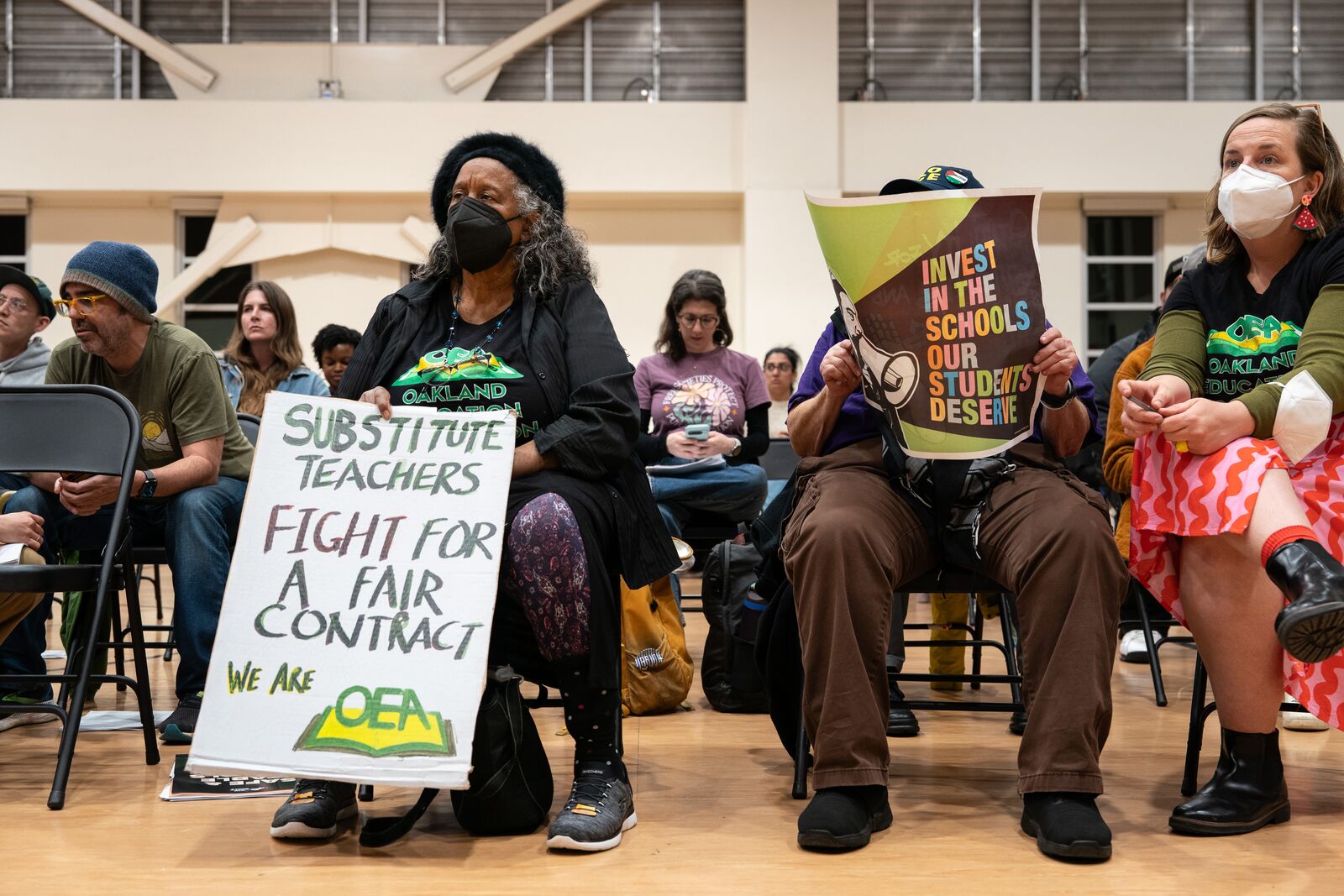 Sharon Thomas, a substitute teacher with 23 years of full-time teaching experience, left, holds a sign while listening to the Feb. 25 school board meeting. Credit: Jungho Kim for The Oaklandside
“There is nothing to inform any of the decisions that are listed here,” Hutchinson said. “This is work that we should have done months ago that I was asking for to be done months ago, and it never got done. This is the outcome of not doing the work.”
Several parents and community members criticized the board for what they called a lack of vision and transparency about how these positions were chosen for elimination.
“Any functional organization facing a crisis like this would do a little bit of everything: Trim contracts, consolidate facilities, right-size administration, and protect the people closest to the students,” said David Chow, a parent at Sequoia Elementary. “Instead, we’re here at the twilight of our budget approval window, voting on whether to gut school-level staff. Who’s going to do the actual work of restructuring this district? Because this board has had a year and we’re still in triage mode.”
OUSD teachers voted to authorize a strike last Friday, seven months after their contract expired. The next bargaining session with the Oakland Education Association is scheduled for today. OEA and OUSD have yet to come to an agreement on compensation or class sizes for early grades.
The teachers union could call a strike at any time. The school board has another special meeting Friday evening to discuss labor negotiations.
“*” indicates required fields