
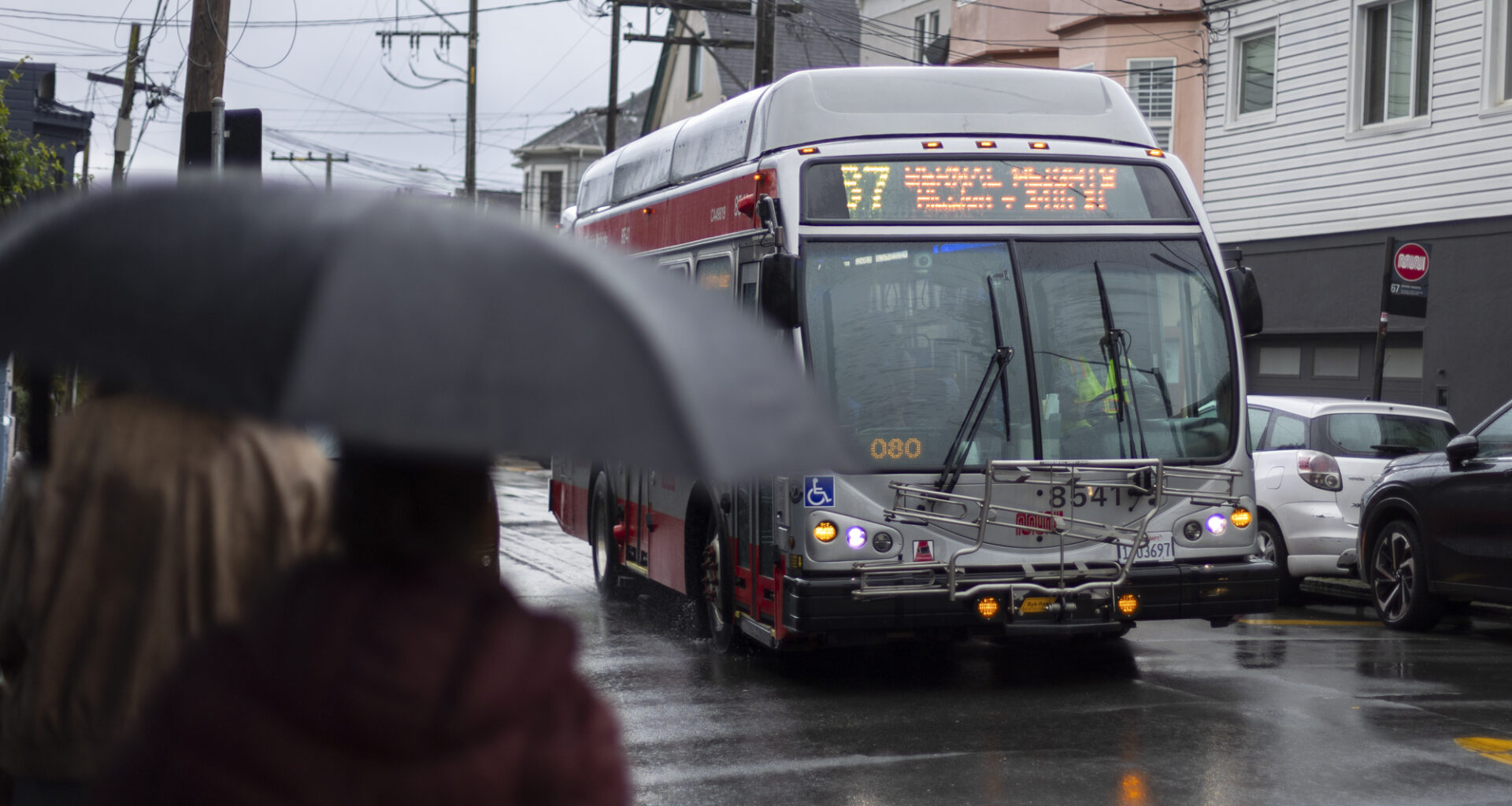
Those looming budget cuts threaten to make waits for the 67 longer or eliminate the route entirely. Because of exhausted state and federal funding, rising costs, and lower fare and parking revenue, the agency faces a $322 million budget deficit beginning in July, one that will continue to grow over the next five years.
In addition to a wide range of street safety, maintenance and staff reductions, SFMTA said it will be forced to reduce Muni service if that budget gap isn’t plugged.
The agency’s worst-case scenario includes suspending up to 12 low-ridership routes without parallel service in hilly neighborhoods of the city, including the 67. While the route serves a modest 800 daily riders, they represent a diverse swath of residents — many of whom live on the steep streets above Alemany Boulevard or near Bernal Heights Park, and who rely on the bus to navigate the area’s sharp grades.
“That’s the trade-off,” said Jaime Viloria, outreach manager for advocacy group SF Transit Riders. “Do you just put all the resources on your core services with the most usage, or do you spread it around a little bit more? You make those choices about which communities get their transit and which ones don’t. That’s the difficult part of what the SFMTA has to do.”
As SFMTA looks to strike that balance, Jones said that for the most part, the agency has moved away from using schedules to measure the reliability of its service, especially for its busier trains and buses.
Since the pandemic, about half of all city transit switched from tracking specific departure times to what transit agencies call “headway management” — a frequency-based system that prioritizes even space between buses, instead of keeping them on a schedule.
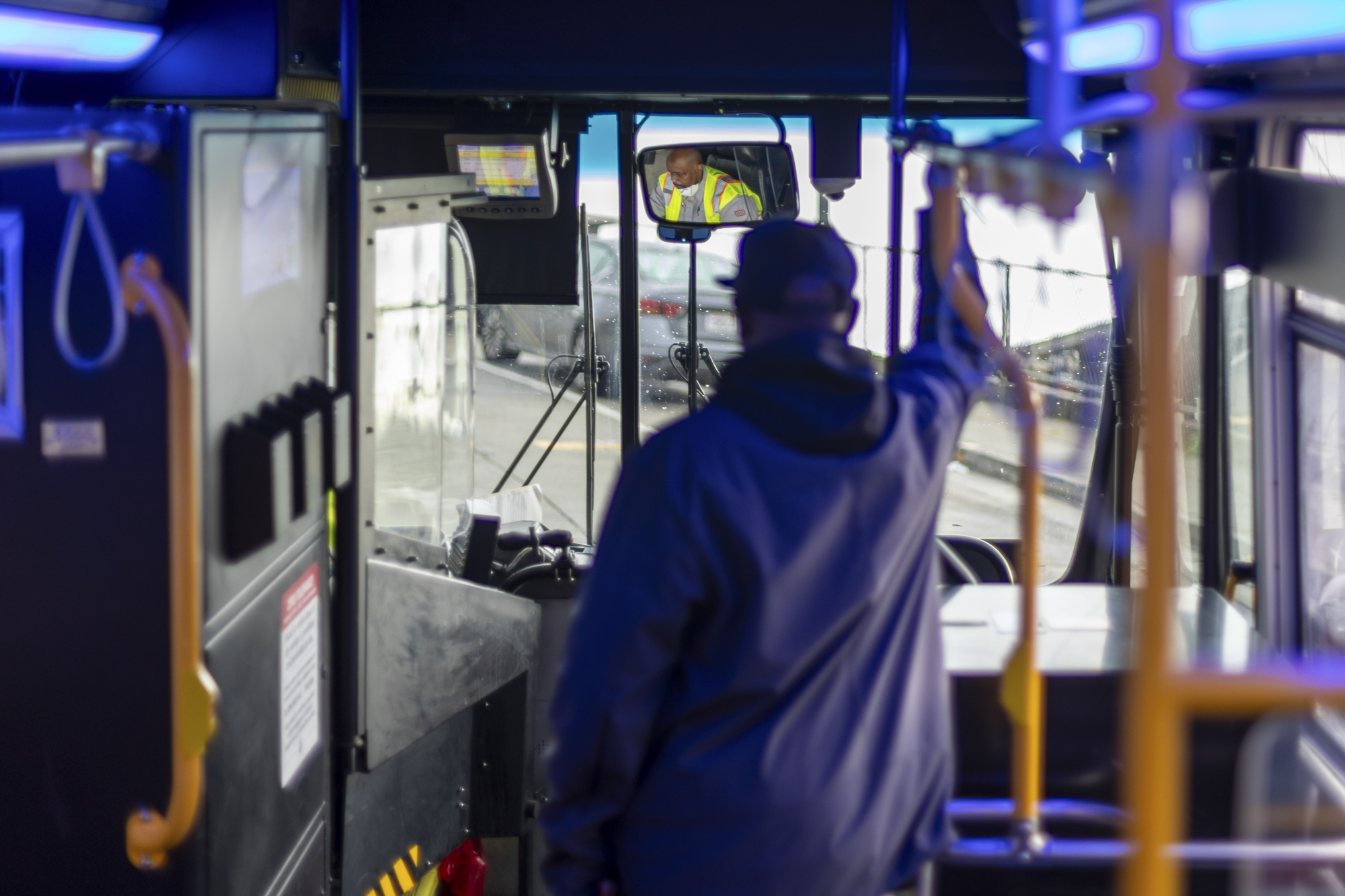 Muni driver Hannibal Thompson is reflected in a rearview mirror as he operates the 67 Bernal Heights bus in San Francisco on Feb. 18, 2026. The route is among those with the most persistent delays, according to Muni performance data. (Gustavo Hernandez/KQED)
The idea is to create fewer gaps in service between buses and to avoid having buses bunch up at a stop at the same time, leaving future riders stranded. Passengers on high-volume lines should expect buses and trains to come at regular intervals, instead of at fixed times.
According to the SFMTA, the agency averages an 85% to 87% headway adherence rate. Data for January 2025, the most recent made available to KQED, shows that the 38R-Geary, the 28R-19th Avenue and the 14R-Mission — all Rapid routes that served a combined 54,100 riders daily in December 2025 — averaged higher than 90% adherence to their headway targets.
By comparison, SFMTA’s lower-volume Muni buses, such as the 67, still run on the old schedule system. Collectively, only 56% of those buses departed on time between October 2024 and October 2025.
The agency acknowledged that headway data is not included on the city’s public transit performance dashboard and that Muni’s “percentage of trips with service gaps” data, which formerly tracked headway arrivals, has not been published publicly since 2021. That’s even though its 1999 charter also included a mandate to make the performance metrics accessible to the public.
While SFMTA and city leaders are committed to avoiding service cuts, officials face a funding quagmire that’s growing each year. Although Gov. Gavin Newsom authorized a $590 million bridge loan to Bay Area transit agencies in early February, that money will be split between the region’s operators — and is only a stopgap before the coming fiscal cliff.
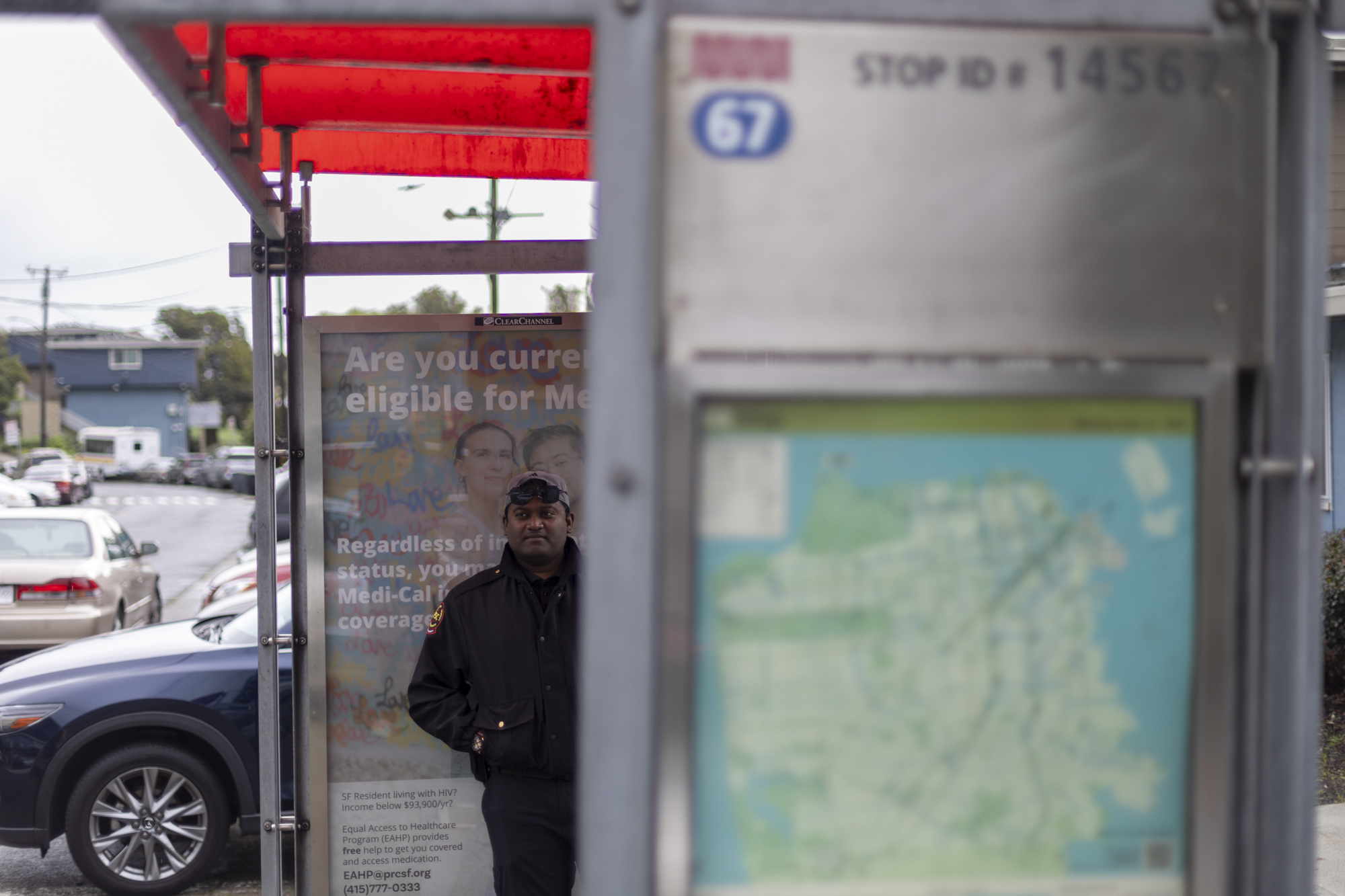 Mano Ram, a Belmont resident, stands beneath a 67 Bernal Heights bus shelter near the Alemany Apartments in Bernal Heights, San Francisco, on Feb. 18, 2026. Ram commutes by transit from Belmont to his job as a security guard at the Alemany Apartments. (Gustavo Hernandez/KQED)
State officials have pushed for a regional transit tax to fund the Bay Area’s largest transit agencies — BART, Caltrain, Muni and AC Transit. The measure proposes a 1% sales tax increase in San Francisco and a 0.5% increase in Alameda, San Mateo, Contra Costa and Santa Clara counties. SFMTA is expected to see about $155 million in revenue from that tax each year.
And in November, San Francisco residents will vote on a parcel tax to shore up SFMTA funding, which is expected to generate more than $180 million yearly to address the deficit.
If passed, the stabilizing effects of these measures would ripple across the Bay Area for some transit riders.
Mano Ram is the area director for security at the Alemany Apartments public housing complex. To reach his home in Belmont, he rides the 67 to 24th Street BART, which connects him to Caltrain through Millbrae. Sometimes, delays leave him stranded for 45 minutes to over an hour, resulting in a two-hour commute to travel 20 miles.
Still, he said, without the bus, “I would be stuck. I would have to rent a car.”