
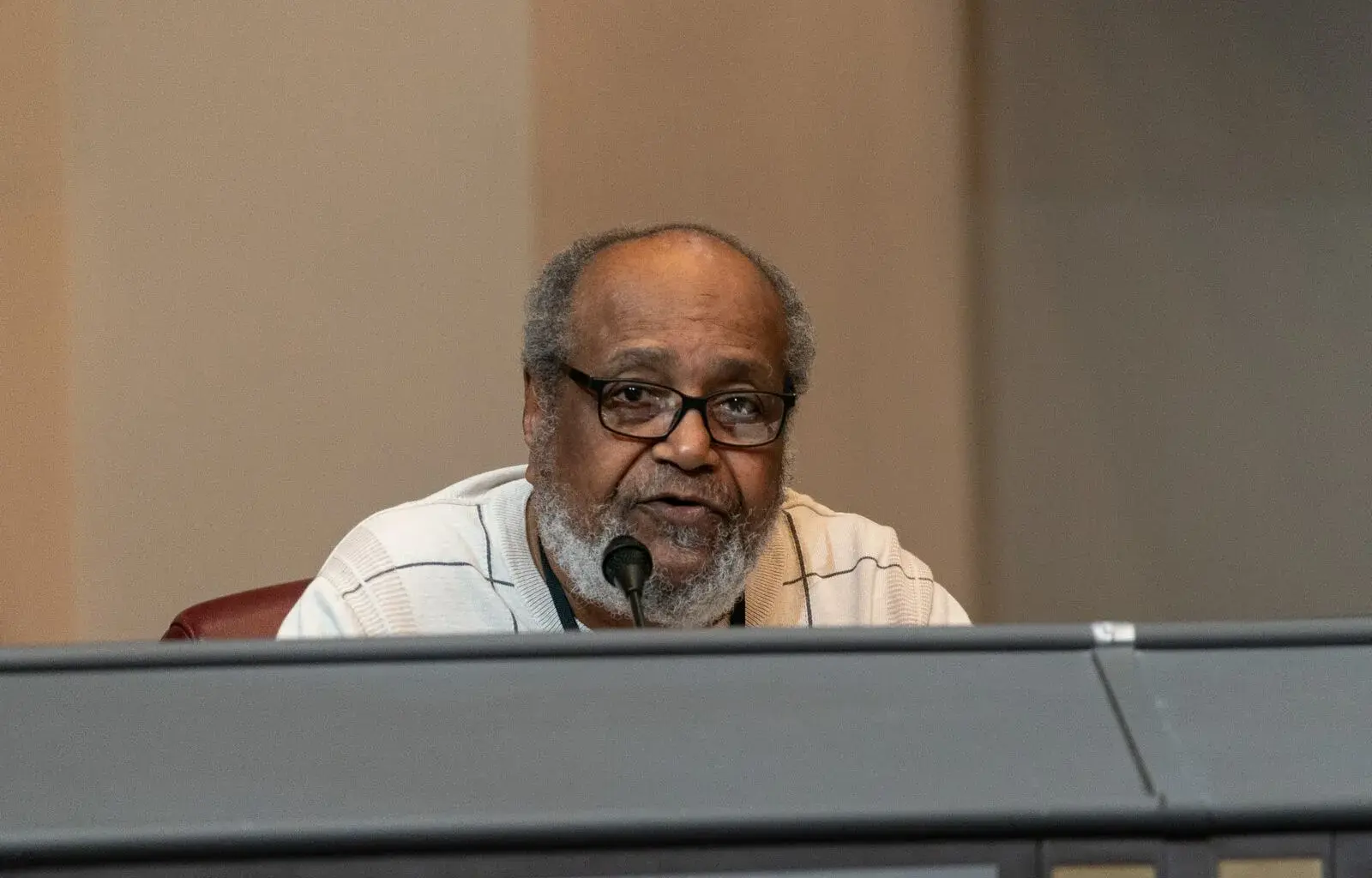
Wilson Riles Jr., a member of the Oakland Police Commission who served on the City Council in the 1980s and carved out a reputation as a principled voice of dissent, suffered a “massive stroke” on Jan. 30, according to his family.
He is unable to move the right side of his body, they said, and cannot speak. But Riles’ loved ones, who have been caring for him at his home in the Laurel, say he is aware, recognizes people, and has shown signs of improvement.
“He smiles. He listens. He feels. He is present. Now he needs us in a new way,” the family wrote in a recent update to the community.
Patricia St. Onge, his partner for more than three decades, said in an interview that she, his children, and friends are working to raise $77,000 to pay for home care that will allow Riles to recover at home, with its familiar routines.
“I’m very hopeful,” she said.
As of Feb. 27, the family’s GoFundMe had raised approximately $42,000.
In-home care is extremely expensive, said Vanessa Riles, his daughter, “so we’re trying to make sure he’s cared for in the way he deserves to be. We’re very appreciative of the support and generosity of everyone so far, and we hope people will show up to make sure he’s taken care of.”
Jacqueline Cabasso, a close friend of the couple, who helped set up the fundraiser, told The Oaklandside that the family has received heartwarming support and messages from many people whose lives Riles touched. And St. Onge said many of his colleagues on the commission have stopped by.
“The way Wilson and Pat have lived their lives in Oakland, opened up their home and their family really to the whole community, it’s a model,” Cabasso said. “Now the broader community is called upon to give back.”
Interrupted work on the police commission
Riles surprised some by joining the Oakland Police Commission in 2023 at the age of 77.
The board requires lengthy hours of work from its unpaid members, and it has gotten bogged down in the past by infighting and disarray. After regaining its footing in recent years, it became the focus of intense political pressure by opposing factions of residents and elected officials, some of whom believe the commission is too tough on the police, and others who believe the board needs to strictly scrutinize OPD.
Riles brought to the commission over five decades of experience in local politics. His close friend, civil rights attorney Walter Riley, said Riles lent wisdom and gravitas to the board, which has been all the more important because it has been so embattled.
Never miss a story. Sign up for The Oaklandside’s free daily newsletter.
“He committed himself to that work because he thinks police oversight is critical,” Riley said. “It’s been something he’s worked on his entire life. Despite his age and health issues, he didn’t shirk from that work, even knowing it was sapping a lot of his energy and creating tremendous stress.”
Riley said he believes the commission’s oversight mission could suffer as Riles steps back.
He said Riles has been “critical to the survival of the values that we’ve been pushing around oversight and the need for reform in the police department, and need for Oakland to develop the follow-through that’s necessary.”
Riles was already involved in the process of selecting the next police chief, with an eye toward attracting candidates who believe strongly in constitutional policing, Riley said.
Decades of activism and leadership
Riles’ stint on the police commission is just the latest chapter in a life of public service.
After graduating from Stanford in 1968 with a degree in psychology, he moved from activism into politics and back, sometimes working in less glamorous roles out of the spotlight, but also stepping into leadership positions when he saw openings to make a change.
“He’s a very gentle, low-key sort of personality, but very open and welcoming to everyone,” Cabasso said. “Absolutely not a giant ego, very modest. He’s very committed to trying to bring about a better world, starting local and connected to the global level.”
After college, Riles worked in Sierra Leone in the Peace Corps for two years, then studied psychology at UC Berkeley and taught math in Oakland public schools.
In 1972, he organized Northern California operations for Shirley Chisholm’s pathbreaking campaign for president. In the following years, he served as an aide to Rep. Ron Dellums and chief of staff to Alameda County Supervisor John George. These roles put him at the center of local and national efforts to build Black political power, and he would go on to become part of an ascendant progressive-Black coalition that would eventually reshape Oakland politics.
In 1979, Riles unseated Fred Maggiora, a member of Oakland’s City Council who’d held the District 5 seat for 29 years with the backing of the Oakland Police Officers Association and the Concerned Citizens Committee, an anti-tax, pro-business group.
As a councilmember in the 1980s, Riles was described by his colleagues as “the conscience of the council,” “a community organizer at heart,” and “often the lone voice for the city’s poorer neighborhoods.” He advocated for affordable housing, funding for education, police oversight, economic development, and environmental justice — and was not infrequently on the losing side of council votes.
Three of the issues he championed had global implications. Alongside other East Bay elected officials, unions, and student groups, he campaigned hard against apartheid in South Africa. He also successfully pushed for Oakland to become a “nuclear-free zone,” making Oakland one of several cities to take a stand against nuclear proliferation. And in 1989, he was instrumental in stopping an immigrant detention center from being built in West Oakland. That year, the City Council voted 6-3 to approve construction of a privately operated jail that would house people suspected of illegally entering the country through Northern California airports. Riles was in the minority, but he supported a community coalition that later filed suit to halt construction of the 100-bed detention center. The federal government withdrew the plan later that year.
Today, Oakland and California leaders are virtually united in opposing aggressive immigration sweeps and new detention centers.
In 1985 and 1990, Riles ran for mayor, losing both times. Then, in 1992, facing a battle with prostate cancer, he stepped down from the council to focus on his job with the American Friends Service Committee.
As head of the Quaker activist organization’s western office, he deepened his work organizing against war, nuclearism, racism, and all forms of violence.
“It was a place he could work without reservation,” St. Onge said. “He was himself there in probably the most robust way.”
Riles soon joined the board of the Western States Legal Foundation, an Oakland-based nonprofit advocating for nuclear disarmament and peace. Cabasso, the foundation’s executive director, said Riles and St. Onge became regular emcees of the group’s annual vigil outside the Lawrence Livermore National Laboratory, one of the nation’s nuclear weapons facilities.
“It’s hard for me to think of him as anything other than a dad, who I’ve had a complicated and wonderful relationship with,” said Vanessa Riles. “In my mind, he was out there trying to save the world, starting with Oakland. He was my hero. When I think about the things he has accomplished in his life, he’s someone who has always put the people of Oakland first.”
A different vision for Oakland
In 2001, Riles broke with Mayor Jerry Brown, a former ally who had endorsed Riles when he ran for council in 1979. Riles said he had hoped Brown could bring positive change to Oakland, but instead promoted gentrification. Disillusioned, Riles jumped into the mayor’s race, challenging Brown.
“We have seen most of the development downtown, and that means those new jobs are already filled, and not with the residents of Oakland,” Riles said. “We need to see more economic development in the neighborhoods… that’s the way to create jobs for residents.”
Riles also accused Brown of unleashing police violence on the city.
The legacy of Riles’ father, Wilson Riles Sr., the first Black statewide elected official in California, who served as superintendent of education in the 1970s, had lifted Riles up in his earlier runs for city council.
But in 2002, Brown, as a former governor, had far more star power and name recognition. Riles lost the election with 37% of the vote.
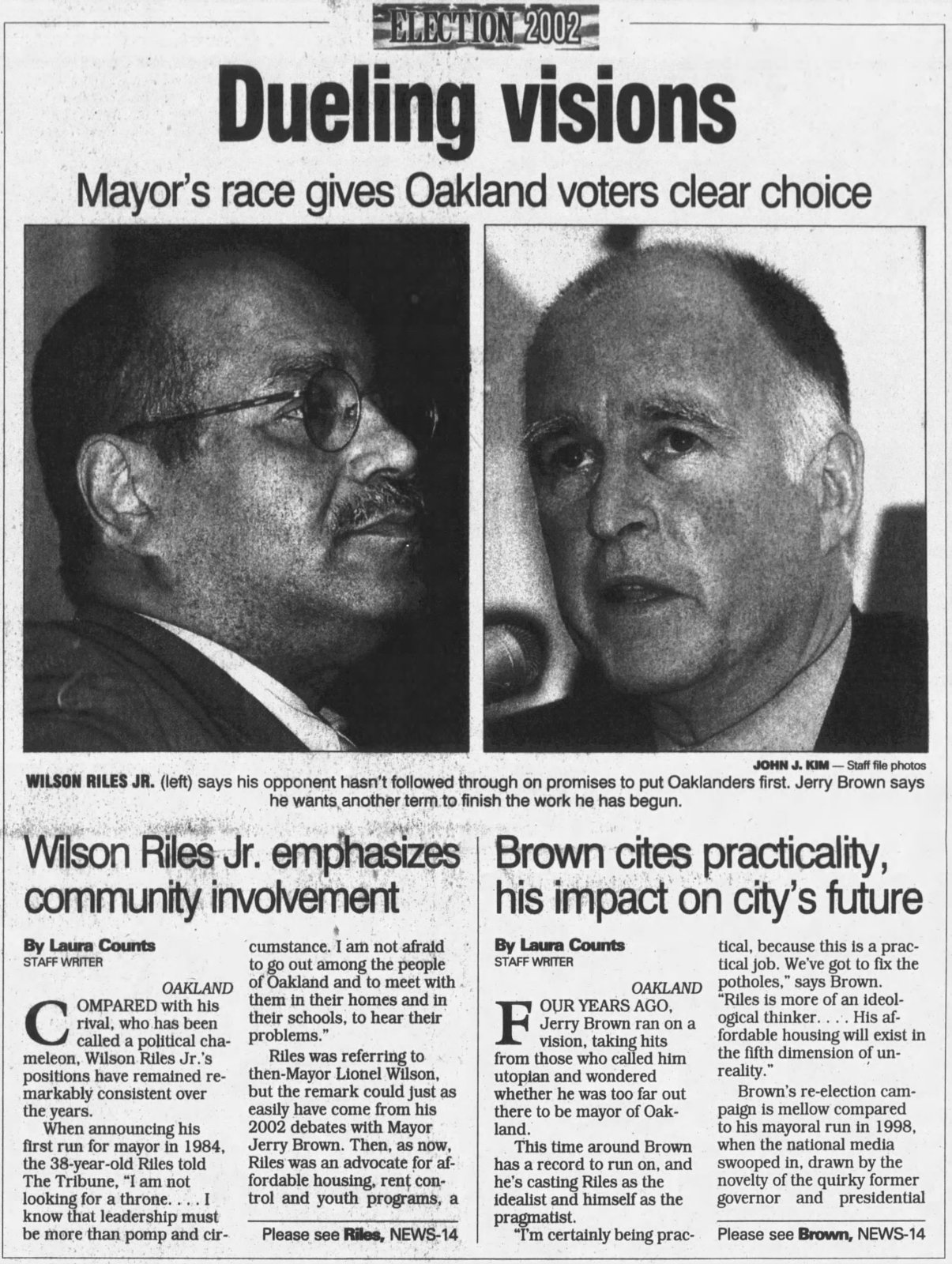 Coverage of Riles’ campaign for mayor in 2002 highlighted his different vision for Oakland. Credit: Oakland Tribune courtesy of Newspapers.com
The next year, he returned to his activist roots by joining the School of Social Justice and Community Development — launched to serve students at risk of dropping out — as its principal. Riley’s son, Raymond, the filmmaker who goes by Boots Riley, taught there before going on to become an acclaimed musician and director. The school was, in a way, a rebuke of Brown’s educational philosophy, as expressed in the Oakland Military Institute, which Brown established. Where the military institute emphasized discipline for the city’s youth, the social justice school emphasized self-determination and creativity.
Riles became an outspoken figure in the movement against police violence that burgeoned in Oakland after Oscar Grant was killed by a transit cop on New Year’s Day 2009. He supported Occupy Oakland protesters and worked on campaigns trying to unwind municipal finance deals that had turned toxic during the Great Recession, costing Oakland millions of dollars while it was forced to make service cuts and lay off staff. And he spoke out against the gang injunctions that city leaders attempted to use in 2010 to crack down on gang violence in North Oakland and Fruitvale, saying they perpetuated a system of racial bias.
One of his biggest passions at the time was the idea of offering municipal IDs, featuring a new local currency, to every adult in Oakland.
In 2013, Oakland did launch a municipal ID program, available to citizens and legal residents alike, though without the alternative currency system.
‘A model for mutual aid’
St. Onge said she and Riles have tried throughout their lives to live up to their deepest beliefs.
“The work is building the world we want to live in,” she said.
The two met in 1987. St. Onge was the director of Habitat for Humanity at the time, and the group was renovating a home on East 21st Street. She was used to politicians showing up to work events in a suit and tie, maybe throwing a few symbolic shovel loads of dirt. She was surprised to learn that Riles, then the District 5 councilmember, had been quietly digging fence post holes all morning.
“He just didn’t move like a politician,” she said.
Not long after, they had a chance encounter in the Dallas airport. Both were flying back to Oakland from work trips, and they sat next to each other on the airplane. “We talked all the way home,” St. Onge recalled.
A few months later, she was at Eli’s Mile High Club when in walked Riles. They talked and danced, and he asked her for her number.
When they moved in together, St. Onge’s children, who lived with them, grew close to Riles. She said he showed an “openness and willingness to engage in a way that has integrity for him and makes room for people to feel like they can have integrity in the exchange as well.”
Together, Riles’ children and St. Onge’s kids created a big family. “We’ve blended the waters really well in our relationships,” St. Onge said. “The world I live in now is very different from the one I would have lived in if I hadn’t met Wilson.”
“The way Wilson and Pat have lived their lives has been a model for mutual aid,” Cabasso said, “for really building community and welcoming people as an extended and blended family in every way.”
This extension of “mutual aid” was on display in the couple’s intimate response to the foreclosure crisis nearly two decades ago. Oakland was devastated by the subprime loans sold by Wall Street and the deep recession and job losses that followed. When their neighbor knocked on their door to let them know they were being foreclosed on and would soon lose their home, Riles and St. Onge asked what they would need, financially, to be able to stay. The couple ended up helping their neighbor make their mortgage payments, and in exchange were allowed to clean up the half-acre backyard and merge it with their own land. In time, they bought a neighboring duplex. Extended family moved in, and more fences separating yards came down. Relationships became closer.
The backyard space became Nafsi ya Jamii, an urban farm and retreat center. “Some of Black Lives Matter’s early meetings were here,” St. Onge said. “It’s been a convening place where we’ve had a book group, and I’m part of the 1000 Grandmothers for Future Generations, and we’ve met here.”
The backyard retreat may have played a role in Riles’s decision to join the police commission. In 2019, as he was visiting the Planning and Building Department to sort out whether Nafsi ya Jamii needed a permit for a sweat lodge, he got in an argument with a city staffer. Police arrived, and, Riles said, grabbed him, twisted his arm, and tackled him before taking him to Santa Rita Jail. Riles sued, claiming he’d been racially profiled and abused. The city settled the case for $360,000.
“There are a lot of very beautiful things that have been shaped here, and Wilson has been a part of it,” St. Onge said. “And so this is his healing space.” — the place where she hopes Riles can “rest and recover in familiar surroundings.”
Vanessa Riles said the stroke has brought the family together for meetings and planning. “Everybody is really coming together at this time to figure out how to do this. We’re all using our organizing skills at this moment.”
If their fundraising is successful, the family wrote in an update, it would mean Riles could recover in a warm setting “listening to jazz, family voices, and old stories.”
Your gift fuels our journalism.
Everyone deserves to have someone looking out for them, including you. That’s why we made it our job. When you give to The Oaklandside, you’re defending facts, funding truth-seekers and keeping Oakland informed.
Help us keep our news free with a donation today.
“*” indicates required fields