
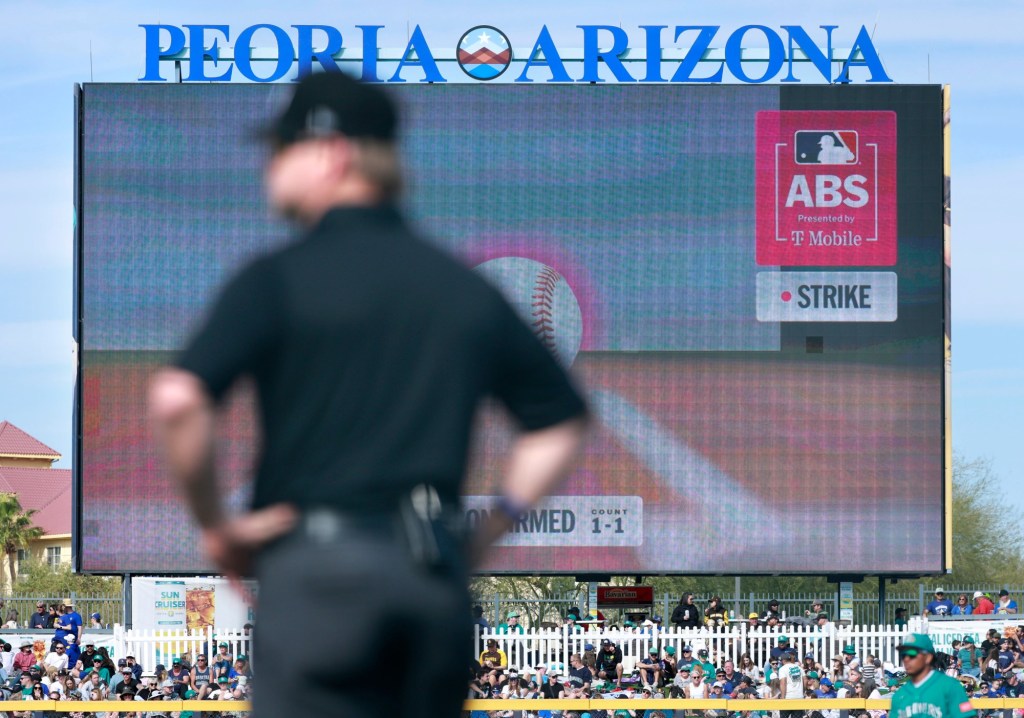
PEORIA, Ariz. — Nick Pivetta pounds his first into his glove after big strikeouts as he stalks off the mound. He’s usually screaming something simultaneously. He leans and ducks and bends in ways that appear like he’s manipulating some kind of force that helps his outfielders make spectacular plays for him. The ensuing thank you could be a yell from the mound, a tip of the cap or a handshake in front of the dugout.
No one wears his emotions on his sleeve quite like Pivetta.
But if you think that means the Padres will need a tight leash on him when the Automated Ball-Strike Challenge System debuts next month in the regular season, think again.
“Everybody thinks it’s Nick, but Nick’s actually the biggest rule-follower I know,” Padres right-hander Michael King said with a laugh. “Me, I’ll get caught up in the heat of the moment and challenge and be wrong, and then (Craig) Stammen will yell at me and I won’t challenge again.
“But if I’m right, then I think I get a little extra leeway. We’ll see.”
Indeed.
The Padres are doing just that for the second spring in a row.
This test run of ABS is the real deal. The system will debut in the regular season after years of tweaking and fine-tuning. The same Hawk-Eye tracking technology that feeds MLB’s Statcast is bringing strike zone judgment into the 21st century.
ABS has set a universally accepted strike zone: the width of the plate (17 inches), 53.5% of a player’s measured height without cleats at the top of the zone and 27% of his height at the bottom, with the actual zone captured as the ball passes through the middle of the plate.
Human umpires will continue to call balls and strikes. But each team can challenge ball-strike calls twice per game, with teams retaining successful challenges. Each team receives one extra challenge in extra innings.
Only pitchers, catchers and hitters can challenge balls and strikes; challenges cannot be used when position players are mopping up games.
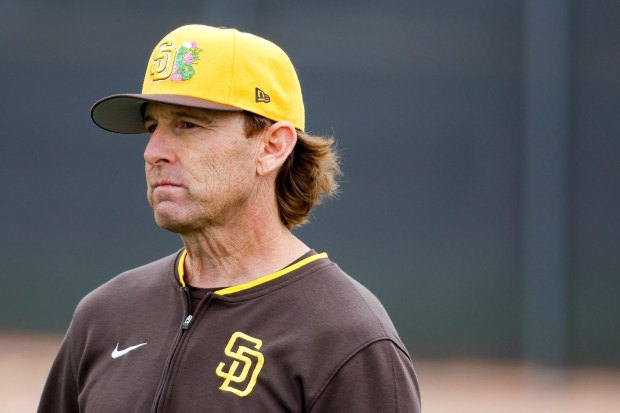 Pete Zamora of the San Diego Padres looks on during spring training workouts at the Peoria Sports Complex on Friday, Feb. 13, 2026 in Peoria, Ariz.. (Meg McLaughlin / The San Diego Union-Tribune)
The Padres do not have a formal set of dos and don’ts when it comes to ABS. But players and coaches have been having regular discussions with the likes of catcher Luis Campusano and Triple-A El Paso manager Pete Zamora, both of whom saw ABS in play last year in the Pacific Coast League.
A former pitcher, Zamora very quickly determined that catchers should be in full control of the challenges. Pitchers, he determined, are too emotional and may not have the best angle.
“What they’re seeing from 60 feet, 6 inches away is a different look than maybe the catcher or the hitter is seeing,” Zamora said. “So in my preference, you’re going to see a catcher that’s catching the ball and maybe showing the pitcher that it’s a strike, but the catcher deep down inside really knows that area.”
Players are being encouraged to pick their spots. Early-count challenges aren’t as impactful as calls that can flip a strikeout or a walk; teams will likely try to keep their challenges for big moments late in games.
“Think about your teammates when you’re challenging,” Zamora said. “Think about your family here. It’s not about you when it’s two (challenges). … Have some feel. I understand hitting becomes emotional sometimes, but it’s really good to have one in your back pocket late in the game.”
It’s the sort of thing that Xander Bogaerts could have used in the ninth inning of the Padres’ Game 3 loss to the Cubs in last year’s NL Wild Card Series at Wrigley Field. Both replays and MLB’s Gameday app showed a 3-2 pitch to Bogaerts crossed the plate well below the zone.
Home plate umpire D.J. Reyburn rung him up, leading Bogaerts to slam his helmet in frustration at the plate and later have a heated run-in with umpires as they left the field.
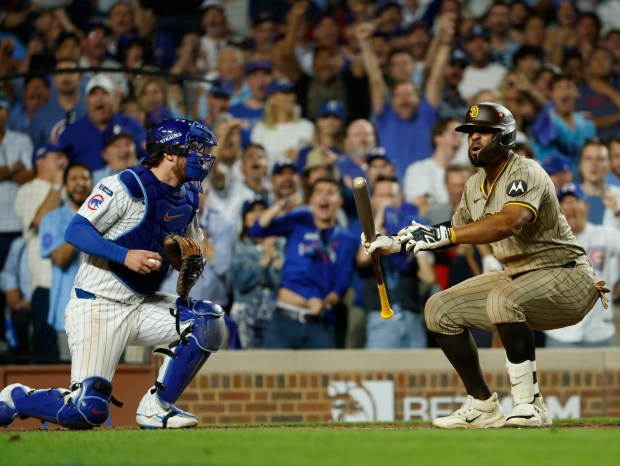 Xander Bogaerts #2 of the San Diego Padres reacts to a called third strike in the ninth inning as Carson Kelly #15 of the Chicago Cubs looks on in Game 3 of the NL Wild Card Series at Wrigley Field on Oct. 2, 2025 in Chicago, Illinois. (Photo by K.C. Alfred / The San Diego Union-Tribune)
A successful challenge would have given the Padres a runner on first with nobody out following Jackson Merrill’s leadoff homer. A 3-1 loss was sealed when Freddy Fermin flied out with runners on second and third.
“Messed up the whole game,” Bogaerts, who was fined for his actions with umpires, said last October. “I mean, can’t go back in time and talking about it now won’t change anything. So it was bad, and thank God for ABS next year, because this is terrible.”
The stakes weren’t nearly as high in Wednesday’s Cactus League exhibition, but a game-altering moment arrived in the sixth inning.
The Padres led 2-1 and had the bases loaded when plate umpire Charlie Welling called Ty France out on a changeup on the outside of the plate. France tapped his helmet, indicating a challenge, and a near-instantaneous replay on the video board showed the ball passed 1/10th of an inch outside the strike zone. Given new life, France hit a two-run single through the middle of the infield to extend the Padres’ lead.
“When I did it, I thought I was 100% right,” France said. “Like the way the catcher caught it, it didn’t look like it was a strike or feel like it was a strike. Then, when I saw it was only less than a 10th of an inch off, I was like, ‘Oh, you know, that was a lot closer than I thought it was.’
“So, yeah, it’s definitely an interesting tool. I think these umpires don’t get enough credit for how good they actually are. … They’re seeing pitches at 100 (mph) that are moving (in) different directions. It’s not easy.”
Not at all.
For all the flak umpires get, only 53% of this spring’s challenged calls through Thursday — 242 of 457 — had been overturned. Batters have been right 49% of the time (100 of 203) and pitchers and catchers have hit on 56% of their challenges.
Those numbers largely align with last year’s ABS data at Triple-A, according to MLB.com. The overturn rate was almost exactly 50%, and batters (45%) weren’t as good as pitchers and catchers (55%) when it came to challenges.
Which is why the Padres and others have spent this spring training to get a feel for when to challenge.
“I think all we want is the egregious calls to be taken out,” Padres first baseman Gavin Sheets said. “You never want an at-bat to be decided by an egregious call, one way or the other. It’s a super hard job for umpires, and if we can just take some of the blame off them and get rid of some calls that they just might have missed, which happens. I think the 50-50 balls, I think that you’re not going to see many guys challenge them, just because it’s hard as a hitter.”
Added Fernando Tatis Jr.: “You have to have some feel for the game. Obviously, if there is nobody on base, you better be 100% sure.”
 Peoria, AZ – February 20: The MLB ABS Challenge System is shown on the video board during a spring training game between the San Diego Padres and Seattle Mariners on February 20, 2026 in Peoria, AZ. (K.C. Alfred / The San Diego Union-Tribune)
The 33-year-old Manny Machado has as much feel as anybody in the Padres clubhouse, but he was hardly the first in line to introduce a new wrinkle to the game after the pitch clock took some getting used to in 2023.
Machado does not expect to challenge many calls this year. He’s got enough on his plate as it is.
“I don’t like it, so it won’t be me,” he said after his two-homer game on Thursday. “I won’t be that guy. … It’s already too hard to hit.”
Pivetta is in the same camp. He said he’s not interested in being the first pitcher to trump a catcher and issue his own challenge.
To be sure, he flagged a curveball he thought was a strike on Thursday only to return to the dugout, see it was a foot above the zone and realize he would have cost his team a challenge.
King similarly signaled for pitching coach Ruben Niebla to flag a pitch to check between innings in his start on Wednesday. It was indeed a strike.
“No, I won’t break the rules; I’m not going to do that,” Pivetta said before starting to smile. “But Michael will for sure challenge and he will get it wrong, and I look forward to that day.”