
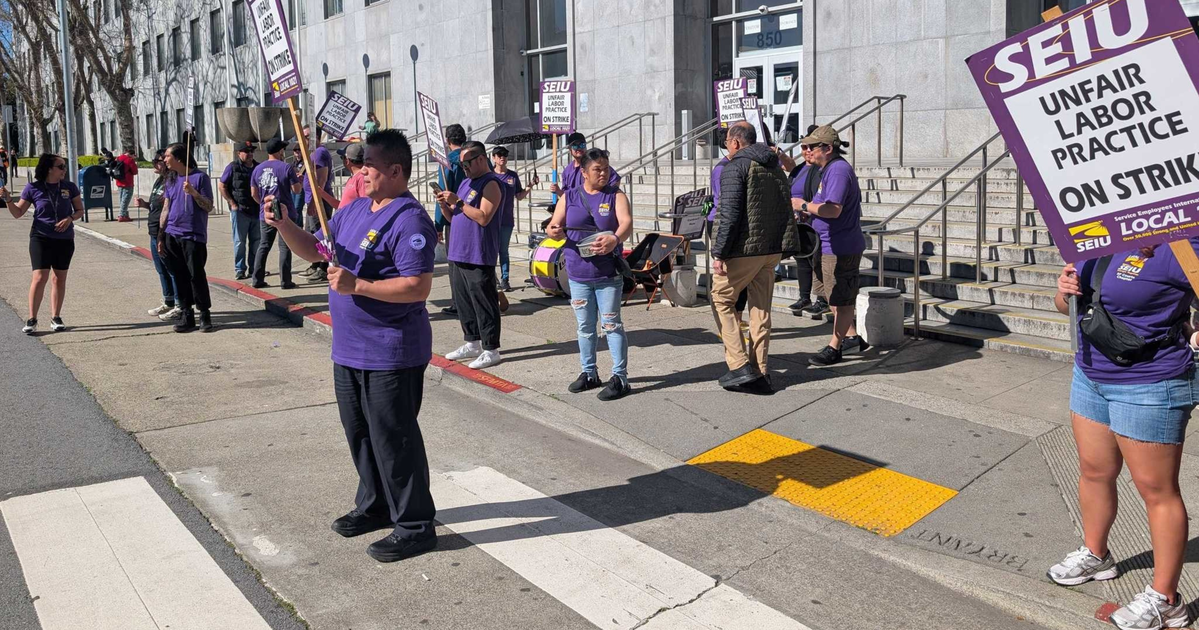
It’s the season of labor strife in San Francisco. The city’s teachers got raises and their healthcare premiums covered after a four-day strike. Nurses for Kaiser Permanente in California and Hawaii just went back to work after a four-week strike. And on Thursday, San Francisco’s court clerks walked off the job and took their grievances to the streets.
One veteran clerk said the stoppage is exacerbating the backlog of hearings and court filings. Jurors may be confused about whether they’re expected to report.
“Things have gotten worse,” said Ashley Hebert, a three-year courtroom clerk who serves on the union’s five-member bargaining committee. “We are not only trying to improve our working conditions for us but to help us do our job more efficiently so that we’re able to serve the public.”
Here’s what you need to know.
Who’s on strike
The strike involves approximately 220 clerks represented by SEIU Local 1021 who work at the Hall of Justice at 850 Bryant St. and the Civic Center Courthouse at 400 McAllister St. The clerks say months of failed contract negotiations over staffing levels, scheduling, and job training left them no choice but to walk out.
According to public records, (opens in new tab) deputy court clerks earn $56,000 to $105,000 per year.
What clerks do
Clerks manage documents for judges and courtroom proceedings, handle public records requests, track case filings through computer systems, and ensure that procedural paperwork is accurately recorded. In short, they are the administrative backbone of a functioning court.
Rob Borders, who has worked as a clerk for 11 years, put it plainly: “If you ask anybody that’s a user of the court, such as an attorney, or even the judges, they’re going to tell you how essential we are to make sure that the court operates efficiently and that justice is reflected in the paperwork and the documents that we produce.”
What’s open
With clerks off the job, court operations are in turmoil.
Even court authorities were unsure which offices remain open. According to the Superior Court (opens in new tab), clerks offices across the Hall of Justice, Civic Center Courthouse, and Juvenile Justice Center on Woodside Ave. may be closed. Attorneys and others should look for drop boxes to file documents and payments.
“The criminal clerk’s office is temporarily closed due to a work action,” a sign said Friday outside one office.
Managers of the Superior Court said they would shift resources toward cases with statutory deadlines, including criminal arraignments, custody matters, unlawful detainers, and civil harassment and domestic violence cases. Matters without pressing statutory deadlines are to be recessed.
A limited number of courtrooms remained open across the court’s three locations to protect defendants’ constitutional rights and meet legal deadlines.
That means San Francisco residents summoned for jury duty may need to report. Prospective jurors should check the court’s website (opens in new tab) for their status.
At the Civic Center Courthouse, open departments included mental health conservatorship, unified family court, juvenile dependency, real property, and civil harassment calendars, along with two civil courtrooms handling a limited number of criminal trials that must proceed due to time requirements.
At the Hall of Justice, departments handling preliminary hearings, domestic violence and felony arraignments, mental health court, and the misdemeanor and criminal master calendars were among those that remained operational. The Juvenile Justice Center kept its juvenile delinquency department open.
The court’s self-help center, known as the ACCESS Center, was open only for unlawful detainer matters.
Mounting backlog
Hebert noted that even before the strike, hearings at the master misdemeanor department, where she works, were being continued as far out as June. The longer the strike lasts, the worse the backlog will grow. “Any delay causes future delays,” Borders said.
He noted that this walkout has already lasted longer than previous one-day stoppages: “I don’t think they really understand what they’re looking at as far as the congestion that this is going to cause.”
The core grievances
The clerks’ complaints center on three interconnected problems: chronic understaffing, a court-mandated computer system that they say doubles their workload, and a training program that relies on email rather than in-person instruction.
Hebert said a case management system was imposed on clerks a few years ago without their input and has made entering case data significantly more time-consuming. “The system we have currently makes doing our entries take double the time,” she said.
Borders described the staffing and training problems as tightly linked. Because the Hall of Justice division is short-handed, clerks are routinely asked to cover courtrooms outside their areas of expertise — a practice he said invites errors that have real legal consequences.
“There’s various courtrooms that have nuances which need a specific procedure and terminology and paperwork,” Borders said. “If you don’t have the experience and the training to be able to compensate in that position, it could lead to errors being made.”
A surge in criminal cases brought by the district attorney’s office has compounded the problem. “The court has had an ample opportunity to make adjustments — hiring or reorganizing — to try to alleviate some of it,” Borders said. “They’ve done basically nothing.”
Where negotiations stand
The court has offered clerks a 6.5% wage increase over three years — 2% annually, with an additional 0.5% in October, contingent on the court receiving additional state funding. The offer also included stepped increases to biweekly health benefits, from $1,643 in January 2027 to $1,811 by January 2029.
The two sides reached a tentative agreement in October, averting a threatened strike, but the union’s rank and file rejected the deal. In November, the union presented a new package with higher wages and additional terms that the court described as “regressive bad-faith bargaining.”
The bad blood deepened this month when the court accused SEIU Local 1021 of failing to bargain in good faith on Feb. 13 and filed an unfair practice charge with the Public Employment Relations Board.
“It is unfortunate that SEIU has decided to disrupt court services after more than 28 bargaining sessions and two mediation sessions,” said Brandon Riley, CEO of the Superior Court in San Francisco, who noted that deals have been reached with three other unions representing court employees.
Borders said a line of communication with the union has reopened, and “there’s some movement happening.” Hebert said the union planned to meet Friday to discuss a new offer from management. No formal bargaining session was scheduled.
The union has directed some frustration at Riley. “His response has been pretty much nonexistent,” Borders said. “He prefers to remain kind of an unknown figure. I think he should take more ownership of the situation happening here.”
In a statement Friday, Riley said that “the court and SEIU are committed to good-faith bargaining.”