
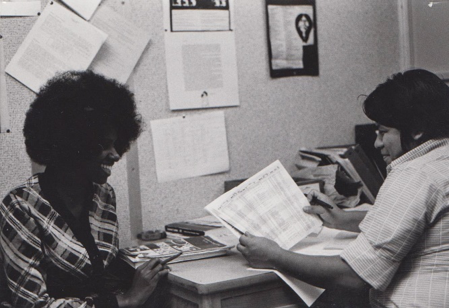
During Black History Month, Sacramento residents are encouraged to explore the contributions of the city’s Black community in shaping its culture, businesses and legacy of activism.
Early History
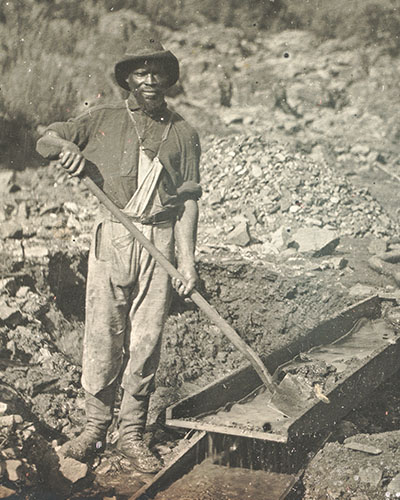 An unidentified African American man stands at a long pan mining for gold near Auburn Ravine in 1852. It is unknown whether he was enslaved or one of many free Black men who came to California during the Gold Rush. (Photo courtesy of the California State Library)
Early Black trailblazers in California included William Alexander Leidesdorff, who is believed to have been the nation’s first Black millionaire.
In the 1840s, Leidesdorff came to California from Louisiana after living in the Virgin Islands. He received a land grant from the Mexican government that covered much of what is now Folsom and Rancho Cordova.
Leidesdorff became involved in trade and launched the first steamboat to sail on the San Francisco Bay. The steamboat, the Sitka, is featured on the California State Seal.
RELATED: Old Sugar Mill puts local Black businesses at the forefront with annual art show
Around the same time, some Black Americans were brought to California by enslavers to work in the mines of the Gold Rush. As the city of Sacramento expanded, its Black community also grew and established businesses that served the mining population.
Black American involvement in the Gold Rush can be seen in places such as the historical Negro Bar in Folsom. The area was the site of a gold discovery by Black miners in 1848.
Many Black men, both enslaved and free men, came to California during this time. Due to the nation’s perception of race at the time, racially charged names like this were common.
According to the California Department of State Parks and Recreation, officials are working with community members and stakeholders to change the name to Black Miners Bar. Members of the public are encouraged to submit a comment in support of or in opposition to the proposed name change.
Education
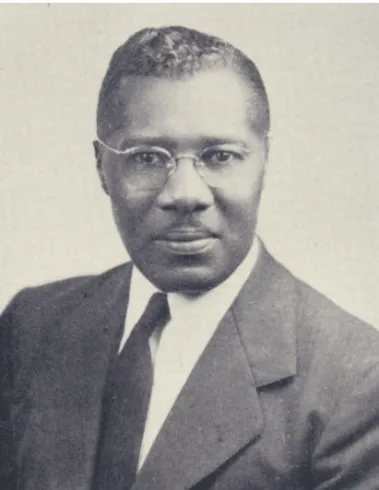 The first African American person to graduate from Sac State, Jerry Dixon earned a degree in education, as well as his teaching credential. Dixon was an important member of Sacramento city, working in the community. (Photo courtesy of The Sacramento Observer)
The first school for Black children in Sacramento, located on 2nd Street, was established in 1854 by Elizabeth Thorn Scott Flood. The 1855 Colored Convention in Sacramento laid out a mandate for establishing schools for Black children in California.
In the 1850s, children of color were barred from attending public schools with white children. In 1874, the California Supreme Court upheld the practice in Ward v. Flood, ruling that children of African and native descent would be required to attend segregated schools. The U.S. Supreme Court later declared school segregation unconstitutional in 1954 in Brown v. Board of Education.
RELATED: Where soul meets flavor: A guide to Sacramento’s Black-owned restaurants
Sacramento went through these changes when elementary schools were integrated. Sac State was also changing at this time, as the university had not yet graduated a Black student.
Jerry Dixon, the first Black graduate of Sac State, earned a degree in education as well as a teaching credential in 1949. Dixon was an important member of Sacramento city, working in the community. He taught school in Alabama and served as a sergeant in the segregated U.S. Air Force during World World II.
Activism
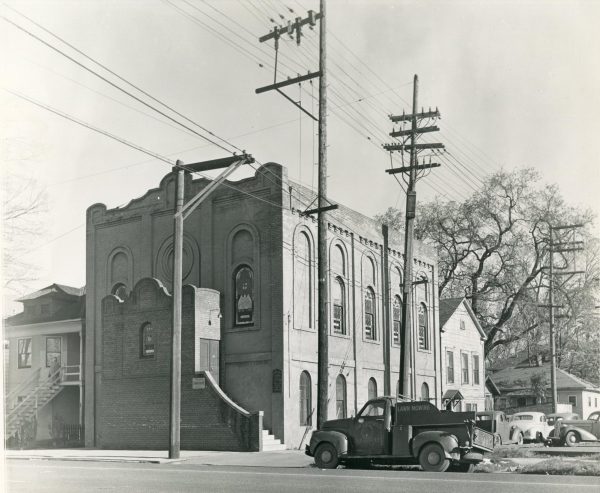 The original St. Andrews church stood on 7th Street until the current structure on 8th Street was built in 1995. The church was founded in 1850 and is celebrating its 176th year. (Photo courtesy of The Metropole)
Hackett House, a hotel owned by abolitionists Charles Hackett and Charles Parker, was a gathering place for civil rights activists in the 1850s.
Black activists from churches and community groups in Sacramento gathered at the Hackett House to protest the showing of the 1915 film, “The Birth of a Nation.” The city commissioner allowed the film to be shown, but required the removal of its most offensive scenes, including one depicting a white woman leaping to her death from a cliff to avoid being assaulted by a Black man. Amid the rise of Ku Klux Klan groups across the state, this was viewed as a significant victory for Sacramento’s Black community.
The site where Hackett House stood on 3rd Street between K and L Street is now home to a parking garage for the Golden 1 Center.
Colored Conventions were an early form of civil rights organizing in California. The first convention was held at St. Andrews AME Church in Sacramento in November 1855 and included delegates from 10 counties. St. Andrews remains the oldest African Methodist Episcopal congregation on the West Coast.
At these Colored Conventions, delegates sought to abolish slavery, end a ban prohibiting Black citizens from testifying in court, secure Black male voting rights, access public education and equal accommodation.
Art
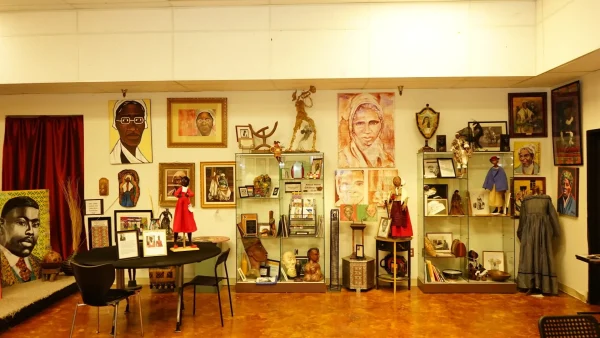 A room at the Sojourner Truth African Heritage Museum that displays paintings, sculpture, photographs and textiles. The Museum is open Thursday through Saturday at 2251 Florin Road. (Photo courtesy of Sojourner Truth African Heritage Museum)
Today, Black art can be seen all around the city. The West Sacramento Community Center houses Gallery 1075, an art space that features local Black artists this month. The gallery invited the artists to exhibit their work earlier in the month, and the showcase remains on display through Friday.
Florin Square is home to the Nubian Family Marketplace, a complex of Black-owned businesses. Within the square is the Sojourner Truth African Heritage Museum, open from noon to 5 p.m. Thursday through Saturday. The museum highlights Black history and heritage from the Harlem Renaissance to the trans-Atlantic slave trade to Black cowboys.
Sac State
Sac State students witnessed history on October 16, 1967, when the Rev. Martin Luther King Jr. spoke at what is now Hornet Stadium to a crowd of more than 6,000.
King had been widely criticized before this for speaking out against the Vietnam War, but addressed unemployment, education inequality and the housing issues affecting for Black Americans in his speech.
RELATED: Remembrance: Artists commemorate vibrant African history in ‘Black History Month Exhibition’
The same year, the university expanded outreach efforts to support Black students entering college. Eight Black students were admitted that fall, and the university launched the Educational Opportunity Program, a program that continues today.
The goal of the EOP is to support students from low-income California households in their transition to college through grants, retention services and advising. By fall 1969, the EOP had grown to 160 students.
Sac State and the city of Sacramento have a long history shaped by Black contributions. Early miners supported the expansion of California’s economy, and local art galleries continue to highlight Black heritage. Sac State has supported Black students since 1949 and expands and bolsters diversity.