
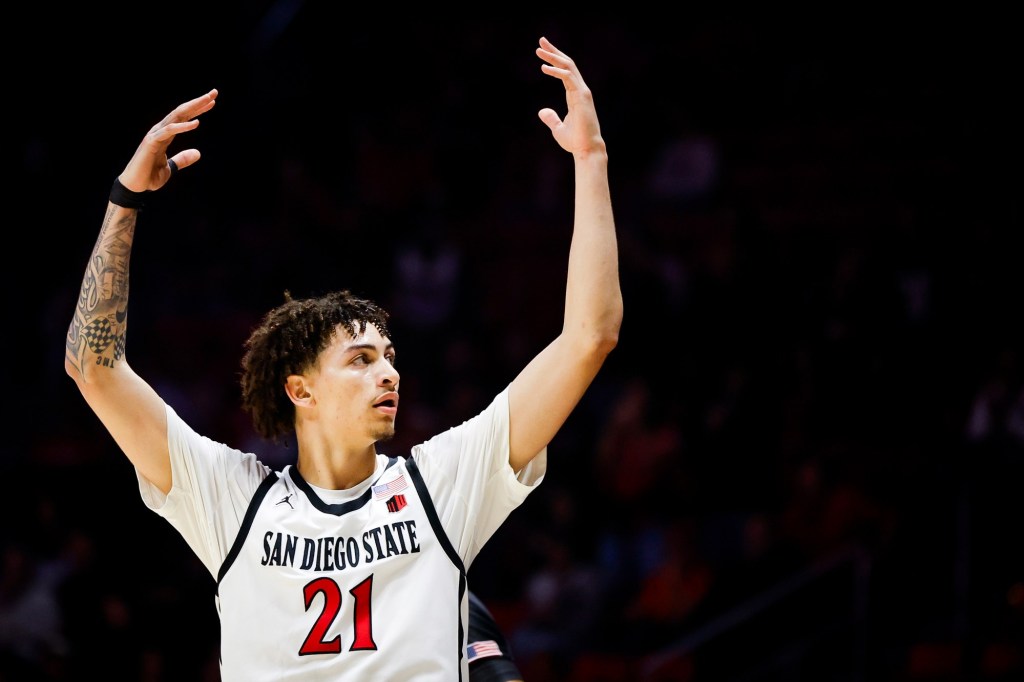
San Diego State beat Utah State 89-72 on Wednesday night to move into a first-place tie atop the Mountain West. The Aztecs outshot the Aggies 54.5% to 41.4%, outrebounded them 38-30, made six more baskets and had seven more assists.
Maybe the most important stat, though, wasn’t in the box score: 9.5.
That was coach Brian Dutcher’s rotation after routinely playing 11 when his entire roster has been healthy, which it was on Wednesday. Senior guard Sean Newman Jr. logged 6½ minutes, or roughly half a rotation. Senior forward Jeremiah Oden, who had started the previous nine games, didn’t play at all for the first time this season.
It gives New Mexico a new wrinkle to consider as the Lobos (21-7, 12-5) host the Aztecs (19-8, 13-4) at a sold-out Pit on Saturday.
“Their performance Wednesday night was super impressive … probably one of their better performances of the season,” UNM coach Eric Olen said. “For us, certainly, (there’s) the recognition of how good a team that we’re playing.”
What do the Aztecs think about the shortened bench? Was it an aberration or a trend? Is it sustainable on Saturday at 5,108 feet of elevation?
We don’t know because SDSU again opted not to make players or the media-friendly Dutcher available, this time before a nationally-televised game that arguably is the biggest of the season.
Olen, meanwhile, was readily available and spoke freely with Albuquerque media on Friday morning for nearly 20 minutes. He has stuck with an eight-man rotation for most of the season, although his options have been limited with serious injuries to former UCSD forward Chris Howell and former USD forward Kevin Patton Jr.
But 10 or 11?
“That’s not been something I’ve done rotationally,” Olen said. “I feel like that’s challenging for me. Everybody does it differently, and lots of respect for how everybody else does it. I think it’s hard for the players sometimes to play shorter rotations or inconsistent minutes. We’re always trying to be as consistent as we can with rotation.
“There have been times in past seasons for me as a head coach, where maybe we have one rotational spot — let’s say we have 20 minutes available — and there are two guys, and I will typically choose one of those players to play 20 minutes versus giving both 10. … That’s just always been my approach, because I think you’re better off getting maybe the best version from one person than sub-optimal from two in those roles.”
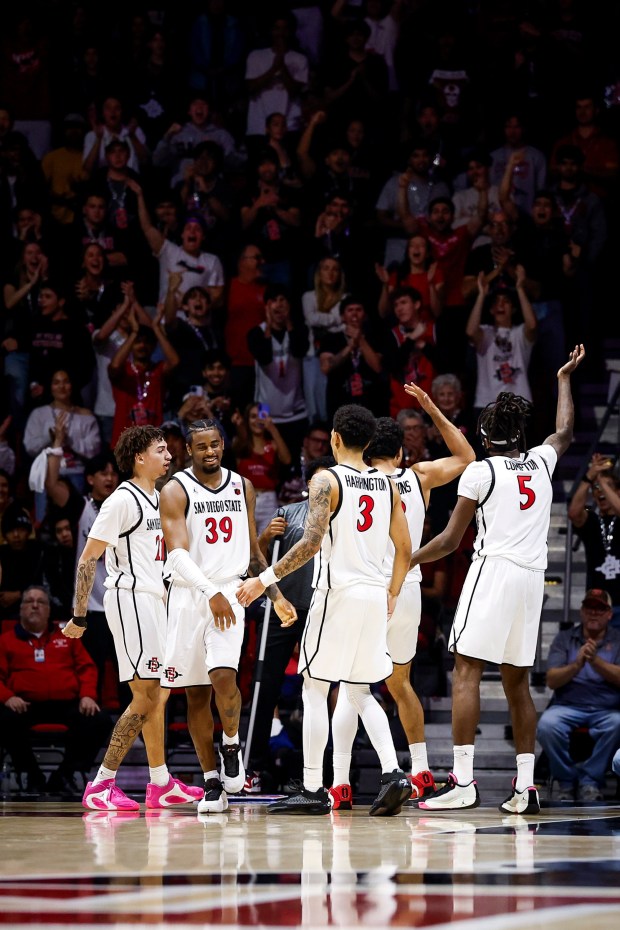 San Diego State players gesture towards the crowd during their game against Utah State at Viejas Arena on Wednesday, Feb. 25, 2026 in San Diego, California. (Meg McLaughlin / The San Diego Union-Tribune)
Even back in October, Dutcher spoke about the challenges of trying to play 11 and hinting that its success or failure might define the season. He’s had all 11 available for 17 of the 27 games, and played all of them. He’s had 10 for 21 games and played all 10.
These things usually work themselves out, whether it’s through injuries or tactical needs or a clear separation in ability. But with their three preseason all-conference selections largely underperforming early in the season and the roster remaining relatively healthy through November and December, it made paring the rotation more challenging.
Some guys would play well one night, other guys would star the next.
The result has been a mish-mash of lineups all season. The Kenpom metric tracks different groups on the floor together, and over the previous five games, no single five have played more than 12.5% of the minutes. The next highest group was 6.1%.
Contrast that to New Mexico, which is using its starting five together for 27.5% of the minutes and four other lineups over 6.1%.
Another indicator is bench minutes. SDSU ranks 16th among 365 Division I programs at 41.8%.
No one else in the Mountain West is in the top 40. New Mexico is 214th at 30.9%.
Dutcher was forced into a nine-man rotation for six games midway through the conference schedule, when starters Magoon Gwath and Elzie Harrington were both shut down with injuries. The Aztecs lost two of those games — at Grand Canyon and at Utah State — but did seem to play more fluid basketball and had some of the season’s best performances. It raised the question of whether how many were playing was as important as who.
But after back-to-back lackluster losses against Grand Canyon and Colorado State, the first time they had dropped consecutive games in February in eight seasons, Dutcher and his staff appear to made an executive decision.
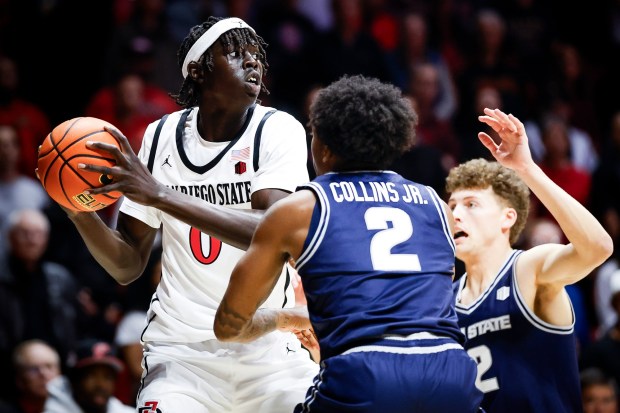 Magoon Gwath #0 of San Diego State looks to pass against Mj Collins #2 and Mason Falslev #12 of Utah State during their game at Viejas Arena on Wednesday, Feb. 25, 2026 in San Diego, California. (Meg McLaughlin / The San Diego Union-Tribune)
Gwath, after logging just five minutes in the previous game at Colorado State, was inserted into the starting lineup alongside Harrington. BJ Davis, who had started seven straight games with mixed results, returned to the bench. Oden went from starter to never taking off his sweats while freshman Tae Simmons was elevated to the backup power forward. Sean Newman went from averaging 19 minutes over the previous seven games to playing 6:29 against Utah State — and only 1:18 in the second half.
“I didn’t play ‘Goon’ enough against Colorado State,” Dutcher said after Wednesday’s game. “He didn’t practice basically for two days, so he’s got to practice hard in order to play. I told him (Tuesday), ‘If you get through practice and you practice hard, I’ll start you because we’re not going to be as good as we can be unless you’re on the floor.’
“To get him back on the floor was a major lift for the team. … If Magoon’s healthy, he’s going to be in the starting lineup.”
The result? Maybe their best performance of the season. The Aztecs led by as many as 24 points and handed Utah State its most lopsided loss of the season.
“A good step,” senior Reese Dixon-Waters said, “in the right direction.”
San Diego State (19-8, 13-4) vs. New Mexico (21-7, 12-5)
When: 11 a.m. Saturday
Where: The Pit, Albuquerque, N.M.
TV: CBS
Radio: 760-AM