
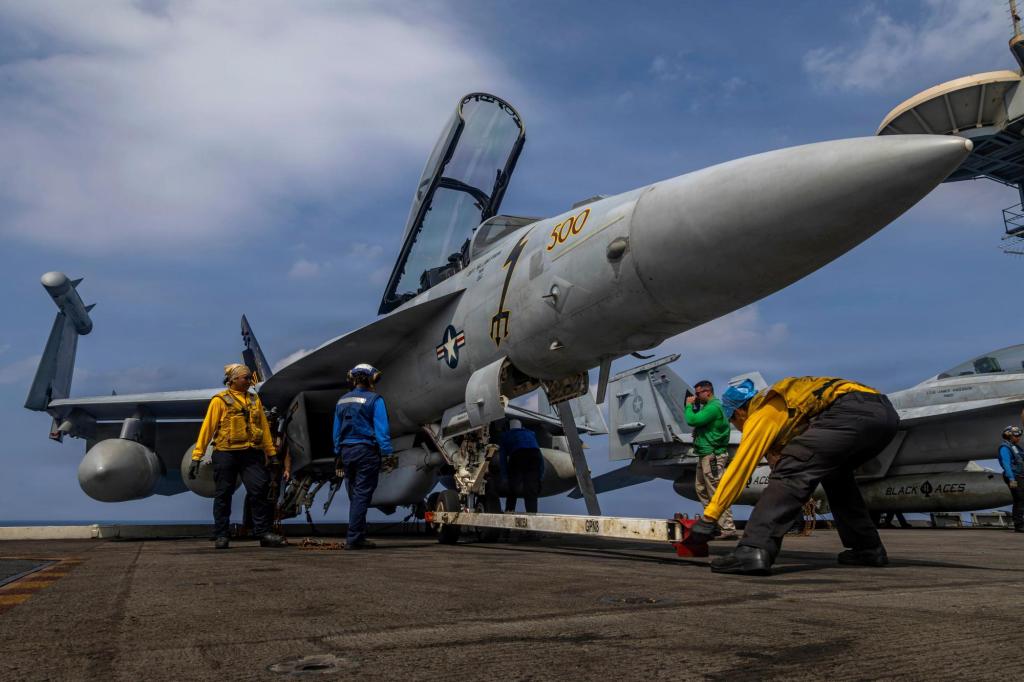
The United States’ joint attack with Israel against Iran deeply involves San Diego’s USS Abraham Lincoln, one of the most distinguished and technologically advanced nuclear-powered aircraft carriers in the world and a veteran of major wars in the Middle East.
The 1,092-foot flattop is the flagship of a nine-ship strike group that features upward of 60 aircraft and 7,000 personnel. Two of the group’s escorts, the destroyers USS Spruance and USS Pinckney, also are based in San Diego, the headquarters of the Third Fleet.
The aircraft now aboard the Lincoln come from Naval Air Station North Island, Marine Corps Air Station Miramar, and bases at Point Magu, Lemoore, located in the Central Valley and Whidbey Island, Washington.
The 37 year-old carrier is operating in Arabian Sea with a mix of F/A-18 multi-role fighter jets and new generation F-35C stealth fighters. Four years ago, Lincoln became the first carrier to deploy with F-35Cs. Both of these aircraft carry precision-guided air-to-air and air-to-ground missiles, giving the carrier range and power.
The strike-group also features six Arleigh-Burke-class destroyers, which are known as the workhorse of the Navy because they are so versatile.
Burke destroyers stock Tomahawk cruise missiles, a weapon that became famous during Operation Desert Storm in 1991 because they were used so effectively by ships and submarines. Tomahawks were originally developed by the Convair division of General Dynamics in San Diego and some of the missiles can travel about 1,000 miles.
The destroyers are indispensable to the Navy but they lack the glamour of aircraft carriers, notably the Lincoln, which was commissioned in 1989 during the waning years of the Cold War.
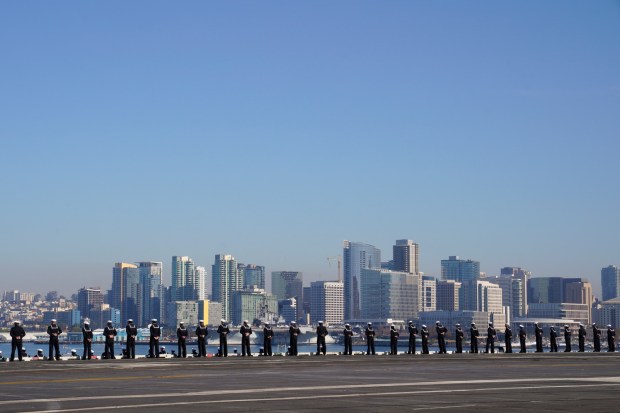 Sailors on board the USS Abraham Lincoln (CVN-72) man the rails on their return to San Diego and NAS Coronado on Friday, Dec. 20, 2024, in Coronado, CA. (Nelvin C. Cepeda / The San Diego Union-Tribune)
The carrier became widely known in June 1991, during its first deployment, when it spearheaded a 23-ship armada that evacuated almost 45,000 people from Luzon Island in the Philippines following the eruption of Mount Pinatubo. It then traveled to the Persian Gulf and provided air support and reconnaissance after the main fighting had ended in Operation Desert Storm.
The Lincoln returned to the region several times in the 1990s to help enforce the no-fly zone over southern Iraq. And in March 2003 it helped lead the so-called “shock and awe” phase of Operation Iraqi Freedom, carrying out more than 2,300 combat missions. Two months later, President George W. Bush famously declared during a visit to the Lincoln that major combat operations had ended. But the conflict lasted, in various ways, for almost nine years.
The carrier — which many sailors call “Abe” — has deployed to the Middle East several times since 2019, mostly due to tensions with Iran.
The Lincoln left San Diego on its latest deployment in Nov. 2025. It was initially assigned to patrol the Indo-Pacific. President Donald Trump diverted the ship to the Middle East in mid-January due to rising tensions with Iran, which has refused to abandon its nuclear weapons program.