

An Anaheim Chamber of Commerce leader emailed a lobbyist confidant and asked for a meeting to discuss more than $500,000 in payments from companies with proposed projects in Anaheim.
Todd Ament, the chamber’s chief executive at the time, wanted to hammer out “splits goals” on companies like Angels Baseball, Brewery X and developers of the Road House hotel near Disneyland, in his Sept. 21, 2020 email to Jeff Flint, head of FSB Public Affairs.
Ament also included Anaheim’s 2020 elections in the “cash flow” conversation.
A ledger with handwritten notes suggests the two men, who later emerged as central figures in an FBI political corruption probe into a self-described “cabal” that ran Anaheim, met sometime after the email was sent to divvy up the money.
The ledger and related emails reviewed by TimesOC offer a rare glimpse into an otherwise shadowy world where lobbyists collect big bounties for influencing legislation or securing contracts for clients from local government agencies without full disclosure.
It also reveals another facet of how monied interests have influenced Anaheim City Hall.
The document listed a $50,000 payment from the Angels to Flint’s business, FSB, around the same time it lobbied for a revised deal, approved in 2020, to sell the city-owned stadium and land around it to a company controlled by team owner Arte Moreno.
Ament, who did not register in Anaheim as a lobbyist for any of the clients listed on the ledger, also discussed payment splits with Flint for more than a half-dozen other companies, including $300,000 from Manatt Housing Solutions for a workforce housing development the Anaheim City Council would approve in November 2020.
According to ledger notes, a $25,000 payment from Road House was described as a “win bonus” with an expected Oct. 29 invoice date. The boutique hotel is currently under construction after the City Council approved changes on Sept. 15, 2020 that cleared its development.
Federal prosecutors have not charged Flint with any wrongdoing. Ament was charged with four felonies in 2022.
Flint declined comment for this story, as did a spokesperson for Ament’s attorneys.
‘Hiding the ball’
Win bonuses are banned by the Political Reform Act, a state law enforced by the Fair Political Practices Commission. The ban only applies to the state Legislature, but Los Angeles County has modeled its own lobbyist rules prohibiting win bonuses, also known as contingency fees, on state law.
Anaheim, which defines a lobbyist as a person or firm paid, or entitled to be paid $500 or more in a calendar month to communicate with city officials, does not explicitly ban win bonuses.
Sean McMorris, a program manager for the nonpartisan government accountability nonprofit Common Cause, stressed the need for transparency, if a local agency does not ban win bonuses outright.
“You’re otherwise hiding the ball on who is playing the game, what they’re being compensated for and, possibly, their motives behind it,” McMorris said.
The ledger also noted that FSB already “tracked” about $200,000 of time representing Moreno’s SRB Management in the stadium deal. Handwritten notes suggest FSB planned to give Ament a $10,000 cut from the Angels payment, which was part of a calculated tally of roughly $220,000 from all companies.
An Angels spokesperson did not comment for this story.
The stadium deal imploded after an FBI investigation into political corruption in Anaheim publicly surfaced in 2022. Team executives have not been accused of wrongdoing.
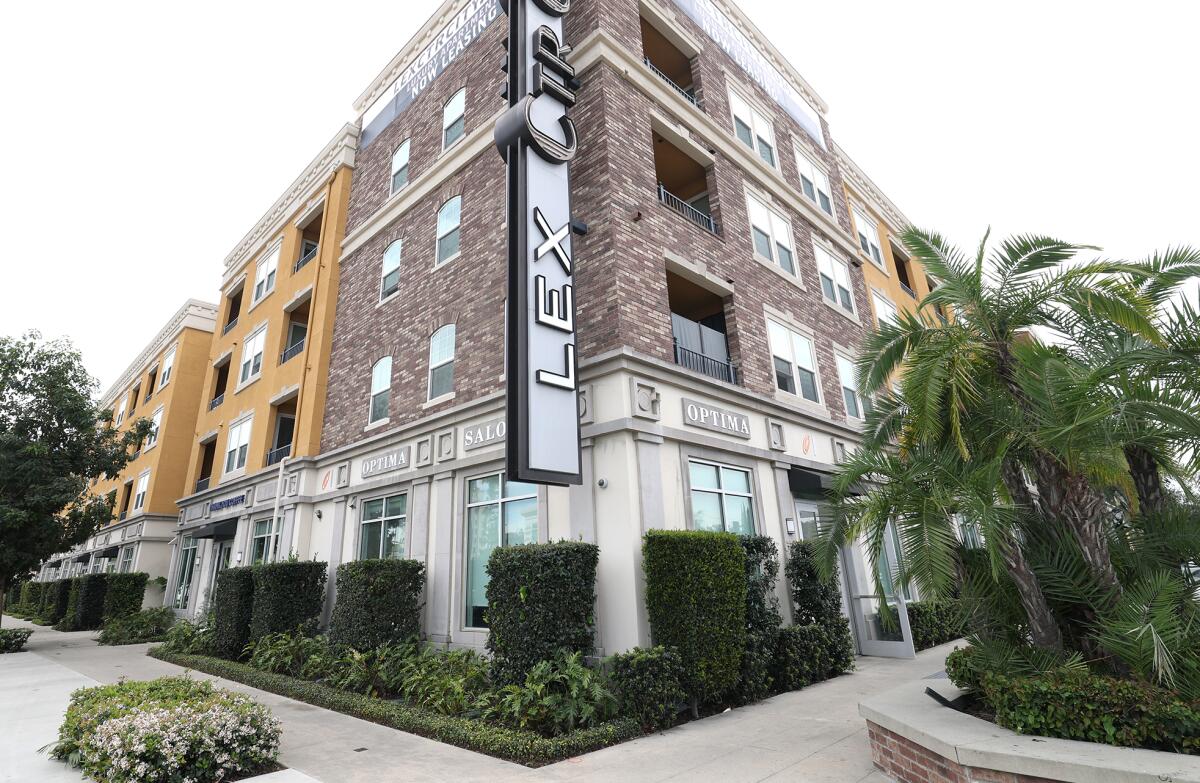
The ledger lists a $300,000 payment that was expected from Manatt Housing for converting Lex CTR City into workforce housing.
(Don Leach/Staff Photographer)
Influence peddling
Flint and Ament flexed political muscle behind the scenes on behalf of many of the clients listed in the ledger, documents show.
Ament’s email arrived on the same day Flint led a mock council meeting to rehearse the stadium deal debate.
Flint and Ament did not register with Anaheim as lobbyists for Manatt Housing Solutions, but were in contact with city staff and elected officials in support of the company’s push to manage the 231-unit Lex CTR City apartment complex in downtown after its conversion into rent-controlled workforce housing.
Mark Wiesenthal, Manatt’s managing director, sent an email on July 29, 2020 to Ament and John Penkower, managing director for California Statewide Communities Development Authority, expressing gratitude for a meeting with Ament and then-Anaheim Mayor Harry Sidhu.
Wiesenthal wanted to schedule a call with Ament and Penkower — as CSCDA would partner with Manatt on the proposed conversion — to make sure they were working with the “right Anaheim officials.”
“We are excited about this project and ready to make it happen,” he wrote.
The next month, Ament offered to connect Kathleen Brown, a Manatt Housing partner, former state treasurer and sister of former Gov. Jerry Brown,with then-Councilmember Trevor O’Neil.
“He is leading the housing [affordability] working group that will recommend this program,” Ament wrote of O’Neil.
While Ament introduced key players, Flint appeared to exert influence over city staff.
By October, Flint reported to Sidhu and Ament that department heads were “intrigued” by the property tax-exempt bond-financing housing program but he had to persuade them the city’s contracted financial adviser, who claimed it was “too risky,” was wrong.
Flint followed by scripting Sidhu’s phone call with Planning Director David Belmer that instructed him to work with the applicants to get resolutions and documents ready for Nov. 10, a scheduled council meeting Flint described in another email as a “lame duck session.”
During that meeting, Anaheim greenlit the program for Lex CTR City, then known as Alexan, and two other apartment complexes without any public discussion.
The ledger outlined a $150,000 split for Ament. It noted Manatt as an “Octagon client, payable in December.”
The reference was to Octagon International Group, a company co-owned by Flint and Ament for “real estate development services, and any other permitted by law,” according to secretary of state business filings.

Flint lobbied for Brewery X to be able to keep an outdoor patio. Ament discussed a split of a $27,000 payment.
(Don Leach/Staff Photographer)
Flint later re-registered the company in 2021 as a consulting business without Ament.
“Manatt Housing Solutions did not engage Todd Ament in any capacity,” said Samuel Eisele, a Manatt Housing spokesperson. “Manatt Housing was not aware of, nor did it approve, any agreement between Flint and Ament.”
Non-contractual payment splits raises key concerns for McMorris, the governmental accountability expert.
“If there are behind-the-scenes agreements where a person who is paid the contingency fee agrees to give a portion of that fee to somebody else, I have questions about the legality of it, because it’s not in the contract,” McMorris said.
“But if that other person is going to receive a portion of that fee, then they presumably also have to register and file as a lobbyist with the city.”
Ament buys mountain home
In mid-December 2020, Ament was awaiting the Manatt split from Flint while trying to close escrow by Dec. 28 on a $1.5- million Big Bear City home.
“So are you pretty confident [Manatt] will wire $300k on the 28th?” he emailed Flint on Dec. 16.
It is unclear if the payment came through on that date.
According to the criminal complaint against Ament, FSB loaned $205,000 in a series of wire transfers to make him appear to have enough income to secure a bank loan, a key allegation in Ament’s mortgage fraud charge.
In November 2020, Ament had created an invoice to FSB detailing $300,000 in retainer fees for political and consulting work on Orange County elections, workforce housing and mixed-use developments, a document the FBI believed was used to fraudulently make the loan appear to be income to the bank.
Ament allegedly used some of the funds transferred from FSB to make a down payment on the home and a $200,000 out-of-escrow payment to the seller.
Three days after escrow closed, Ament deposited a $150,000 check from Flint, the same amount the ledger noted as his Manatt share.
The FBI believed Ament used a portion of the check to repay money borrowed from the Chamber of Commerce to cover the out-of-escrow payment that agents flagged, but did not know the nature of the deposited funds.
Flint did not respond to a TimesOC question regarding the check.

Construction is underway for the Road House hotel in Anaheim. Flint and Ament penciled a $25,000 win bonus for its approval.
(Don Leach/Staff Photographer)
Calls for reform
After the FBI and a city-commissioned corruption report detailed how Flint allegedly circumvented Anaheim’s lobbyist registry in an effort to legalize retail cannabis, the City Council took measures to tighten up lobbying laws on two separate occasions.
The ensuing reforms expanded the definition of a lobbyist to include in-house employees and added misdemeanor penalties for failing to register as one under the new terms.
But as win bonuses were not detailed in either the FBI investigation or the corruption report, the council did not include a ban on them.
State Assemblymember Avelino Valencia, who previously served on the Anaheim City Council, called on the city to take another look at its lobbying laws where it concerns win bonuses.
“It’s concerning that these payments are kept from public view,” he said. “These types of payments may create a personal incentive to advocate in ways that do not serve the public interest. Lobbyists, just like elected officials, have to conduct the business of the public ethically, and these revelations cross ethical lines.”
Valencia urged elected officials in Anaheim to consider an outright ban modeled after state law. At a bare minimum, he said, win bonuses should be more clearly disclosed.
“There is no check box for win bonuses,” said Mike Lyster, Anaheim spokesperson, “but city regulations go beyond that to cast a wide net to ensure that all lobbying activity is reported, even when someone may not end up being compensated for that work.”
None of the compensation listed in Flint’s quarterly lobbyist reports from 2020 match the ledger payments from disclosed clients. In one example, he reported zero income from Road House through July but the ledger details an expected $25,000 win bonus in October.
McMorris added that if Flint and Ament received and split a $35,000 commission related to Anaheim’s elections in 2020 — which produced a business-friendly supermajority on the City Council — an independent expenditure or candidate committee already had a duty to disclose such payments.
But it’s unclear if the commission was paid and by whom.
Without disclosure requirements, McMorris surmised that win bonuses are more prevalent than the public realizes.
“If a jurisdiction doesn’t have laws that prohibit it,” he said, “then the people getting these bonuses are not going to advertise it.”