
In the scientific world, this could be groundbreaking.
Even Nobel Prize-worthy.
I may be living proof that there is such a thing as xenoglossy.
For nontechnical readers, xenoglossy is the sudden ability to speak a language completely unknown to the individual.
Despite no documented proof until now of someone suddenly gaining this ability, it has happened to me and I have a witness.
Let me explain.
It began with a passing glance at a small pond we have here on Mt. Hoo, which is now filled to the brim thanks to generous recent storms. I caught movement and paused to see what it might be.
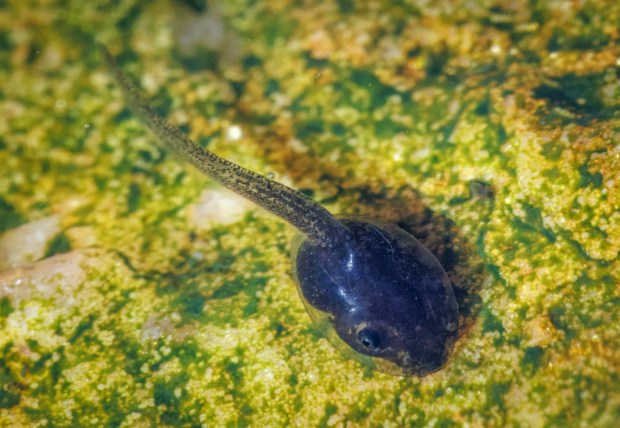 A Bajac California tree frog tadpole. (Ernie Cowan / For The San Diego Union-Tribune)
Looking closer, I discovered the pond filled with tiny, quarter-inch long tadpoles, along with several egg sacs of unborn tadpoles attached to twigs just under the pond’s surface. Each cluster can contain up to 750 eggs that will hatch in two to three weeks.
Once emerging from the egg sac, the tadpoles will begin a metamorphosis that will turn them into adult frogs in about eight to 12 weeks.
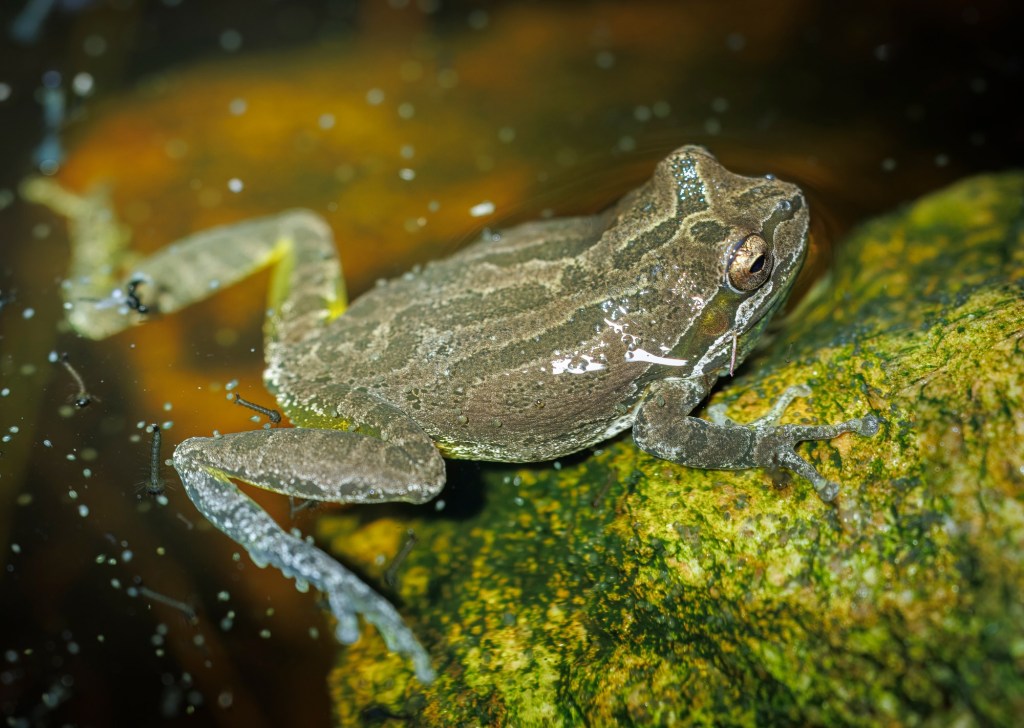
I have written before about the small, 1- to 2-inch Baja California tree frogs that we have found in our planter pots here at Mt. Hoo.
These tiny frogs have an enormous voice for their size, and the recent warm evenings have been filled with their lovely chorus.
These Southern California natives are quite common and most easily identified by a dark stripe running through each eye.
Their colors can vary from brown to green, or combinations of both, and they have the ability to change color depending on their environment.
Right here in this little Mt. Hoo pond, I discovered a life cycle unfolding and realized it would be a story my readers might enjoy.
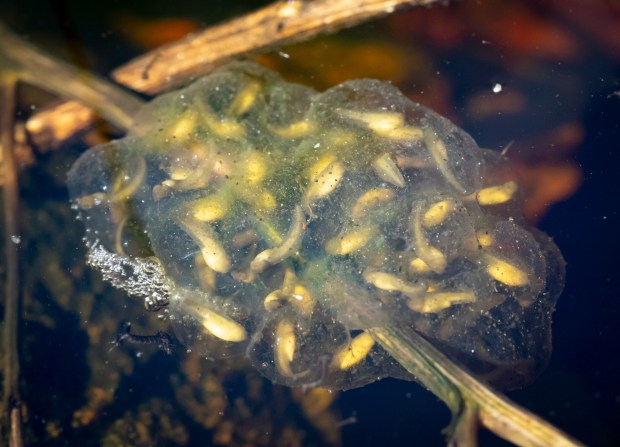 The Baja California tree frog’s egg sac filled with tiny unborn tadpoles. (Ernie Cowan / For The San Diego Union-Tribune)
That day, I sat at the pond’s edge for a while, using a macro lens to capture images of the tiny tadpoles and the eggs clustered inside of a protective, gossamer membrane.
During the day, the adult frogs remain hidden from the eagle eyes of predators, but they emerge at night to feed on flying insects.
Males also begin their chorus of throaty croaks in hopes of attracting a willing mate.
Their croaking involves pushing air over vocal cords into a thin membrane known as a vocal sac that inflates under the chin.
This process magnifies the croaking, resulting in a surprising volume of sound considering the size of the small frogs.
With hundreds of tadpoles in the pond and the dozens of adult males croaking at night, I am confident we will have beautiful nightly serenades all summer long as the males practice their language of love.
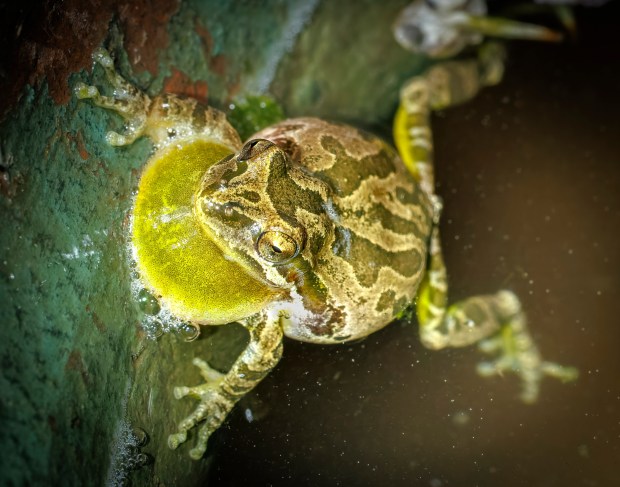 A close-up of a croaking Baja California tree frog with its vocal sac enlarged. (Ernie Cowan / For The San Diego Union-Tribune)
To complete my story, I needed to return at night for pictures of the adult Baja California tree frogs going about their nocturnal routine.
As twilight faded to darkness, I could hear the eager males begin their amorous advertising, which is the quintessential “rib-it” sound associated with frogs.
With camera, flash and flashlight in hand, it was time to blend into the darkness and enter the nocturnal world of the tree frogs.
From a distance the croaking frogs were loud and numerous, but as I approached the pond, they went silent.
I sat on the ground at the edge of the pond and there was no sound.
I don’t know where it came from but suddenly, I tightened my vocal cords and began a deep vocal growl followed by a quick gasp of expelled air that created a higher-pitched ending note.
It sounded pretty good to me, and instantly several frogs around me began croaking.
I shuffled around a bit and the croaking again stopped.
I croaked again, and the male frog melody instantly resumed.
Several males jumped into the pond, and one surfaced to see what was going on and to pose for pictures.
I continued to croak and my new amphibian friends continued to answer.
It was true: Xenoglossy exists and I was speaking fluently to frogs.
Was this just a fluke?
I needed a witness and went to get my wife to show her my newly found language ability.
Again, the frogs went silent as we approached the pond but began responding immediately after I croaked my presence.
This was amazing.
I continued frog chatting for some time, but I had to admit, it was hard on my vocal cords.
By the end of the evening, I mentioned to Kati that I was a bit hoarse with strained vocal cords.
She gave me that look and replied, “Maybe you have a frog in your throat.”
Cowan is a freelance columnist. Email ernie@packtrain.com or visit erniecowan.substack.com.