
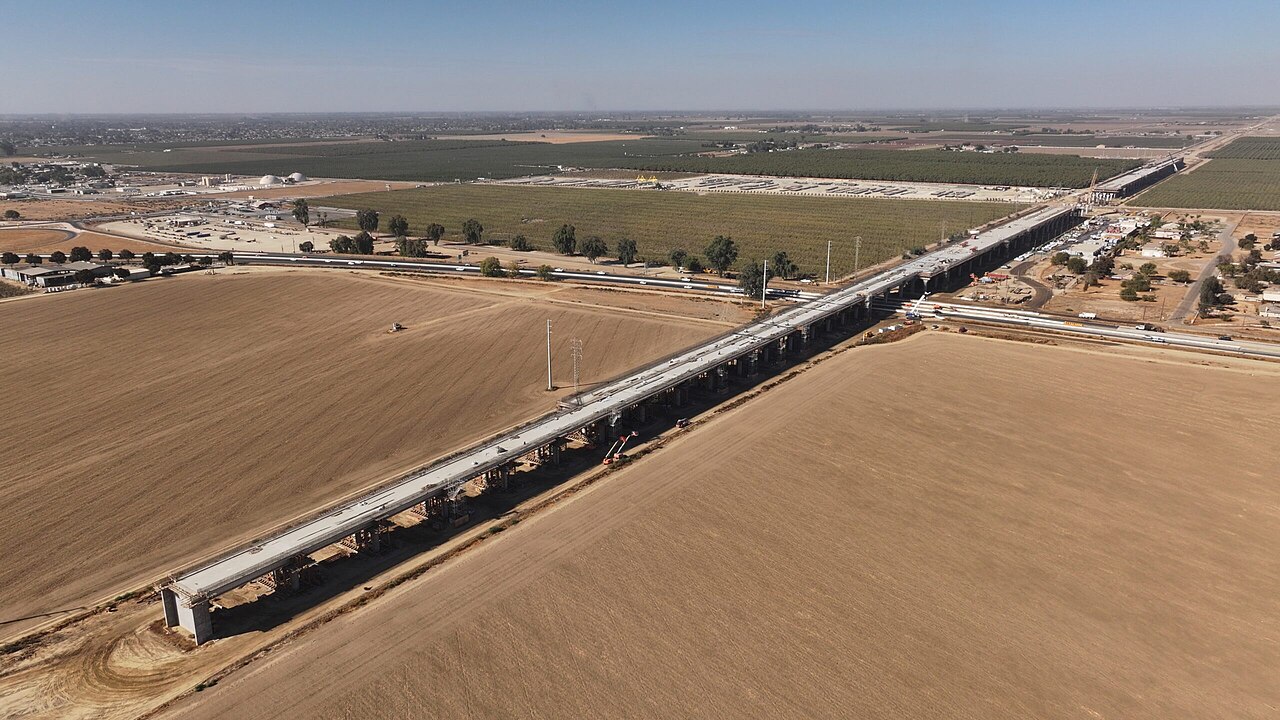
The California High-Speed Rail Authority released its 2026 Draft Business Plan on February 28, two years after the prior plan and in a radically different environment than when that last plan was written. While quite detailed, the new plan raises serious questions that the Authority has not fully answered: about costs that keep growing, about ridership projections that don’t add up, about legal requirements the plan quietly sidesteps, and about a critical segment of track between Tamien and Gilroy that the Authority has deliberately excluded from its headline cost figures and buried in a footnote. Those concerns are echoed and amplified in materials prepared for the California Assembly Transportation Committee’s March 2 oversight hearing — to which the plan was simultaneously submitted — by the Legislative Analyst’s Office and the Office of Inspector General for High-Speed Rail.
The headline numbers in the 2026 Business Plan are sobering. To complete the Merced-to-Bakersfield segment, the stretch currently under, the Authority’s cumulative spending will have to reach an estimated $34.76 billion. That figure represents a net reduction of roughly $2 billion from the 2025 Supplemental Project Update Report, a savings the Authority attributes to a “bottom-up cost review.”
The latest plan presents 2033 as the target service year while simultaneously acknowledging that the 2032 construction completion depends on “additional time for optimization and pending policy changes” — meaning the schedule is already carrying contingencies that could easily push service past 2033.
Beyond the Central Valley, the costs escalate sharply. The plan presents three buildout scenarios:
San Francisco to Bakersfield: $60.34 billion total ($25.57 billion net of the Merced-Bakersfield cost)
San Francisco to Palmdale: $96.73 billion total ($61.97 billion net)
Phase 1 — San Francisco to Los Angeles/Anaheim: $126.20 billion total ($91.43 billion net)
All figures are presented at a P65 contingency level — meaning there is a 65 percent probability that the actual cost will fall at or below the stated figure.
The Legislative Analyst’s Office, in its handout prepared for the Assembly Transportation Committee’s March 2 oversight hearing, lays out a stark funding reality. Even accepting the Authority’s own SPUR figures and the $1 billion annual Cap-and-Invest commitment, the loss of $4 billion in federal grants leaves available funding at $39 billion — against estimated costs of $37 billion plus at least $4 billion in borrowing costs, yielding a $2 billion funding gap just for the Merced-to-Bakersfield segment. And that gap assumes that all proposed statutory changes are enacted, that roughly $14 billion in assumed project savings materialize, and that the project stays on budget — a combination the LAO characterizes as uncertain, “particularly given the history of the project.” Notably, the LAO also flags that the Authority has discussed moving the Merced station roughly four miles south of downtown to save costs — a step that would potentially conflict with SB 198 (2021), which expressly requires a station in downtown Merced.
One of the more striking claims in the 2026 Business Plan appears almost as an aside in Chapter 1: “With California’s Phase 1 ridership projected to be between 23.6 and 30.6 million passengers per year, high-speed rail stations would become magnets for economic activity.” That range — 23.6 to 30.6 million annual riders — is a remarkable projection, and it deserves critical scrutiny.
The plan is explicit about one key service parameter: Phase 1 will provide “two trains per hour” in each direction. That is a relatively modest frequency for a major intercity corridor. For comparison, the Business Plan itself notes that the Madrid-Barcelona route operates roughly 90 daily trains and the Milan-Rome-Salerno corridor runs more than 160 per day — figures that work out to roughly 3–4 and 6–7 trains per hour respectively in each direction. At two trains per hour, California’s system would have roughly half or less the peak capacity of its European comparators, yet the plan appears to use European ridership performance to validate its demand projections. Capacity and frequency directly drive ridership: fewer trains per hour means fewer seats available, which means that even if consumer demand existed, the system could not fill it.
The ridership projections also need to be read alongside the plan’s travel time assumptions. The plan envisions trains traveling at up to 220 miles per hour on the dedicated central spine between Gilroy and Palmdale. But between San Francisco and Gilroy, and between Burbank and Anaheim, trains will share existing track under the “blended system” approach — running at a maximum of 110 miles per hour. The practical implication is a significantly longer trip than the system’s designers once promised.
As I noted in my August 2025 analysis of the 2025 Supplemental Project Update Report, Proposition 1A’s requirements — now embedded in California’s Streets and Highways Code at Section 2704.09 — mandate that nonstop SF-LA travel time must not exceed two hours and 40 minutes. Under the blended system, achieving that standard was already barely theoretically possible. Under the current plan, trains operating at 110 mph on the Peninsula and in the Los Angeles Basin will take materially longer to complete the journey than the law allows. At the same time, slower trains are less competitive with flying and driving, which means the system’s appeal to discretionary travelers — the segment that makes up the bulk of high-ridership forecasts for premium intercity rail — will be diminished. The plan projects 23.6 to 30.6 million Phase 1 riders while simultaneously describing a service that will be slower than originally projected and less frequent than comparable European systems. These claims are in tension with each other in ways the plan does not acknowledge.
For the Merced-Bakersfield segment alone, the plan projects annual ridership of just 1.4 to 1.9 million — and acknowledges that even with ancillary revenues (advertising, parking, etc.) estimated at $19.3 to $41 million annually, the segment will recover only 35 to 49 percent of its operating and maintenance costs. The plan estimates those costs at $155 to $175.6 million per year, against farebox revenues of $35.2 to $45.7 million. The M-B corridor, the Authority concedes, “would not generate sufficient revenue to cover its total operational expenses.”
This is the same legal problem I flagged last year. Section 2704.08 of California’s Streets and Highways Code — enacted under Proposition 1A — requires that the planned passenger service “will not require a local, state, or federal operating subsidy.” The Authority’s own projections now make clear that the initial operating segment will require exactly such a subsidy, and likely a substantial one. The plan offers no legal analysis reconciling this statutory requirement with projected operating losses on the first segment to operate.
Perhaps the most ambitious financial maneuver in the 2026 plan is the proposal to borrow against future Cap-and-Invest (greenhouse gas reduction) revenue streams to meet the 2033 service inception date. The Authority has secured a commitment of $1 billion per year in Cap-and-Invest funds through 2045 and wants to leverage that stream to issue bonds that would let it build faster.
The plan is candid that achieving this will require significant new legislative authority. The Authority is seeking “non-impairment language guaranteeing the state will not change the law in a manner that would impair any contracts entered into by the Authority secured by the GGRF revenues,” as well as “financing provisions in the Authority’s enabling statute to facilitate implementation of bonds and other obligations and indebtedness.”
The Legislative Analyst’s Office is skeptical. Its March 2 hearing materials identify the Greenhouse Gas Reduction Fund as “poorly suited for conventional borrowing” for two specific reasons. First, the California Air Resources Board can adopt changes to the cap-and-invest program structure that could reduce revenues significantly — the LAO notes that some changes currently under consideration could “reduce GGRF revenues markedly.” Second, cap-and-invest auction revenues have historically been volatile, including periods during the COVID-19 pandemic and before the program’s recent reauthorization when auctions were undersubscribed and revenues were very low. Both factors undermine the payment certainty that bondholders would require. If the state wanted to guarantee that certainty — through non-impairment language or other mechanisms — it would be constraining its own future flexibility to reform the cap-and-invest program.
Buried in the plan’s footnotes is an acknowledgment that the cost estimates for the San Francisco-to-Bakersfield buildout scenario exclude the segment between San Jose and Gilroy. A footnote assigns a placeholder cost range of $2 billion to $5 billion for that segment. The spread — a factor of 2.5x between the low and high estimate — is a clue that the Authority does not have a firm grasp on what it would actually cost to build this section. Notably, the LAO’s oversight hearing materials cite the corresponding figure from the 2025 SPUR at $3 billion to $6 billion — suggesting the 2026 plan’s lower range may itself be optimistic. And the real-world challenges of that corridor suggest the high end of either range is the more realistic figure.
The approximately 30-mile segment from Tamien station (in South San Jose) to Gilroy is currently operated by Caltrain using diesel trains, with service running only four times per day in each direction. Crucially, this portion of the corridor is not owned by Caltrain or the state — it is owned by Union Pacific Railroad, which operates freight service on the line and holds preference rights for its trains. High-speed rail trains operating on Union Pacific trackage must work around the freight railroad’s schedule and can be subordinated to freight operations, which is antithetical to the reliable, frequent service high-speed rail requires.
The track itself is currently single-tracked south of Tamien, meaning trains in both directions must share a single set of rails. The segment is also un-electrified — the Caltrain electrification completed in 2024 at a cost of $2.4 billion covers only the 51 miles from San Francisco to Tamien. High-speed rail trains cannot operate under diesel power.
To bring high-speed rail through this segment, the Authority would need to: acquire or reach agreement with Union Pacific for access rights and likely for the right-of-way itself; electrify the entire 30-mile segment; double-track the single-track sections (to meet federal requirements for 110mph operation); improve roughly 20 grade crossings; and possibly rebuild or significantly upgrade the track geometry to support higher operating speeds.
The 2026 Business Plan’s decision to exclude this segment from the headline cost figures for the San Francisco-Bakersfield scenario is, at best, an accounting convenience and, at worst, a significant misrepresentation of what it will actually cost to run trains from the Bay Area into the Central Valley. Readers of the plan should add at least $5–6 billion — and possibly considerably more — to the published San Francisco-Bakersfield cost figure to arrive at a more complete picture.
The timing of CEO Ian Choudri’s leave of absence could hardly be worse for the project. Choudri was arrested on February 4, 2026 on suspicion of misdemeanor domestic battery in Folsom; the Sacramento County District Attorney’s Office subsequently declined to file charges. Nonetheless, Choudri agreed to take leave on February 18 to allow the Authority’s board and the California State Transportation Agency to review the situation — just ten days before the Draft 2026 Business Plan was released.
The plan was simultaneously submitted to four legislative committees — Senate Transportation, Assembly Transportation, Senate Budget, and Assembly Budget — and on March 2, just two days after the plan’s release, the California Assembly Transportation Committee is holding an oversight hearing on the high-speed rail project, taking testimony from the Legislative Analyst’s Office and the Office of Inspector General and examining the Authority’s funding plan, procurement record, and path forward. Choudri is unavailable to appear.
Whatever the ultimate resolution of the personal matter that prompted his leave, Choudri’s absence from that hearing — and from the broader legislative dialogue that will determine whether the Authority receives the additional policy authorities and financing tools the 2026 plan depends upon — is a significant institutional liability at exactly the moment the project most needs an articulate champion in Sacramento. As I noted in the crossroads piece I published ahead of this plan’s release, Choudri had brought a clarity of purpose that the Authority had lacked. Now that asset is unavailable.
In my prior analysis of the 2025 Supplemental Project Update Report and in the crossroads piece I published ahead of this plan’s release, I argued that the Authority’s fundamental challenge is not strategic or managerial but legal. The project as currently conceived cannot meet the statutory requirements that California voters embedded in the Streets and Highways Code when they approved Proposition 1A. The travel time requirement and the no-operating-subsidy mandate are not bureaucratic technicalities — they are the terms on which voters approved the bonds.
The 2026 Business Plan does not resolve this tension. It projects a segment that will require an operating subsidy. It proposes to deliver a Phase 1 system that will not achieve the mandated travel time. It seeks bond financing authority that does not currently exist in law. It buries the cost of the most legally and operationally complex segment in the entire northern reach of the project — the Tamien-to-Gilroy segment, on freight-railroad-owned, single-tracked, non-electrified right-of-way — in a footnote.
The Authority has made genuine progress in the Central Valley, and CEO Choudri brought commendable realism to the plan’s structure and tone. The $34.76 billion Merced-Bakersfield estimate, while large, is at least grounded in actual construction activity and bottom-up cost review.
But none of that changes the arithmetic. The project cannot complete Phase 1 within anything resembling the original budget, on anything resembling the original timeline, or within the legal constraints that voters imposed. If the Authority wants a genuinely honest path forward — and if the public is to make an informed decision about whether to continue — the right move remains what I recommended last year: return to the ballot, disclose the real costs and constraints, and ask voters whether they want to continue on updated terms.
Marc Joffe is a Visiting Fellow at California Policy Center and President of the Contra Costa Taxpayers Association.