
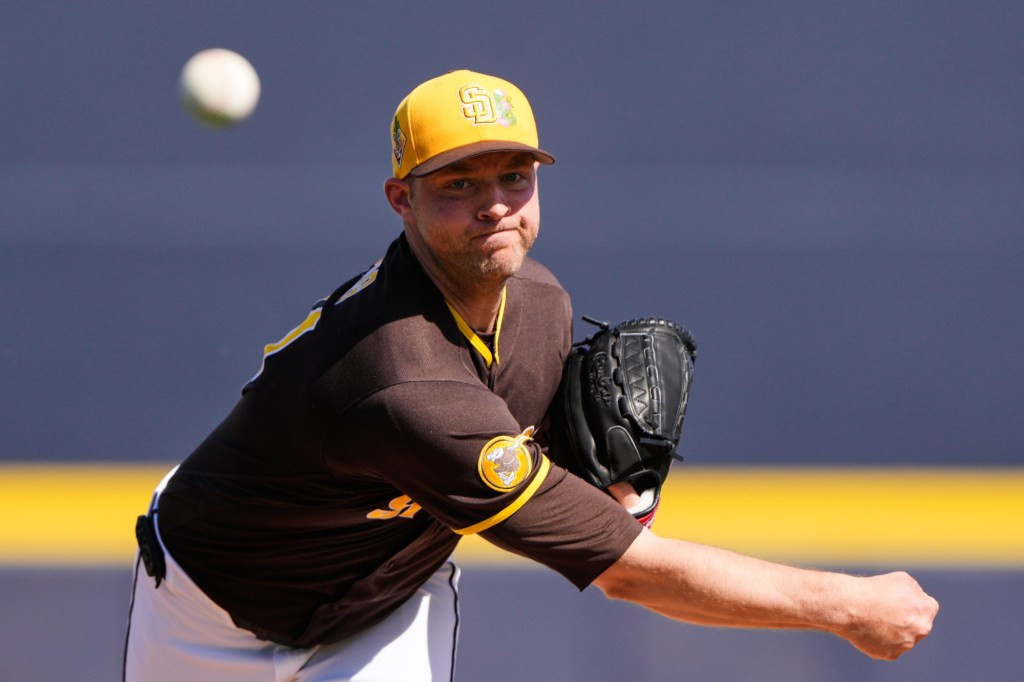
PEORIA, Ariz. — In the dugout one afternoon last week, Padres physical therapist Scott Hacker found himself watching Michael King’s first Cactus League appearance with a level of concern.
Is he babying his knee? Is he babying his serratus?
Hacker quickly caught himself.
King is fully healthy. He had a fantastic offseason. There is no reason for apprehension.
But such is the residual effect from months spent consulting shoulder specialists and helping King come back from an unprecedented injury and then having that comeback interrupted by a bone bruise in the pitcher’s left knee.
When Hacker told King after the game what had been going through his mind, King understood.
It was quite an ordeal in 2025.
First, in late May, inflammation in the long thoracic nerve near his right (throwing) shoulder caused King to be shut down. Over the next few weeks, he and Hacker visited a specialist, sat together for video calls with two others and consulted with two doctors in San Diego to get assessments and seek treatment plans. Their diligence was due to the fact there was no record of an MLB pitcher having been through the same issue.
While the initial explanation from the Padres was that King slept wrong, doctors told him the nerve got stretched too much over time and essentially shut off for a while.
When it turned back on, King got to work a little bit too hard, too quickly and developed a bone bruise in his knee.
“My whole thing was, I didn’t have a soft tissue injury, I had a nerve injury,” he recalled. “So as soon as I got function back, I’m going to push it as fast as I possibly can. I remember talking to the training staff and doctors, and they put together a timeline that was much later than I wanted to. And so it was my own fault to be competitive and wanting to get back as fast as possible.”
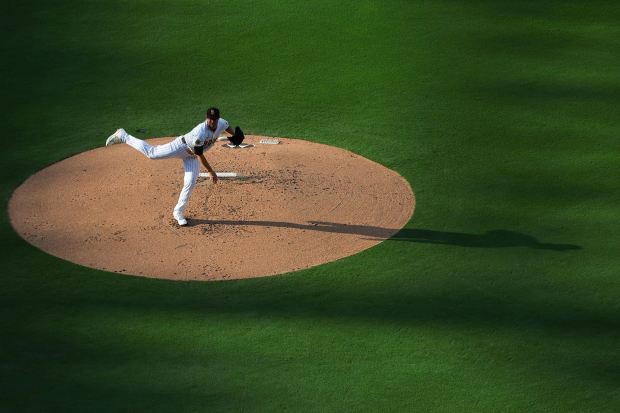 Michael King #34 of the San Diego Padres pitches against the Boston Red Sox during the second inning at Petco Park on Saturday, Aug. 9, 2025 in San Diego, CA. (Meg McLaughlin / The San Diego Union-Tribune)
King returned on Aug. 9. King’s next bullpen session left his left knee swollen, and he went back on the injured list.
Had it been early in the season, that injury would have sidelined him for six weeks or more. Being where the season was, King got a cortisone injection and returned to make four starts in September. He limped to the finish, limited to one inning in relief in Game 3 of the National League Wild Card Series.
So King knows what it is for worry to become habitual.
“As a pitcher, you come back, especially in the middle of the season with an injury, you’re thinking, ‘Did my knee hurt on that one?’ ‘Oh, did my arm slot lower because of my serratus on that one?’ ‘Oh, my knee did hurt on that one. Is it gonna hurt on this next one?’” he said. “And then all of a sudden, you look up and you’re like, ‘I’ve got bases loaded right now, and I haven’t paid attention to competing against the other team that I’m facing.’ And it got to a point where I definitely was competing against myself and my health instead of the other team. And that’s where I feel like it’s so nice to come into spring training healthy and just compete instead of worrying.”
King’s assessment following a rough outing Monday — four runs on five hits and two walks in 2⅓ innings in his second Cactus League appearance — sounded very much like any pitcher who has a shaky spring training start.
“It mechanically just felt off,” King said. “Backed off the gas a little bit to try to figure it out. … I felt too fast in my lower body and slow with my upper body. So then I tried to flip them, and then it felt too slow with my upper body. It was just out of sync. Spring training is a learning experience, so I just gotta make sure I’m ready in three weeks.”
For as traumatic and disappointing as 2025 was, there is virtually no lingering concern about King’s health.
The bone bruise was healed about four weeks after he threw that scoreless inning in the postseason. And the Padres say their research shows that the nerve issue is not one that recurs. King’s focus was on strengthening the serratus, a muscle attached to the shoulder that is controlled by the long thoracic nerve.
“It was a fully healthy offseason, a normal offseason coming in,” King said. “… As soon as I got healthy, come like November 2, when I first started throwing, it was all systems go. Had zero setbacks. So I came into this camp really confident that I’m back to my normal self.”
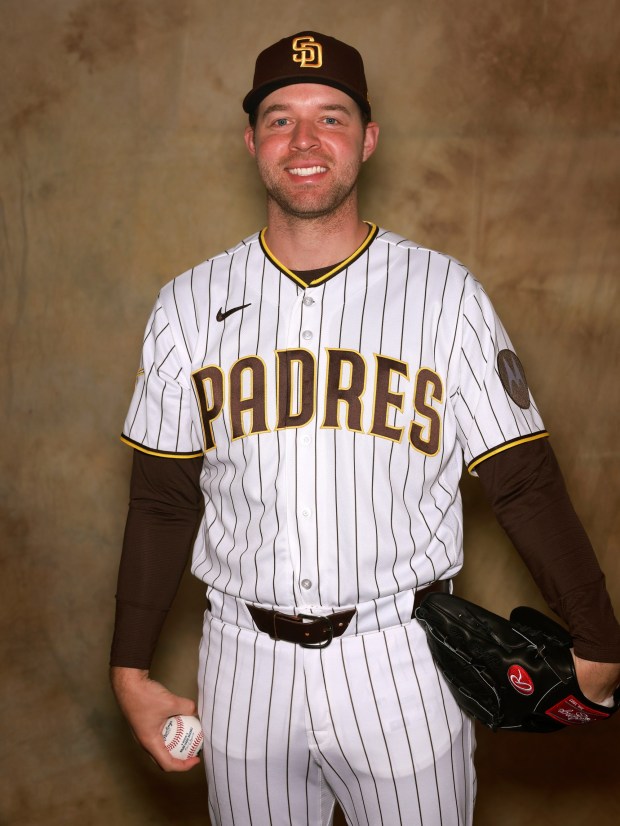 Peoria, AZ – February 18: Michael King #34 of the San Diego Padres poses for a portrait on February 18, 2026 in Peoria, Arizona. (K.C. Alfred / The San Diego Union-Tribune)
It seems the King the Padres need is evidently the one they have again.
They believe so much in what they saw in 2024 after acquiring him as the lynchpin in the Juan Soto trade with the Yankees — not to mention in the ethic that kept King seeking solutions and trying to get back as soon as possible in ‘25 — that they gave him a three-year contract that guarantees him $75 million if he does not opt out after either of the final two seasons.
If Nick Pivetta can come close to repeating his 2025 season (2.87 ERA over 181⅔ innings) and Joe Musgrove can come close to being the pitcher he was from 2021 to ‘24 (3.20 ERA, 97 starts) in his return from Tommy John and King can come close to matching the 2.95 ERA he posted over 173⅔ innings in his first season as a starter in 2024, they could well comprise one of the better trios atop any rotation.
The only question regarding King that nags after last season is how much he can pitch in 2026.
He worked just 72 innings over his 15 starts in 2025.
It isn’t a question for him. King told manager Craig Stammen the other day that his goal is 200 innings.
“I’m not coming off of Tommy John, where I had no innings,” King said. “But you look at guys that miss a full year (or) year-and-a-half because of Tommy John and they come back and still can go 180-plus. … I don’t think it’s a challenge. It’s more so of just go out there every fifth day.”
His making a big jump in innings has precedent. After pitching mostly as a reliever with the Yankees in his first five seasons in the majors, he went from 104⅔ innings in 2023 to 173⅔ in 2024.
Besides his pitching repertoire, perhaps the biggest thing that had the Padres insisting on King being part of the Soto trade and then deciding to bring him back this offseason was that he has shown he has the will to find a way.
King was excellent at the start of last season and simply battled through the end of it.
His 2.59 ERA through his first 10 starts was tied for sixth best in the National League. His ERA in his final five starts was 6.11 over just 17⅔ innings, the product of rust and being unable to fully “get over” his left (landing) knee during his delivery.
“I fully changed my mechanics in September just to, like, be in the zone and be able to work,” King said. “… I tried to figure it out, and I was trying to get it. It made most of my pitches worse. But if I could command it and have some conviction, I could get some outs.”
That is a word pitchers use a lot: conviction.
For all the movement King possesses on his sinker and sweeper and the confounding nature of his changeup, he is, like many pitchers, a big-time believer in conviction as a weapon. And he was missing that last season because of the almost ever present doubt.
“You can see when a pitcher is doubting himself, hitters just jump all over that,” King said. “When I’m not convicting at the plate, as a hitter, you’re like, ‘All right. … I always say confidence overtakes ability in a lot of aspects. You can see guys with bad stuff that aren’t throwing great velo that are missing location, but they’re ripping those by these guys, because they’re saying, ‘I’m better than you.’ And it still works. And the confidence aspect is something that I started to lose in that September, October, because I was never thinking, like, ‘I’m better than this hitter.’ I was thinking, like, ‘Please don’t have my knee zing right now.’ And it was hard.”