
What’s at stake:
A new exhibit at Arte Américas features Dr. Lizbeth De La Cruz Santana, a migration scholar turned muralist, highlighting four collaborative mural projects she created alongside undocumented people and their communities.
Dr. Lizbeth De La Cruz Santana began as a migration scholar and educator, using research and digital storytelling to challenge dominant narratives about belonging. She didn’t set out to become an artist, but muralism grew naturally from her community-based work and became an extension of her scholarship.
At the U.S.-Mexico border, she has led collaborative mural projects that merge art, storytelling and activism, while portraying childhood arrivals, deported veterans, DACA recipients and multigenerational families impacted by undocumented status and deportation.
Her new exhibition, “Humanizar Historias,” opened Feb. 26 at Arte Américas. The show explores four mural projects, the stories behind them, and the community-based methods that shaped their creation.
Through behind-the-scenes photographs, process documentation, firsthand testimonies, and interactive elements, the exhibition traces how the murals became a response to the instability of immigrant life in the U.S.
De La Cruz Santana described growing hostility towards undocumented people and communities of color, including U.S. citizens, raising questions about who is allowed to remain within the country’s borders.
Amid escalating anti-immigrant rhetoric, the exhibition confronts viewers with the human toll of deportation, laying bare the emotional and political realities of exile in a system that renders people disposable.
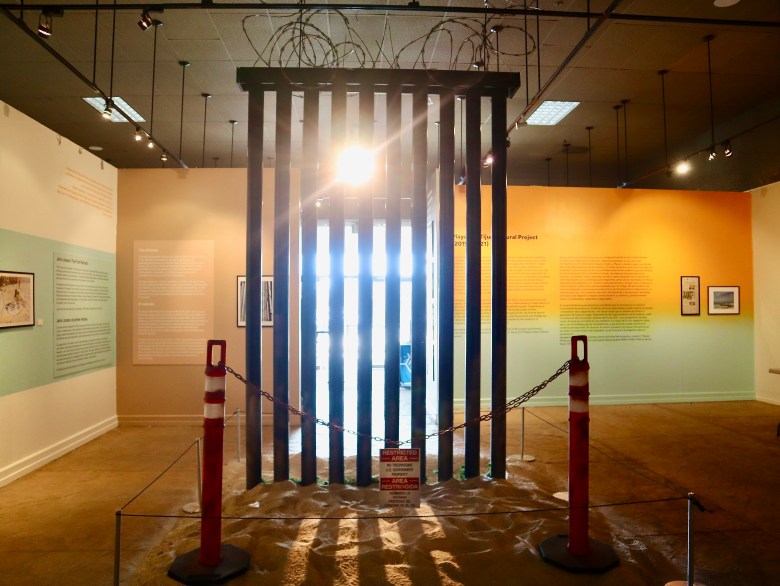 The back of the reproduction of Jairo Lozano’s, representing the U.S. side, with a restricted area warning sign. Gisselle Medina | Fresnoland
“I never said or questioned the fact that I would do this work, because I think it’s my duty to do so, I’ve been granted this opportunity,” De La Cruz Santana said. “People trust me to tell their stories through different mediums and genres like storytelling, portraits, but then to also use my positionality, as a U.S. citizen and an academic. This is the heart of my work, my research and my community engagement.”
She said she began this work in 2016, during President Donald Trump’s first administration, and is now presenting the exhibit at the height of his second term, a political moment that has pushed her to lean even further into the work.
Through the exhibit, she intentionally thought about how it offers a counternarrative that centers immigrant voices and refuses their erasure.
She said she worked with Arte Américas to thoughtfully consider who was represented and why, while putting safety measures in place to ensure the exhibit is a space where immigrant communities feel protected and visitors can challenge their own assumptions.
On view through the end of June, it calls for participation, not passive observation, urging visitors to ask: How does this affect my community? And what role will I choose to play?
The first mural project’s inception
Born in Torrance in 1991 and raised between Compton and Jalisco, Mexico, De La Cruz Santana grew up as a child of immigrants. She then moved to Fresno at 15, attending Hoover high school and later Fresno State, where she earned a master’s degree in Spanish Latin American Literatures and Cultures. She went on to complete a Ph.D. in the same field at UC Davis.
She joined UC Davis’ Humanizing Deportation Project in August 2016, helping build what is now the world’s largest qualitative archive of migrant deportation experiences — a bilingual collection of more than 500 audiovisual testimonials created by over 400 community storytellers.
That work led her to field research at Playas de Tijuana three months later, where the border wall meets the Pacific Ocean. These experiences culminated in her doctoral dissertation and later in her most recognized work, the Playas de Tijuana Mural Project (2019-2021), a fellowship initiative that began at the westernmost point of the U.S.-Mexico border.
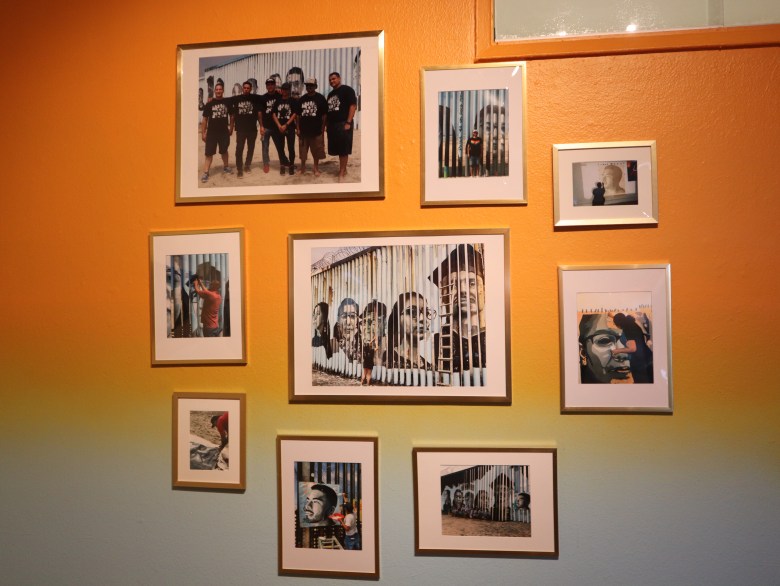 Photographs of Playas de Tijuana Mural Project (2019-2021), a fellowship initiative that began at the westernmost point of the U.S.-Mexico border. Gisselle Medina | Fresnoland
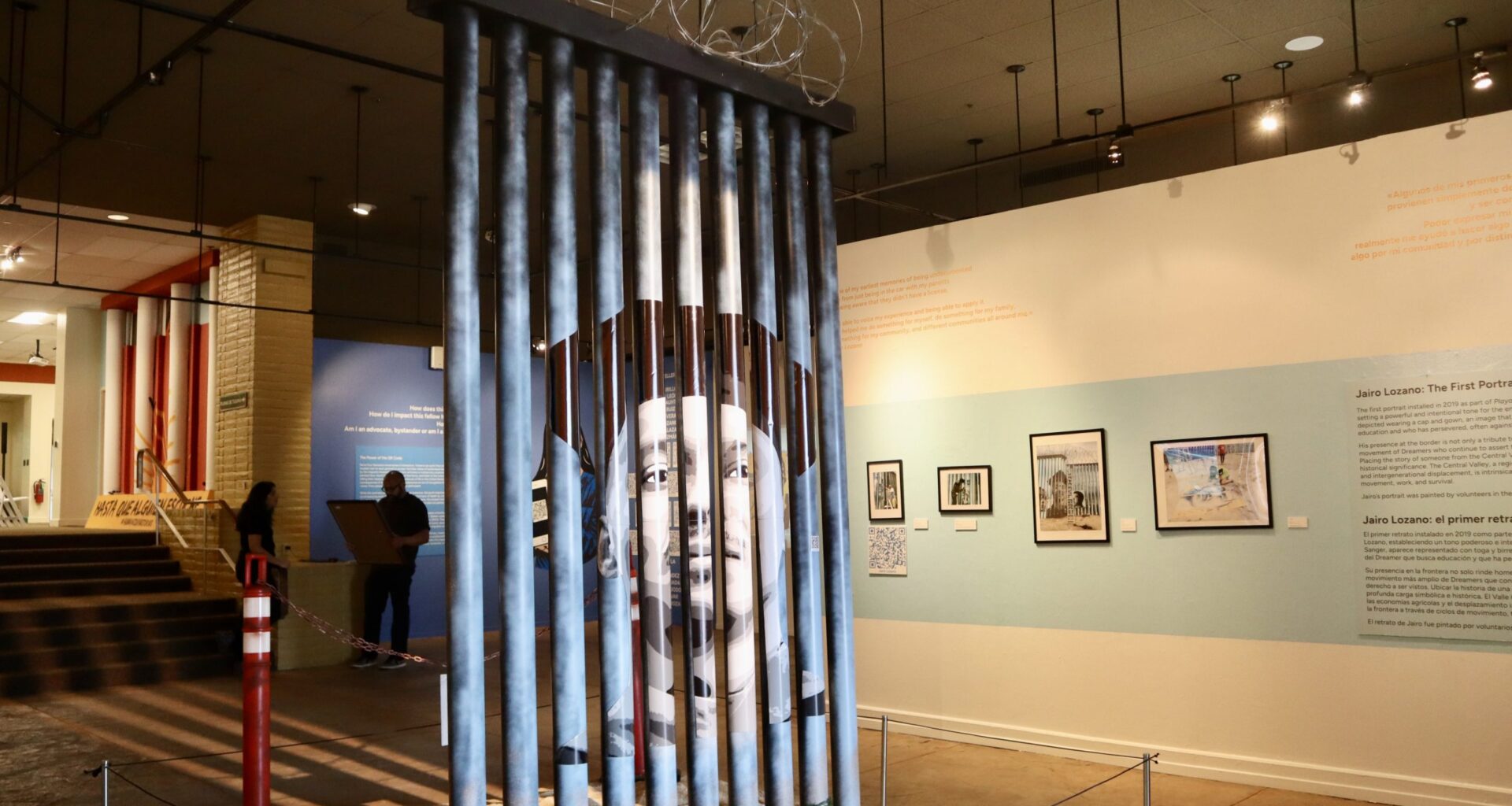
The project features 15 large, gray scale portraits made out of cloth, painted in an improvised art studio and migrant shelter. They were then installed on the rusted vertical steel columns that make up the border fence, alongside more than 300 QR codes linking to digital testimonies from childhood arrivals, including DACA recipients who were later detained or deported.
The exhibition traces the timelines of De La Cruz Santana’s research and mural projects, featuring photos of the border before the murals as “a potential site for public testimony,” but more broadly as an archive of stories that continues to grow.
She also wanted to reveal how her academic mind engaged with these projects. To do this, the exhibit includes a yellow desk scattered with research books, mural notebooks, her laptop, and a water bottle, alongside photographs of those collaborating on the murals. On either side of the desk, bookshelves hold additional books and binders filled with research papers, emphasizing the depth and process behind her work.
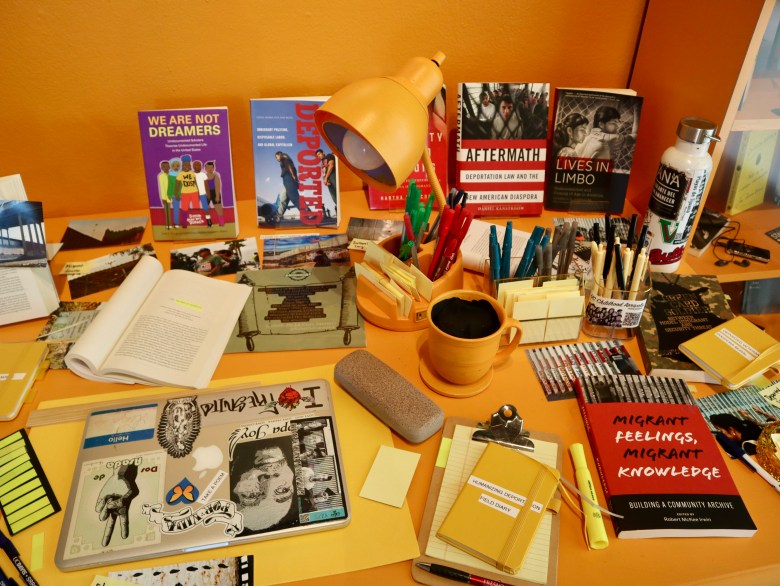 A recreation of De La Cruz Santana’s desk, packed with her personal books, notebooks, and other supplies used to study and facilitate her mural projects. Gisselle Medina | Fresnoland
“Her bibliography of research is a testament to the years of immigration policy and systems that have failed swaths of communities,” said Arianna Paz Chávez, executive director of Arte Américas. “It’s not about this one moment. The border is never the same. It can take many shapes, as high as 30 feet. But these stories show that relationships exist on both sides of the wall.”
The exhibition also highlights Jairo Lozano as the first portrait installed in 2019. He grew up in Sanger, depicted wearing a cap and gown, an image that deliberately alludes to the Dreamer who seeks education and who has persevered, often against immense odds. His portrait was painted by volunteers in the historic Casa del Tunel in Tijuana.
“It’s literally saying this is what someone from the Central Valley could do if we nurture our students,” De La Cruz Santana said. “It’s just seeing the value that we all have to contribute and empower our youth, especially with the recent walkouts. Instead of criminalizing and punishing them, let’s sit at the table with them and see how we can get to the same space or come together to do something to benefit everyone.”
De La Cruz Santana and lead artist Mauro Carrera provided tools and guidance that enabled participants (storytellers, students, volunteers, and community members) to work as artists themselves.
“We want to make sure that even people who may be documented that cannot go to Mexico, or people who are deported but far away, but still want to tell a story, that they have someone representing them and helping draw, paint their portrait and then installing it,” De La Cruz Santana said.
In the process of teaching others, De La Cruz Santana herself became a muralist, learning the craft alongside those she mentored.
The other murals on display
De La Cruz Santana’s exhibit fills the entire Arte Américas’ exhibit space, with some sections reflecting one of her four mural project’s locations and signs for viewers to experience Playas De Tijuana and Ciudad Juárez.
In the Deported Veterans Diaspora Mural Project (2024), she collaborated with James Smith, co-founder of Black Deported Veterans of America, to highlight the stories of non-citizen veterans who served in the U.S. military but were later deported.
In the exhibit, photographs of deported U.S. Navy veterans are displayed around the section. In one area, red, white and blue papel picado hangs upside down to depict a distressed American flag with “SOS” inscribed.
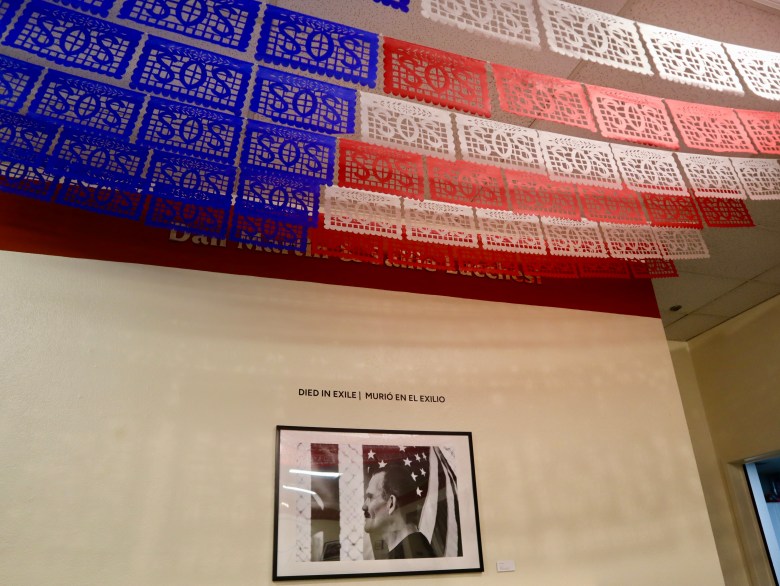 A photo of Alex Gomez, who died in exile, hangs in the Deported Veterans Diaspora Mural Project section. Gisselle Medina | Fresnoland
Below is a photo of Alex Gomez with a label that reads: Murió en el Exilio or Died in Exile.
There’s also interactive elements spread across sections. One is called ‘Hasta Que Alguien Eschuche’ or ‘Until Someone Listens’ that invites viewers to write on sticky notes with their own stories.
Mural participants also created portraits of family members across generations affected by undocumented status and deportation, underscoring how contemporary immigration policies impact not just individuals, but their families and communities as a whole.
“We have a specific generation that has grown up in this country, has decided to resist being deported, and while waiting for something to happen, are living their life and changing the narrative by saying undocumented people are literally contributing to this community,” De La Cruz Santana said.
She wanted people to see how both coasts are connected through these murals and for viewers to begin to break down what a border is, and at the end of the day, see the humanity behind it.
In Fresno, a mural is installed at Rubio Ranchwear on the corner of Fulton and Belmont. But De La Cruz Santana said securing a location was difficult, as many local businesses hesitated to publicly highlight undocumented people amid concerns about how it would be perceived under the new administration.
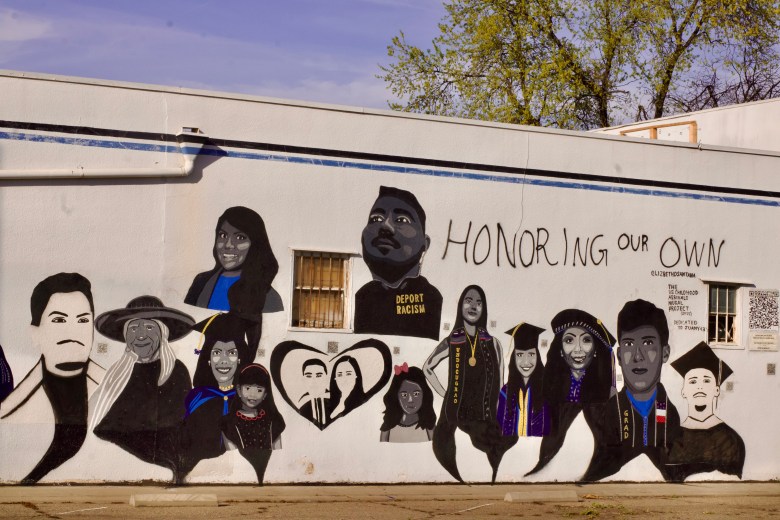 In Fresno, a mural part of the Bicoastal U.S. Childhood Arrivals Mural Project located at Rubio Ranchwear on the corner of Fulton and Belmont. Gisselle Medina | Fresnoland
“This moment is so crucial, saying through these stories and mural that we’re also supporting the rebirth of a place in Fresno which has most likely been forgotten and abandoned,” De La Cruz Santana said. “Let’s bring it back to life and give it another shot at being a community in a space where people go and play music or buy Chicano clothing.”
Creating the murals and bringing the project to your community
The exhibition traces the creation of De La Cruz Santana’s murals, drawn on parachute cloth, color-coded for accessibility, and installed on the Mexican side of the U.S.-Mexico border fence. Left to erode for more than 10 years, the murals symbolically reflect the “ten-year bar” under U.S. immigration law, highlighting the ongoing struggles of displaced and undocumented people.
The murals have also been incorporated into K–12, college, and law school curricula across the country.
De La Cruz Santana, now an assistant professor of Chicano Studies at Baruch College, shares her expertise in the exhibition, offering visitors a step-by-step guide to bringing the mural project into their own communities.
One gallery room walks visitors through the process: story collection, photography, collaborative painting, and QR code integration while offering materials to make protest signs and explore the tools used in the murals.
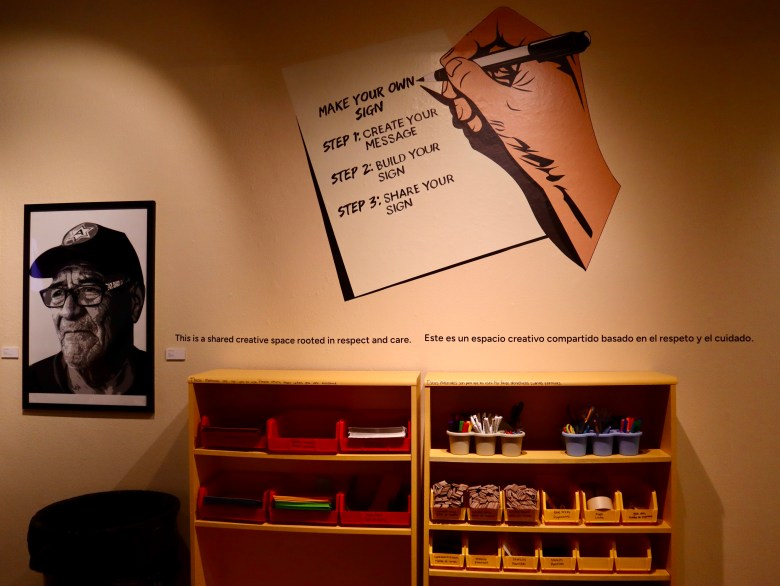 The art studio section of De La Cruz Santana’s exhibit where viewers are invited to create their own protest signs. Gisselle Medina | Fresnoland
“Art making is a possibility, a way of communicating, that we should all be able to access,” Lorena Marrón, director of education and public programs at Arte Américas, said. “This demystifies what it means to be an artist.”
Chávez and Marrón said Arte Américas seeks to foster dialogue about the violence, arrests, and detentions affecting immigrant communities.
They encourage visitors to spend time with the interactive exhibit, with a gallery room offering a quiet space to reflect on the weight of sharing others’ stories. Inspired by veterans and community members honoring those affected by deportation, visitors can sit, observe the painted border, listen to waves, and consider the human impact of immigration policies.
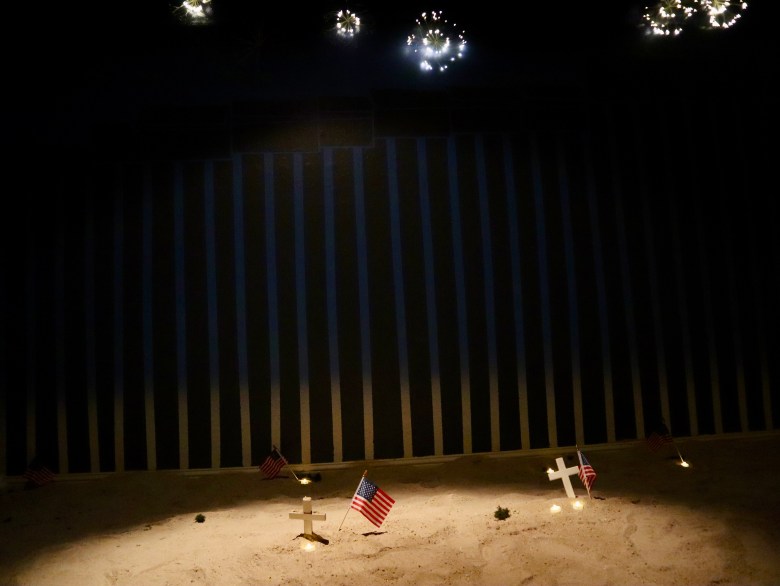 A gallery room offers a quiet space in honor of veterans affected by deportation. Gisselle Medina | Fresnoland
“I think about the role Arte Américas has in our community—continuing to cultivate art while bringing an edginess to the work,” De La Cruz Santana said. “This mixture of activists and academics shows another way for our youth and community to pursue education. Education is another form of protest.”
Related