
Why this matters
How to fix San Diego’s housing shortage is a problem that has dogged city leaders for years.
San Diego voters will get to decide whether property owners should pay thousands of dollars a year for intentionally keeping homes vacant and off the market.
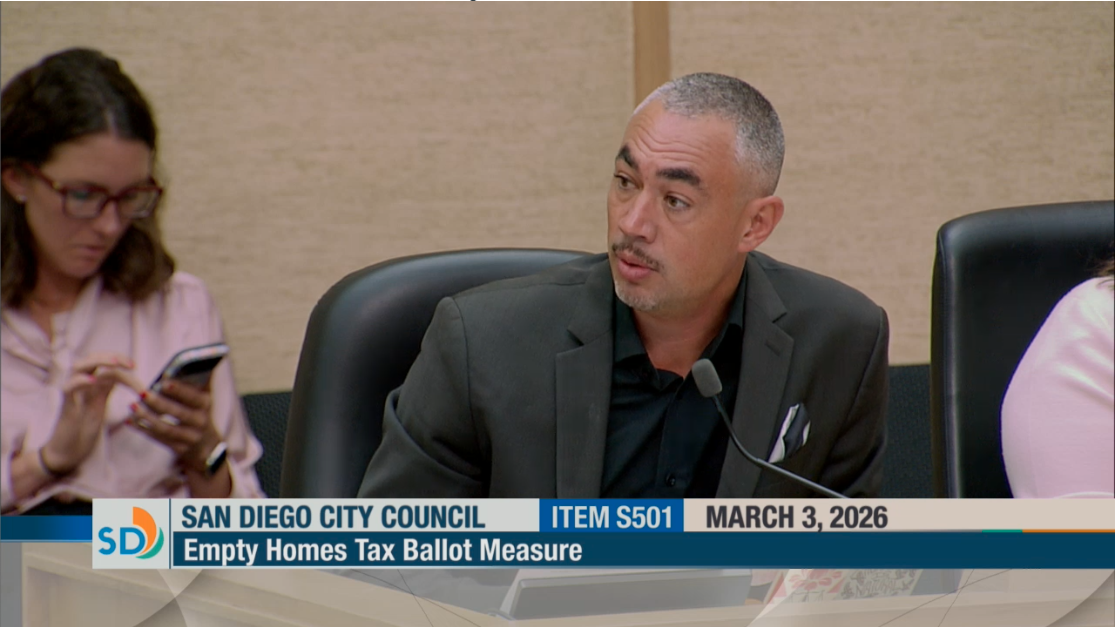
After about two hours of back-and-forth public debate on Tuesday, the San Diego City Council voted 8-1 to start working out the details of a proposed “empty homes tax” to be placed on the June 2 ballot. Councilmember Raul Campillo voted no.
Councilmember Sean Elo-Rivera, who led the charge on this proposal after a failed first attempt in January, said homes should not be left vacant during a housing crisis.
“We cannot predict exactly how many homes will return to the long-term market if this measure passes, but we do know this, incentives will change and homes will come back into use,” Elo-Rivera said. “Every time we add a home (to the market), we relieve pressure in a market that has become a pressure cooker for everyday people.”
Tuesday’s vote represents nearly a year of “working in close partnership with the city attorney’s office and the treasurer’s office to build a strong and legally defensible ballot measure,” said Maya Rosas, who works as deputy chief of staff for Elo-Rivera.
City officials have until March 10 to submit ballot language to the Registrar of Voters.
That tight deadline is part of the reason why Councilmember Campillo voted no. He said he asked the City Attorney’s Office for one thing to help make his decision and it was a robust legal memo analyzing the proposal’s ability to withstand a lawsuit. He said he never got it.
“When we have tight timelines, as we do today with less than one week between committee and council, we should rely on the analysis, not just the conclusion, to make responsible decisions,” Campillo said. “I’m hesitant to vote for this today because I have not received the information I need to be confident in that decision, and confidence in our decisions is something the public truly lacks these days.”
The tax proposal would apply only to vacant homes that are not claimed as a primary residence, and it calls for an $8,000 tax for the first year beginning in 2027 and $10,000 every following year. Corporate-owned empty homes would have to pay a $4,000 surcharge the first year and $5,000 every following year. The tax and surcharge would be adjusted based on inflation beginning in 2029.
If approved by voters in June, the first empty home tax bill would be sent to property owners in January 2028.
The city’s independent budget analyst is now projecting the proposal could generate between $9 million and $21 million in the first year, and in the following year, between $10 million and $24 million — a slight decrease from what was projected in a committee meeting last week. It all depends on how property owners respond. There are more than 5,100 homes that would qualify for the tax — about 40 are corporate owned.
The proposed tax would generate money for the general fund and likely increase the number of homes available for long-term rental over time, according to the IBA. At the same time, that money would likely decline over time if the measure is effective in reducing vacancy — one of the stated goals of the measure.
The proposal carves out exclusions and exemptions for property owners who can prove certain circumstances were present. They include situations in which the owner is in long-term care or dies, disaster periods where the home is uninhabitable, a family member is in the home, financial hardship for legacy owners, and qualifying military service. Also, owners can receive an exemption if they live on the property or have a lease.
This proposal is similar to the one Elo-Rivera introduced late last year, which called for a tax on both vacant homes and full-time vacation rentals. That proposal was torpedoed in January after hours of heated public debate — fueled at least in part by paid protesters from Los Angeles who were bused into town to oppose the measure.
More than 50 people filed into City Hall to support or oppose the proposed ballot initiative on Tuesday.
Some criticized the proposal as a “money grab tax” that tramples the constitutional rights of property owners. Others pleaded with council members to stand up for renters, adding that voters deserve an opportunity to weigh in.
Councilmember Marni von Wilpert said she appreciated that the proposal narrowly targets homes that are intentionally left vacant.
“I’ve heard from too many local San Diego families who are struggling to find housing that they can afford and it’s reasonable to ask whether a vacant second home should be part of that conversation,” she said. “I believe that letting the voter decide how we address our housing challenges is appropriate and right.”
Type of Content
News: Based on facts, either observed and verified directly by the reporter, or reported and verified from knowledgeable sources.