
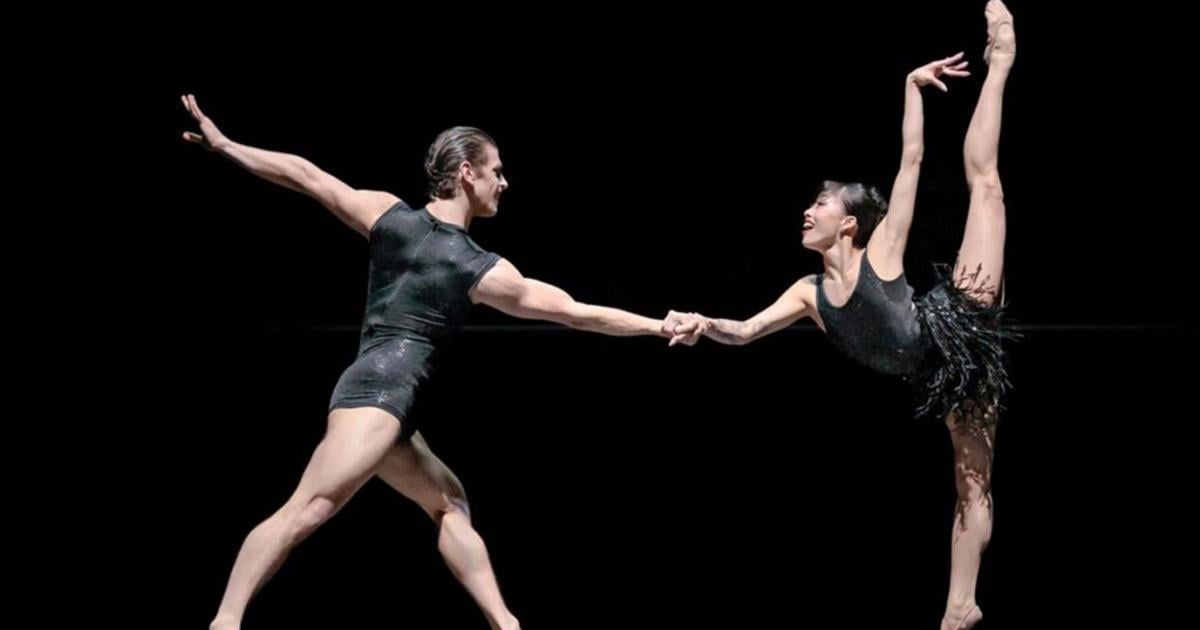
On Feb. 27, San Francisco Ballet brought an electric spontaneity to the War Memorial Opera House with their opening of acclaimed choreographer William Forsythe’s “The Blake Works.” The ballet is a three-part series displaying Forsythe’s “Prologue,” “The Barre Project” and “Blake Works I.” Set to the music of Grammy Award-winning composer James Blake, this work brings forth a tone scarcely seen in such a setting. Blake’s music is atmospheric, crafting a distant, emotive and often unsettling feeling through electronic beats, textured sound bites and gentle vocals. It sets the stage for an exciting immersion into a world of modernity.
Forsythe’s choreographic style is unlike anyone else’s. Geometric movement, sharp precision and profound exaggeration of the well-known Balanchine style highlight both the dancers’ physicality and their technical prowess.
The ballet opens with the premiere of “Prologue,” which is an immersive group piece that is just as much about space and silence as it is about the music and movement. The black backdrop stage is flooded with a deep blue lighting, revealing dancers clad in simple leotards that emphasize their lines and limbs. While the track “Lindisfarne I” brings a reverberating, warbling sound, it’s the moments of silence that stand out the most — when the breaths of the dancers are audible to the audience.
A simple short film breaks the “Prologue” from “The Barre Project,” spotlighting the all-important yet wholly overlooked act of hands overlapping on the barre. It is a dance in itself, bringing to light how a detail as seemingly insignificant as placing a hand on the barre is just as important to ballet as every other component.
This break is followed by “The Barre Project,” which incorporates the most foundational instrument in ballet that goes invisible to an audience. Forsythe’s choreography incorporates the ballet barre in innovative ways. It is nothing like barre — repetitive, often slow and arduous, focused on repetition and perfecting technique. The three pieces, “Buzzard & Kestrel,” “Lullaby for My Insomniac” and “200 Press,” deconstruct classical technique and reconstruct it into dimensional, avante-garde expressions of space and movement.
Forsythe’s choreography demands a certain level of funk. While dancers each aimed to bring unapologetic confidence, only one embodied it wholly. Madeline Woo, a former principal at The Royal Swedish Ballet, displayed a captivating firecracker performance. “Buzzard and Kestrel” is her tour de force and the stage is her stomping ground. She is electric, showing off wicked extensions and a bold attitude. With the speed of a bullet, Woo’s jumps are high and precise, rendering the song’s 140 beats per minute an easy metric for her rhythmic mastery. Woo didn’t just dance with the music, it was as if the music was coming out of her. Beyond being a technically and aesthetically pleasing watch, Woo’s dancing commands attention. Her performance was the peak of the entire show, marking it a true spectacle.
“Lullaby for My Insomniac” spotlights Principal Wona Park. Park’s dancing is not necessarily expressive, but it holds a distinct grace. Like a ballerina in a music box, there is a cinematic elegance to the slow solo. Her long clean lines accent the beauty in high attitudes and intricate hand movement. Illuminated by violet hues and completely alone, the stage makes her look particularly small.
Danced by Nikita Fogo and Joseph Walsh, “The Colour in Anything” from “Blake Works” grounds the show. This pair brought tension, story and heart to the performance. It is one of the more touching pieces of the show, emphasizing connection and closeness. While the song is romantic in nature, featuring soft vocals, the lyrics recall a lover attempting to mend a broken relationship. But even without understanding the words, the choreography portrays the tension, a constant push and pull. It is intimate and yet rigid.
“I Hope My Life” and “f.o.r.e.v.e.r.” emphasize Forsythe’s inclination to feel space through intricate formations. “The Blake Works” stands out among other contemporary ballets through its unique choreography, allowing dancers their moments of spotlight without causing a chaotic scene. Each piece stands out in its ability to simultaneously shift through geometric patterns while maintaining stylistic cohesion.
A captivating performance by SF Ballet, “The Blake Works” is onstage through March 8.