
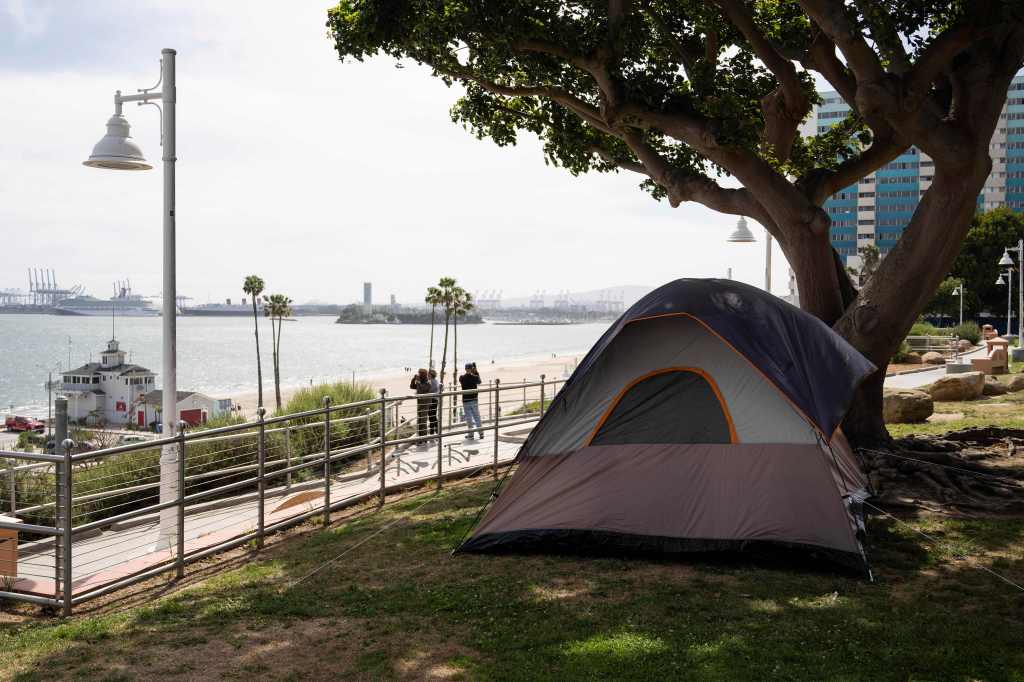
The Long Beach Police Department has seen an increase in calls for service to address homeless encampments and has begun using a new misdemeanor citation in a proactive attempt to support the city’s homelessness and public safety goals, according to Police Chief Wally Hebeish.
In a city memo released Tuesday, March 3, Hebeish shares what the police department is doing as part of Long Beach’s increase in enforcement efforts to clear homeless encampments after the U.S. Supreme Court’s decision in the case of Johnson v. Grants Pass in 2024.
The ruling set a precedent that public agencies may enforce local law restricting sleeping and/or camping in public spaces, regardless of the availability of shelter options.
As a result, police officers responding to calls for service now have the discretion to enforce ordinances restricting encampments in public spaces, according to city officials.
In August 2024, city staff outlined how these additional enhanced enforcement efforts would be integrated into the city’s homeless response strategy.
The city’s interdepartmental approach focuses on ways to resolve encroachments that pose significant and persistent obstruction to the use of public resources such as parks, libraries and beaches, according to the city memo. Priority focus areas allow city staff to utilize an intensive encampment resolution approach, including multiple days of outreach, offering supportive services and shelter, cleanup protocols, and notifications.
That same month, Long Beach cleared out five homeless encampments, which targeted those priority focus areas for the city. These areas include Billie Jean King Main Library, Lincoln Park, Gumbiner Park, Veterans Park, and Jenni Rivera Memorial Park.
Enforcement may be used as a means of dispersing encampments in priority focus areas if other outreach and service provision measures prove ineffective, officials said.
“The Long Beach Police Department participates in the city’s interdepartmental team, and the city’s general approach to homelessness is to lead with compassion by connecting individuals to services aimed at resolving their housing needs,” Hebeish said in the city memo. “However, when officers encounter an encampment or individual who presents a public safety or public health risk, they may issue a citation as a means of encouraging the individual to transition to a safer environment or set of circumstances.”
In May 2025, the city provided an overview of the approach to services and enforcement across Long Beach. At that time, the Public Works Department had conducted more than 2,000 encampment cleanups from July to February, removing nearly 600 tons of garbage and debris, while the police department issued about 350 citations for camping in designated areas or loitering after hours in parks and beaches from June to February.
Long Beach has continued its efforts to clear encampments. The city, for example, was part of Gov. Gavin Newsom’s statewide strategy to address homelessness by deploying the State Action for Facilitation on Encampments Task Force to address the persistent encampment located alongside the 91 and 710 freeway interchange.
In a proactive initiative to support the city’s interdepartmental team and enhance public safety, the LBPD has partnered with the City Prosecutor’s Office to create a new misdemeanor citation form, according to the March 3 city memo.
This updated form incorporates violations associated with encampments and individuals posing a public safety or health risk, facilitating more efficient citation processing, Hebeish said.
“By reducing the time officers spend on paperwork,” he said, “this resource will allow them to focus on emergency calls, ultimately improving overall efficiency and responsiveness within the community.”
The police department’s Quality of Life strategy prioritized identified focus areas as key locations of concern. While officers were directed to maintain a balanced deployment approach, officers retained discretion to address these issues as conditions warranted. Over time, this strategy evolved as Quality of Life enforcement became integrated into the response tools available to officers, citywide, according to the city memo.
Additionally, officers have continued to support the efforts of the Public Works Clean Team in public spaces and Parks, Recreation and Marine Department’s maintenance teams in parks and on beaches. To ensure efficient operations for these city partner departments, officers have taken enforcement action.
Following the Supreme Court decision, increases were observed in both Quality of Life calls for service and related enforcement activity within the designated focus areas, Hebeish said. Citywide trends reflect a similar and significant rise.
Between the pre-decision period, from Jan. 1, 2023, to June 27, 2024, and the post-decision period, from June 28, 2024, to Dec. 31, 2025, Quality of Life calls for service increased from 663 to 1,309. While Quality of Life arrests/misdemeanors increased from 8 to 270, according to the March 3 city memo.
Citywide, in the same pre-decision and post-decision period, Quality of Life calls for service increased from 370 to 858. While Quality of Life arrests/misdemeanors increased from 19,289 to 28,878, according to the March 3 city memo.
City officials say that another update on increased enforcement to clear encampments, as well as an item to the City Council, will occur in the next couple of months.