
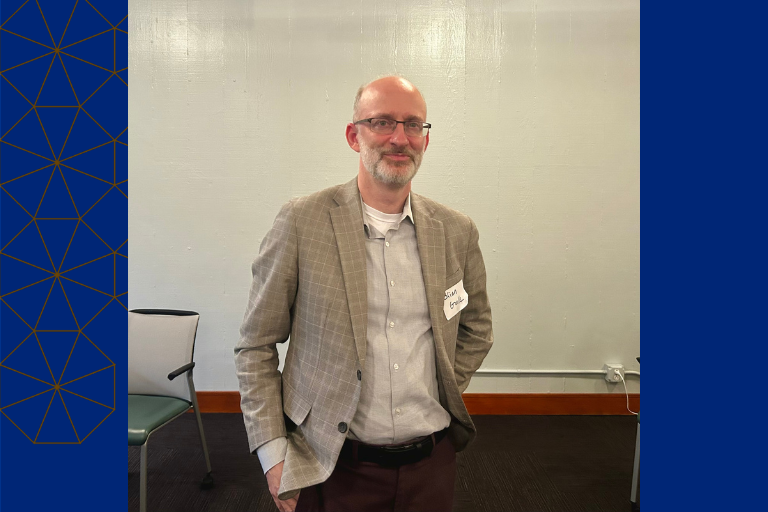
A new federal “fair share tax” could raise significant revenue from the nation’s wealthiest households while avoiding constitutional barriers that have stymied other proposals to tax extreme wealth, UC Berkeley Law Professor Brian Galle said during a recent James M. and Cathleen D. Stone Center on Wealth and Income Inequality lecture at UC Berkeley.
Galle outlined the proposal during a talk titled “How to Tax the Rich,” based on his monograph, “How to Tax the Ultrarich.” He argued that a small number of Americans now hold an extraordinary share of the nation’s wealth — more than at any other time in U.S. history — and that addressing the imbalance requires reforms that are both economically effective and able to withstand scrutiny from the U.S. Supreme Court.
As an expert in federal income tax and corporate tax policy, Galle has spent much of his career examining how revenue systems can be redesigned to create a more equal society. At the event, he argued that the Fair Share Tax (FAST), a framework designed to generate significant revenue while limiting tax avoidance, is a new instrument that could avoid the constitutional barriers that other proposals would likely come up against.
The Stone Center event also covered a range of policy tools aimed at raising federal revenue. These included higher income tax rates, taxes on large fortunes or systems that tax asset appreciation annually. Galle noted that many of these proposals face significant practical obstacles, such as failing to generate substantial funds or align with the constitution.
As an alternative, Galle also promoted the 2026 California Billionaire Tax Act, which he helped develop, that will appear on the November ballot if it obtains enough signatures. The measure would impose a one-time 5% tax on qualifying assets for the ultra rich, with the option to pay upfront or over several years.
Others who spoke at the event included UC Berkeley Economics Professor Emmanuel Saez, who acted as a moderator, and University of Chicago Law Professor Jacob Goldin, a panelist. Goldin underscored the ingenuity of the FAST proposal, while arguing that implementation decisions could affect both its economic efficiency and constitutionality. Saez echoed the importance of using legal tools to make economic change.
Ultimately, while the speakers considered a variety of proposals, Galle argued that FAST as the most practical solution to raise revenue, curb extreme wealth inequality and create a more sustainable model for taxing the ultra-wealthy.