
 article
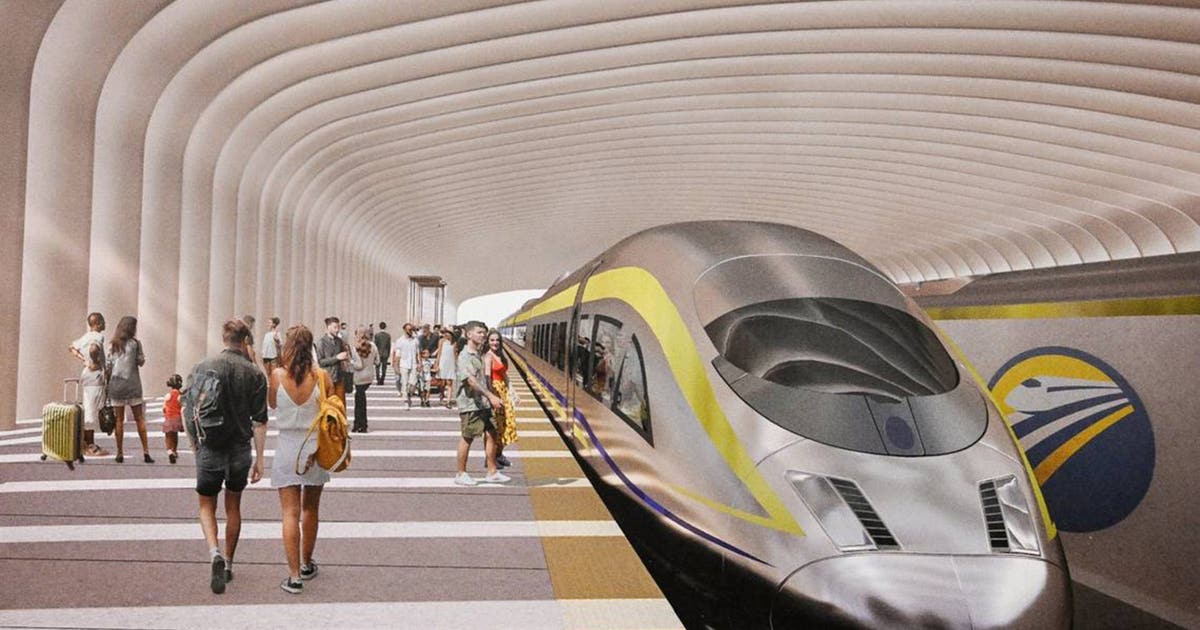
A rendering shows a high-speed rail train as it enters a station during an informational open house by the California High-Speed Rail Authority at the Hilton DoubleTree in downtown Fresno, California, on Wednesday, May 1, 2024. (Craig Kohlruss/The Fr
Oakland, Calif. – The embattled CEO of California’s high-speed rail will return to work on Thursday, following an investigation into his arrest for domestic battery.
After being placed on administrative leave on Feb. 17, Ian Choudri will return to work at the California High Speed Rail Authority, a position he has held since August, 2024.
The organization on Feb. 28 issued its Draft 2026 Business Plan, which outlines how the project will move ahead through the rest of the year. That plan is undergoing a 60-day public review, and estimates the cost of the project’s first phase, which will connect San Francisco to Los Angeles, will decrease by $1.7 billion.
“The promise of high-speed rail is larger than fast trips between two endpoints,” Choudri wrote in the plan. “It is the opportunity to connect all the corridor’s communities — Gilroy, Merced, Fresno, Bakersfield, Palmdale, and others — to the state’s largest job centers and innovation hubs in ways that create new opportunities for millions of Californians.”
By the numbers:
An oversight report published by the California Legislative Analyst’s Office on March 2 of this year states the project funding currently available is likely insufficient to pay for the cost of connecting Merced to Bakersfield. Current projects show the cost for that stretch of track at $41 billion.
“With the loss of federal funds, available funding drops to $39 billion… somewhat over the $37 billion in estimated costs for Merced to Bakersfield,” the report states. “However, that estimate does not include any borrowing costs (previously estimated by HSRA at $4 billion, which resulted in a $2 billion funding gap for the segment).”
The report states the $37 billion estimate is contingent on assumptions that “might not be realistic,” such as: all proposed statutory changes are implemented, whether an assumed $14 billion in savings materializes, and whether the project stays on budget.
The other side:
The project has long been criticized for overshooting deadlines and surpassing projected budgets. The project came under new scrutiny last July, when the Trump administration pulled $4 billion in federal funding for the project.
U.S. Transportation Secretary Sean Duffy, in a social media post announcing the withdrawal of funds, said federal officials were “pulling the plug on federal funding for this train to nowhere.”
Duffy referred to the project as a ‘boondoggle,” and said it was the definition of “government incompetence and possibly corruption.”
The backstory:
California voters first approved the project in 2008 with the passage of Proposition 1A, which allocated $9 billion to the High Speed Rail Authority for planning and construction, as well as $950 million to local high-speed rail connectivity projects, as overseen by the California Transportation Commission.
Since then, the price tag of the project has nearly quadrupled. Over three-quarters of the funding has come from the state, mainly through a voter-approved bond from its cap-and-trade program.