
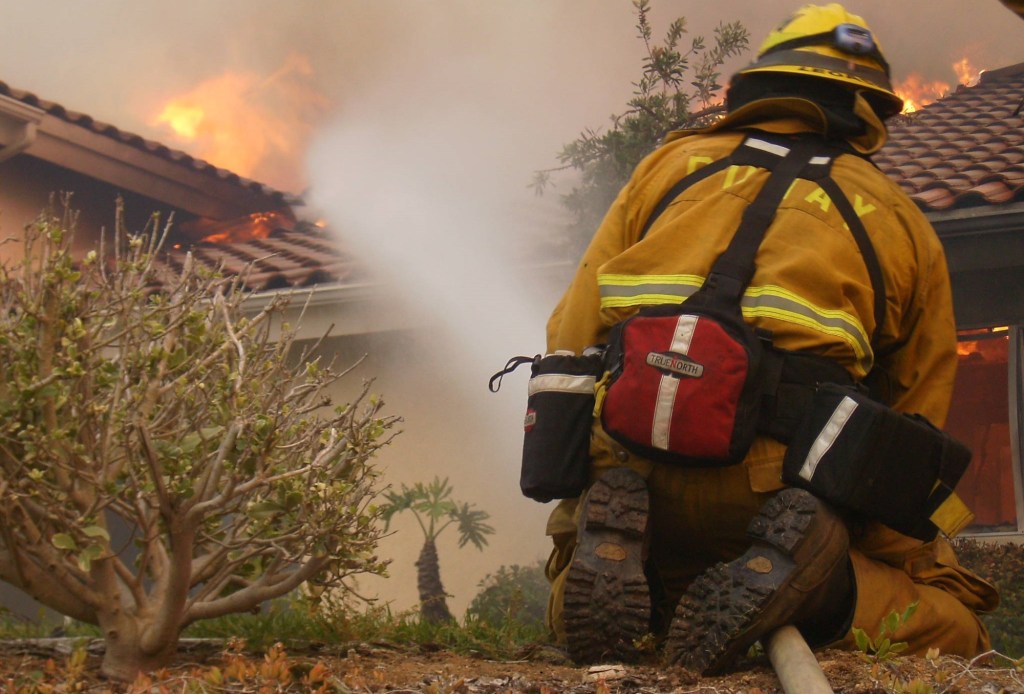
Poway residents had a sneak peek of plans by wildfire prevention officials to prepare them for a new program that aims to make homes safer and aligned with insurance requirements.
The Home Ignition Zone Assessment community meeting was held Feb. 25 at Poway City Hall. The gathering with about 100 attendees was hosted by the Poway Neighborhood Emergency Corps nonprofit that offers outreach and education for emergency preparedness and provides communication in neighborhoods during emergencies.
The official rollout of Poway’s program is scheduled for May. The goal of the voluntary program is to have residents sign up for a free home assessment to understand what steps they can take to reduce wildfire risks on their own property, said Jenna Stein, emergency manager for the city of Poway.
The assessors will be city volunteers who have had a background check and are covered by insurance, Stein said. They can suggest ways to make a property more fire resistant by making low-cost retrofits and installing wildland urban interface-compliant products, she said.
“Education is important if you want to take action to make your home safer and more affordable for insurance,” said Stein, noting that most homes burn during a wildland fire due to embers. “We hope to start the one-on-one assessments in May.”
Home ignition zones are divided into three segments, fire officials said at the meeting.
Zone 0 is the distance of 0 to 5 feet from a structure. It’s the smallest distance of the three zones, but it makes the greatest difference, the officials said. Suggestions for this zone are to remove combustible items and vegetation; screen vents and fill gaps in or totally enclose eaves; and clear debris from a home’s roof, gutters and deck.
The next zone is referred to as the Intermediate Zone and is 5 to 30 feet from a structure. This is where residents can be “firewise” by creating breaks in vegetation; removing ladder fuels from below trees; and keeping trees trimmed back 10 feet from the house.
The third zone is the Extended Zone, which is 30 to 100 feet from a structure. This is where residents are encouraged to clear dead and dying vegetation; maintain space between large, mature trees; and clear debris from the ground.
Mike Cornette, a firefighter with the Cal Fire and San Diego County Fire Protection District, showed a video during the meeting that compared a firewise home with an unprotected structure.
The wooden fence of the unprotected home caught fire within a few minutes, then the exterior of the home was on fire within 6 minutes and finally, the interior of the home caught on fire within 9 minutes. The firewise home was “unscathed,” Cornette said.
“This is an example of what proper defensible space can do in that environment,” he told the audience.
Some of the improvements Cornette suggested are removing leaves from gutters and lawn furniture close to homes, replacing wood fences with metal fences, ensuring that no gaps are around vents, and adding double-paned windows and fire-resistant siding.
Cornette shared information about the devastating effects of wildland fires in California. Between 2013 and 2018, the UC Berkeley Fire Research Lab reported 47,000 structures were lost and 147 people were killed due to wildland fires in the state, he said.
The 1991 Oakland Hills Fire, dubbed the “Tunnel Fire,” destroyed the Hiller Highlands Development within 16 minutes, Cornette said.
A decade later, he said the state issued its defensible space guidelines.
“Fire is a constant in our environment,” he said. “Vegetation is designed to burn. And history repeats itself when it comes to wildland fires. Typically, you’ll see similar fires over and over. Our goal is to make sure your home is safe for yourselves, firefighters and the community.”
Some easy steps to take now are to keep plants well-watered, remove the lower limbs of trees and talk to neighbors about what they can do to make their homes fire-resistant, he said.
Brian Gallagher of the San Diego Fire Safe Council talked about the county’s successful launch of the Home Ignition Zone Assessment Program in 2024. The initial focus of the program was in Ramona, Fallbrook and Julian where it could have an impact on “tackling defensible space,” Gallagher said.
A key feature of the program is that it is confidential, he said. If someone signs up for a home assessment they will not be cited for noncompliance with recommendations for the three zones, he added.
“If we see a violation we will not tell anyone,” Gallagher said. “We’ll just make suggestions. You can take it or leave it.”
After the assessors make suggestions, some people may upgrade their homes, which they can show to their insurance provider and possibly get insurance discounts or policy renewals, he said.
Stein said more information about the Poway Home Ignition Zone Assessment Program will be available at free public workshops set for 6:30 p.m. Wednesday, May 27 and also 8:30 a.m. Saturday, May 30, both at Poway City Hall.
For more information or to sign up for the home assessment program, visit the city of Poway’s website at Poway.org/wildfire or the Poway Neighborhood Emergency Corps website at PowayNEC.com/HIZAssessment.
For more information about the high fire risk severity zones visit Poway.org/firezones. For general emergency preparedness information check AlertSanDiego.org, the Genesys Protect website at Protect.Genesys.com, or the Watch Duty app.