
The UC system’s treatment of cadavers donated to UC San Diego’s Body Donation Program, and its ambiguous response regarding the bodies being used as training dummies for surgeons in the Israeli military, reveals a shocking complacency in a precarious moment for academia.
The UC system acquires more than 1,000 California-sourced donated cadavers a year, making it a significant source of bodies for scientific research. This tags it with the important ethical responsibility of controlling where these bodies end up, protecting the spirit of donor consent and honoring the trust of families who have extremely limited information on the whereabouts of their family members.
It has failed this responsibility.
Through complicated bureaucratic hand-offs, the UC system has allowed academic protections on cadaver financialization and privacy of research purposes to overreach into operations that train a foreign military force.
According to contracts dating back to 2018, at least 32 bodies have passed hands between the University of Southern California, the Navy, and the Israeli military, of which an unknown number came from UCSD. Additionally, there is parallel contractual evidence that the Navy requested USC to source bodies specifically from UCSD.
The UC system basically buried its head in the sand when asked to clarify the beneficiaries and locations of the bodies. This, combined with its appeal to the “underlying task” and its circuitous relationship with the Navy and the Israeli military, illustrates a callous ethical framework and foolishly pushover relationship with the federal government — whose current administration has maintained an antagonistic relationship with the UC system.
While the sale of organs for transplantation is illegal in California, exceptions are made for academic and scientific uses. Similarly, academic institutions are not required to communicate with families or next of kin regarding the results or whereabouts of cadaver donations.
UCSD covers the responsibility of cremation, but does not send remains, reports or results back to families at all. Donated cadavers effectively become black boxes, which denies anyone the ability to hold the involved parties accountable. All that is available is opaque quantitative data: the value of the most recent contract between USC and the Navy, updated within the past year, is $741,268.
According to the UCSD website, donated bodies will “(help) medical students to master the complex anatomy of the human body and … provide researchers with the essential tools to help our patients of tomorrow.” Donors are not informed that their bodies may be exchanged for money to train the U.S. military. They are certainly not informed that their bodies may be exchanged to a foreign military.
Schmitt’s appeal to the “underlying task” is hard to engage with, considering the UC system’s reluctance to be transparent about the siphoning of cadavers from UC campuses to the U.S. Navy and Israeli military. How would the UC system even know what the Israeli military does to cadavers? We’re stuck on the outside of the black box.
It is not that the UC system has blatantly betrayed its word and its self-designed ethical boundaries. It is that its language and boundaries themselves have become so weak that it’s now difficult to discern what it would take to betray them at all. UCSD’s acquiescence to an explicit request for cadavers by the U.S. Navy, which only intends to sell those same bodies to the Israeli military, is a clear-cut betrayal of meaningful consent from donors and of good faith from the academic departments those resources were intended for. If we accept this practice, then we accept a world where meaningful public research is analogous to private military experimentation. Israeli military training and UC medical research become the same thing, with the same ethical implications and litigious responses.
If we accept the world where the financial transaction tied to the cadavers follows the law, we do not differentiate between UCSD’s interface with USC, USC’s following transaction with the U.S. Navy and the Navy’s transaction with the Israeli military. All of these things become protected under academic use, and when the Israeli military’s training is protected by the same laws designed for academic institutions, how do we differentiate the work that we do on campus from the work done on a battleground? How do we maintain that separation in an environment where campuses around the country are being pressured to reshape themselves by the federal government? The strength of academic institutions like the UC system rests in their ability to distinguish themselves from public and private institutions that do not align with their values. The UC system should be morally headstrong during national instability — now is the moment to take a stance and say no.
They have protected statuses for a reason. There are situations in which it makes sense for schools to exchange, with financial parallels, donated cadavers in order to maintain funding for a given program. But these protections are being abused, and the UC response is failing to confront the individual threat and understand its wider implications. Now is the moment for the UC system to remain aware and sensitive to government overreach into academia.
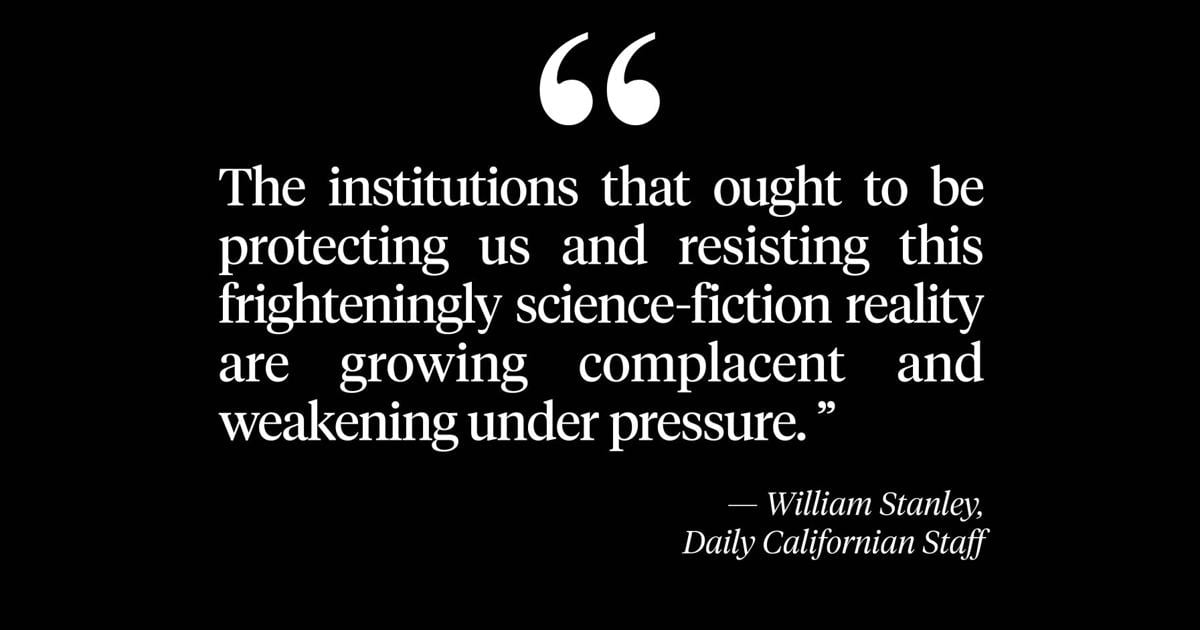
If we so choose to donate them to one of the world’s most trusted public research institutions, the very bodies through which we interact with the world are at risk of swapping hands for money and ending up on a table to train a foreign military. The institutions that ought to be protecting us and resisting this frighteningly science-fiction-esque reality are growing complacent and weakening under pressure.
Whether it’s massive information leaks from UC Berkeley last semester, UCLA’s nascent lawsuit with the DOJ or UCSD’s relationship with the U.S. Navy and Israeli military, the cracks in the UC system are clear.
Body donation is an intimate process — it is perhaps the final moment of intimacy that we have with the world. It is what we choose to have done to the one thing we’re forced to leave behind, and the character of that decision should be respected by any institution that has been chosen to follow it through.
Students at UC Berkeley should recognize this threat’s relationship with their current enrollment and resist in the uniquely privileged way they’re still able to. When we confine ourselves to the letters of a name on an enrollment list, remain content with lying in a cell of a spreadsheet, we are no more than dead bodies — expendable cadavers for the university to ship and shape as it wishes.
We have to make ourselves strong in the ways we’re familiar with, radically embodying ourselves in protest and outreach while resisting the impulse to mirror complacency and reduce ourselves to numbers on a spreadsheet. The UC system has shown its hand with its disregard for the most helpless; our role is then to resist ever being that helpless ourselves. whether through protest and outreach or through a defiant return to the vibrancy of our individual lives, away from a public university system capitulating to federal pressures to disembody faculty, students, and donors alike — a move away from the lack of humanity they’re so comfortable with us inhabiting.
The UC system has shown its hand with its disregard for the most helpless; our role is then to resist ever being that helpless ourselves. Through protest and outreach, we must move away from the inhumanity they’re so comfortable with us experiencing and away from a system capitulating to federal pressures to disembody its faculty, students and donors alike.