
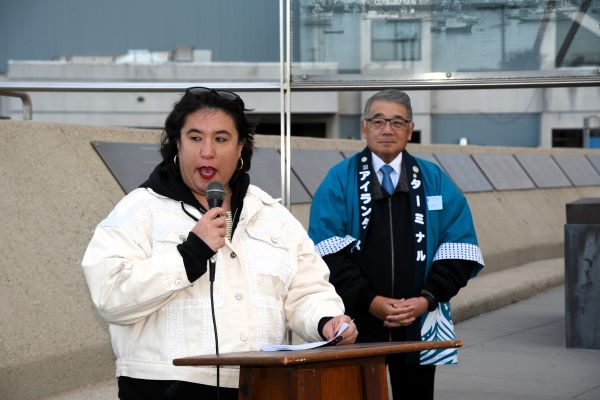
 Maya Suzuki Daniels from the Harbor Area Peace Patrols (left) and Terry Hara from the Terminal Islanders Association (right). Photo by Tim Yamamoto
Japanese American Community Leaders Reflect on Parallels Between Past and Present at Day of Remembrance Ceremony on Terminal Island
By Emma Rault, Columnist
On Thursday, Feb. 19, a crowd of community members gathered on a cold, windy afternoon by the Japanese Fishing Village Memorial on Terminal Island. They were there to observe the annual Day of Remembrance and reflect on a dark chapter in American history with chilling echoes in the present moment.
Feb. 19 marks the anniversary of President Franklin D. Roosevelt’s 1942 signing Executive Order 9066, which led to the imprisonment of more than 120,000 men, women and children of Japanese descent in concentration camps.
They were stripped of their civil rights and property under the guise of national security and spent the duration of World War II locked away behind barbed wire. The Japanese community on Terminal Island — which back then was known as East San Pedro — was forever uprooted. Homes, storefronts and houses of worship in the area known as Fish Harbor were bulldozed by the Navy just days after people were evicted at gunpoint.
The ceremony at the Japanese Memorial was organized by the Harbor Area Peace Patrols, the local group of community volunteers monitoring ICE activity around the Harbor Area, in conjunction with Nikkei Progressives, a grassroots community organization fighting for social justice and immigrant rights based in Little Tokyo.
The Harbor Area Peace Patrols formed last June, when federal immigration agents began a wave of aggressive raids and arrests in American cities, with masked, anonymous men grabbing people off the streets in broad daylight.
The Harbor Area became a key location in this terror campaign — ICE began using the Coast Guard base on Terminal Island, just down the road from the Japanese Memorial, as a “staging area,” or base of operations.
For the last eight months, members of the Harbor Area Peace Patrols stood watch on Terminal Island every single morning, documenting the movements of federal agents and alerting the community.
On Feb. 13, it was announced that federal immigration agents had left the Coast Guard site. The Day of Remembrance ceremony, then, also marked a powerful victory for community activists.
“Last week, we won,” said Maya Suzuki Daniels, a local teacher and co-founder of the Harbor Area Peace Patrols.
The group’s work on Terminal Island was a powerful full circle moment for Suzuki Daniels. During World War II, her Japanese American grandfather fought in the U.S. Army while the rest of his family was imprisoned in concentration camps.
Being on the island “in the sun, in the rain, in the wind, in the dark, to protect our communities” meant “acting in the legacy of our ancestors,” she said.
Terminal Island’s history and the ongoing struggle for immigrant justice are part of the same fight — that was the core message that echoed across the speeches at the Day of Remembrance event.
Amy Oba, who spoke for Nikkei Progressives, talked at greater length about the historical parallels. “This past year, President Trump used the Alien Enemies Act to deport Venezuelan migrants to El Salvador, an act not invoked since it was used on Japanese Americans. We also witnessed the reopening of Fort Bliss [in El Paso, Texas], the largest immigration detention center right now in the U.S., which was also a place Japanese Americans were interned. And we have seen the Supreme Court sanction the use of race to determine if someone is an ‘illegal alien,’ in eerily familiar language to the Japanese Americans being called ‘enemy aliens.’”
Oba’s words also brought to mind what happened in August 2025, when Amanda Trebach, a member of the immigrant rights group Unión del Barrio and an ICU nurse, was violently detained by federal agents right next to the Japanese Fishing Village Memorial. She was pinned face-down on the ground, taken in an unmarked van and detained overnight before being released without charges.
This year, two legal observers of immigration enforcement activity — Renee Good, a mother of three, and Alex Pretti, an ICU nurse — were killed by federal ICE agents in Minnesota. What happened to Trebach here on Terminal Island, then, was not an isolated incident but an early warning sign in a pattern of alarming escalation.
But the community is holding fast, Oba said. “Justice is once again coming for immigrant communities in the U.S. … People are once again uniting against the racism and xenophobia and scapegoating of immigrants in our country.”
And Japanese American history offers lessons in how to fight back. “In 1988, over 40 years after internment, Japanese Americans won $2,000 in reparations and an official government apology for every camp survivor,” Oba said. “We remain the largest group ever to receive reparations from the U.S. government.”
Representatives of the Terminal Islanders Association — composed of former residents and their descendants — were also present at the event, bundled up in warm sweaters under their ceremonial happi coats printed with the waves of Fish Harbor splashing in turquoise and white.
President Terry Hara gestured toward the federal prison that sits next to the Coast Guard base. He recounted what happened here on Dec. 8, 1941, the day after the Japanese government’s attack on Pearl Harbor. As the local Japanese fishing boats headed back to Terminal Island with their catch, they were stopped at the entrance to the breakwater. “The men were removed from their boats … and put into the federal detention center right here. That location is part of history.”
Like Maya Suzuki Daniels and Amy Oba, the Terminal Islanders are committed to honoring their legacy. “We’re around, we’re very strong, and we want to keep the story alive,” Hara said.
They plan to do this using the two surviving buildings from Fish Harbor on Terminal Island’s Tuna Street, which were designated as LA Historic-Cultural Monuments last year in a joint effort between the Terminal Islanders, CD15 Councilman Tim McOsker, and the LA Conservancy.
“I hope that we can … make something with these two buildings that will teach future generations what was here, what happened, and not to forget,” said Tim Yuji Yamamoto, whose grandfather, Akimatsu Nakamura, ran a grocery store in one of the landmarked buildings.
The Terminal Islanders Association recently became an official nonprofit, enabling them to start fundraising for the restoration of the buildings.
After a prayer by Pastor Joshua “Yoshi” Kuramoto of the San Pedro United Methodist Church, attendees came together to fold origami cranes — a Japanese tradition of prayer and healing. The colorful paper birds were placed at the base of the memorial’s statue of two Japanese fishermen.
Terry Hara pointed out the statue’s symbolism. One of the bronze figures is looking back toward the lost community of Fish Harbor; the other’s gaze is aimed ahead, at the future — a reminder that the next chapter of history is up to us.
Like this:
Like Loading…
Related