
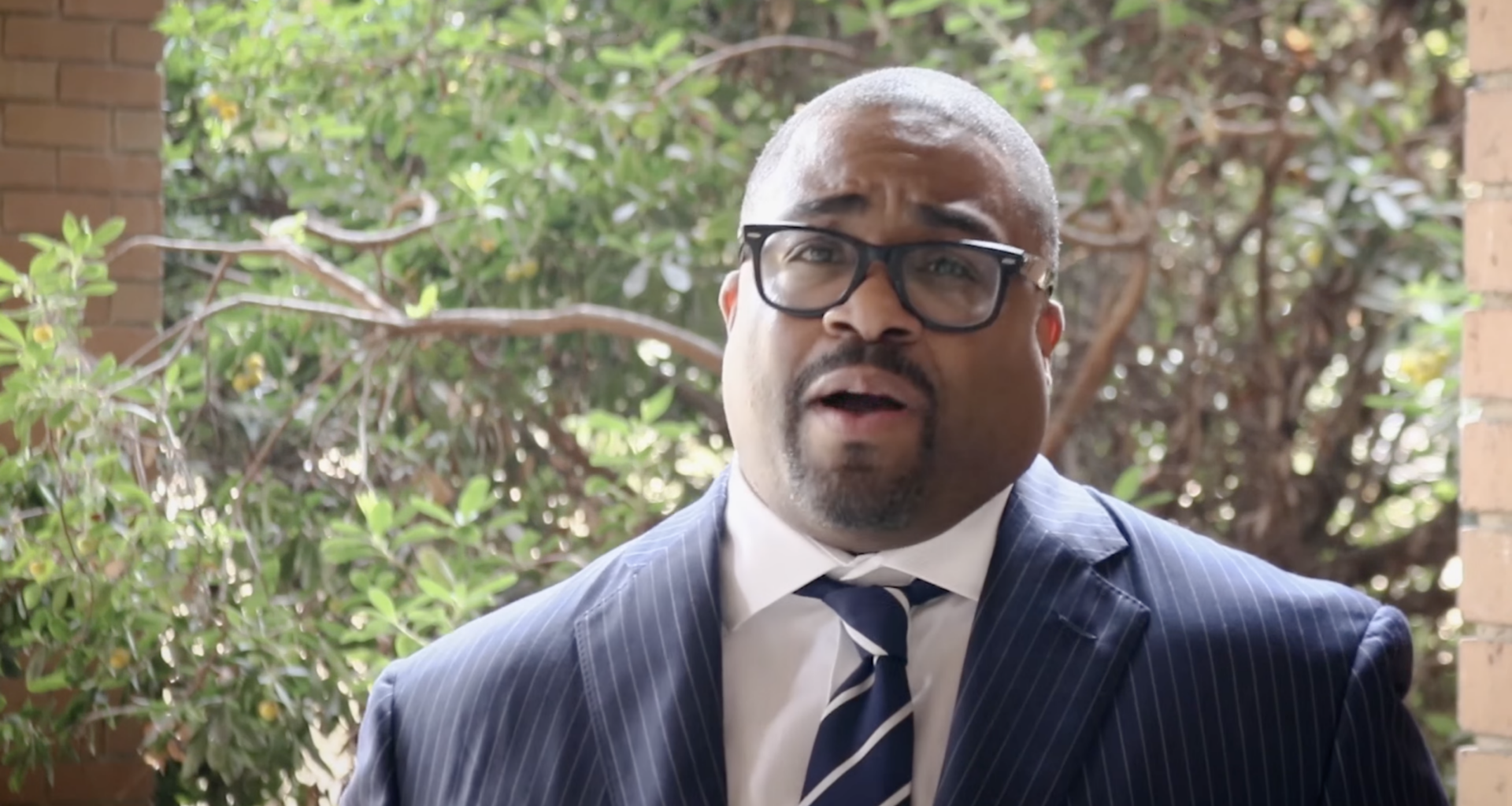
The head of Santa Clara County’s largest water supplier sexually harassed subordinate employees, according to independent investigators looking into allegations of misconduct.
Valley Water has released the report conducted by law firm Atkinson, Andelson, Loya, Ruud & Romo, which was investigating internal claims into CEO Rick Callender and his behavior with employees. The more than year-long probe found Callender violated Valley Water policy and sent inappropriate comments and photos and made intimidating statements to workers.
The report, dated Sept. 10, 2025, said Callender pressured employees to message him on social media after work hours; sent invasive messages about their hygiene and questions about their sexual history; sent a photo of his clothed lap; and engaged in unwanted advances based on interviews with three accusers, as well as written and photographic evidence. Accusers in the report said Callender pressured them into certain roles, threatened to fire them and sat on the promotion panel for an employee he allegedly harassed. In one exchange, Callender texted a female employee, “Showered yet? Just playing.”
“Callender’s conduct is particularly troubling because in his position, he wields considerable power and influence within the organization,” the report reads.
Callender, who had been on leave since December 2024, resigned Feb. 20. The board of directors approved a separation agreement that retains him for a year as a special advisor. He’ll continue to receive his CEO pay and benefits that total $716,000. That includes an annual pension contribution of $167,000.
Callender in the hot seat
Callender declined to comment. In a December letter to Valley Water through his attorney Lori Costanzo, he called the investigation a biased campaign to smear him through messages and conversations taken out of context. Valley Water made the letter public on Feb. 24, characterizing it as Callender’s response to the report.
Callender’s attorney said investigators cherry picked certain messages which, in full context, reflected professional dialogue.
“Statements allegedly implying sexual thoughts or risk of being ‘fired’ are taken out of context,” Costanzo wrote. “The investigation conducted by Atkinson, Andelson, Loya, Ruud & Romo exhibited a prosecutorial posture toward Mr. Callender, repeatedly accepting complainants’ assertions without adequate scrutiny, and engaging in aggressive, repetitive, and disrespectful questioning inconsistent with neutral fact-finding.”
Investigators said Callender gave untrustworthy explanations that “defied common sense.”
“Callender frequently gave evasive, argumentative, and sarcastic answers,” investigators wrote. “Combined with explanations of certain incidents that defied reasonable interpretation and a refusal to acknowledge any inappropriateness of his behavior, we found his credibility suspect.”
Sean Allen, president of the NAACP of San Jose/Silicon Valley, has defended Callender over the course of the investigation, calling it biased. Allen, a former Santa Clara County correctional officer, has also been accused of sexual harassment. A county personnel board in 2024 unanimously sustained allegations he made unwanted advances against a female colleague, though he is suing the county over those findings.
Allen said there’s a pattern of accusing Black leaders of sexual harassment to discredit them.
“Of course, there is always a possibility that mistakes were made, but we want to make sure the process is fair and equitable,” Allen told San José Spotlight.
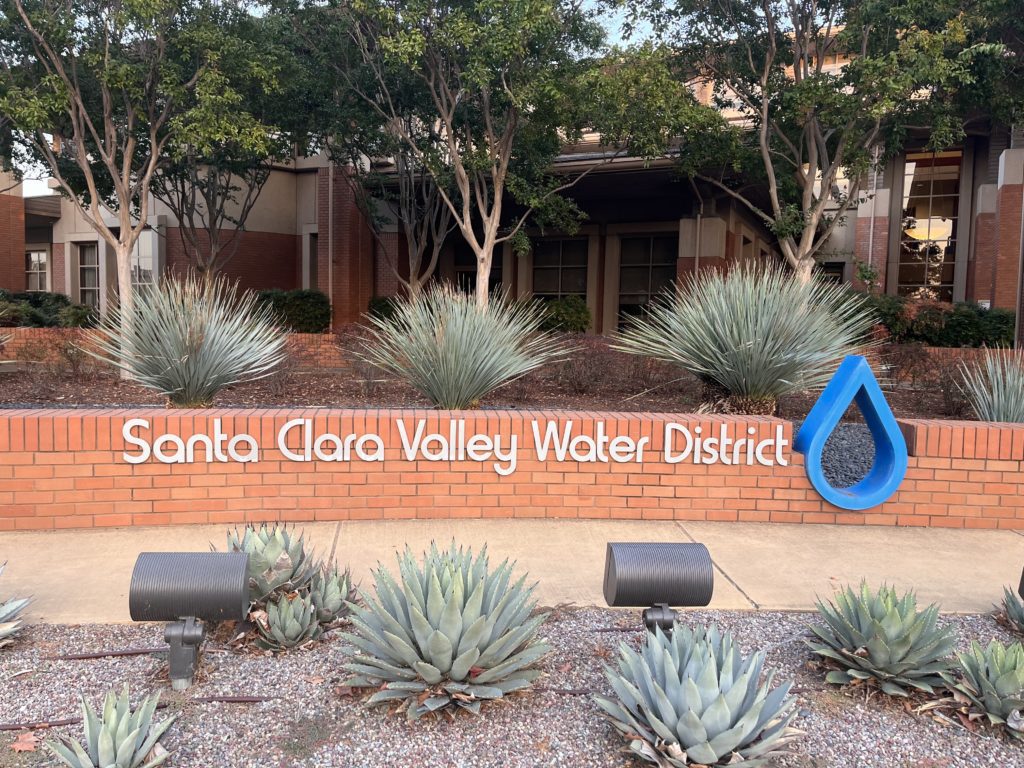 A representative for unionized Valley Water workers said they remain fearful of retaliation from former CEO Rick Callender. File photo.
Employees blindsided
The investigation’s findings were published four days after Callender resigned and the board agreed to retain him as their special advisor. This sparked outrage and disbelief among the agency’s 800-plus employees that the board opted to reward Callender’s alleged conduct and lavish praise on him after their approval of his separation agreement.
“This will be the only statement I will be making,” Board Chair Tony Estremera said at the Feb. 20 meeting. “As CEO, Rick Callender led Valley Water through extraordinary operational and fiscal pressures, including the COVID 19 pandemic, inflationary constraints and complex regulatory demands of continuing to deliver measurable results to the community.”
Estremera later came under fire for his “tone-deaf” remarks after investigators’ findings became public.
“The victims still have not heard a word of apology from the board of directors, who are responsible for hiring this man,” Salam Baqleh, a representative for the agency’s employee union, the Valley Water Employees Association, told San Jose Spotlight.
Baqleh said employees remain fearful of retaliation and will attend the board’s March 10 meeting to protest.
“Considering the glowing statement (about Callender from the board), the pay and the special advisory role, our members are having difficulty understanding the board’s motivations, and how they might serve the interests of rate payers,” Baqleh said.
After the release of the probe’s findings, Valley Water hosted an online Feb. 26 town hall with three board directors. Employees submitted written comments in real time, skewering Estremera and Directors Nai Hsueh and Shiloh Ballard for the “disgusting” vote. Employees accused the board of prioritizing Callender over the integrity of the agency.
Employees also questioned why directors approved a separation agreement worth more than $1 million benefiting Callender while Valley Water works under a hiring freeze and adopted a 9.9% rate increase — $7.80 more a month for an average household — to boost funding for agency services last May.
They demanded the board vote again on Callender’s separation agreement in light of the released findings.
“This is disgusting. The board should be ashamed,” one employee wrote in remarks read aloud by the district’s spokesperson, Matt Keller, during the town hall. “We knew this is what he was like — we were his coworkers, it was no secret. It’s difficult to believe that you all did not know. … This is a slap in the face to both employees and taxpayers, especially those who came forward as victims of abuse.”
At the town hall, Estremera indicated Callender was threatening legal action.
“We had to try our best to do what we could and make sure we minimized any potential litigation against the district,” Estremera said at the town hall.
Estremera made another gesture to employees in an agency-wide email on Wednesday. He wrote the events of the last two weeks had been “weighing” on him.
“On behalf of the Board, I want to acknowledge the three complainants and what they’ve been through. I’m sorry that this happened to you under our watch,” Estremera wrote. “We do not condone this behavior from ANY employee, regardless of title or rank.”
Questionable ethics
Callender is barred from entering Valley Water’s offices without Estremera’s express permission. Director Rebecca Eisenberg, who was the lone vote against Callender’s separation agreement, is doubtful. Estremera and other board members often sided with Callender during public clashes with Eisenberg over district spending and workplace investigations, leading to a March 2024 vote to censure Eisenberg.
“Right now the only thing standing between Rick Callender’s ability to come to the office and physically threaten his victims is the unreliable word of Chair Estremera, who has sided with Callender for more than 20 years each time a female staff member has asked for protection from Callender’s serial predation,” Eisenberg told San José Spotlight.
Callender became the first Black man to lead Valley Water in May 2020. Three women directors voted against his appointment at the time, citing similar allegations of sexual harassment he faced in 2008.
Outside of Valley Water, Callender serves as president of the NAACP of California-Hawaii State Conferences. Following reports of Callender’s troubles at Valley Water, a colleague who worked under Callender at the statewide NAACP filed a March 20, 2025 lawsuit against him over alleged emotional abuse. The lawsuit claims Callender discreetly pushed the NAACP to ask for a public money sponsorship from Valley Water while he was in charge of both organizations.
Valley Water released a separate ethics report on Callender’s dual roles, conducted by the same law firm that handled the misconduct report. Investigators sustained complaints about Callender’s use of Valley Water property to host NAACP events, but did not sustain others. They also raised concerns about him deleting Meta Messenger conversations despite being public records.
Contact Brandon Pho at [email protected] or @brandonphooo on X.