
Public universities are navigating a period of profound uncertainty. From political pressures to shrinking federal support, institutions that have long relied on stable government partnerships are confronting what some leaders describe as a critical turning point for higher education.
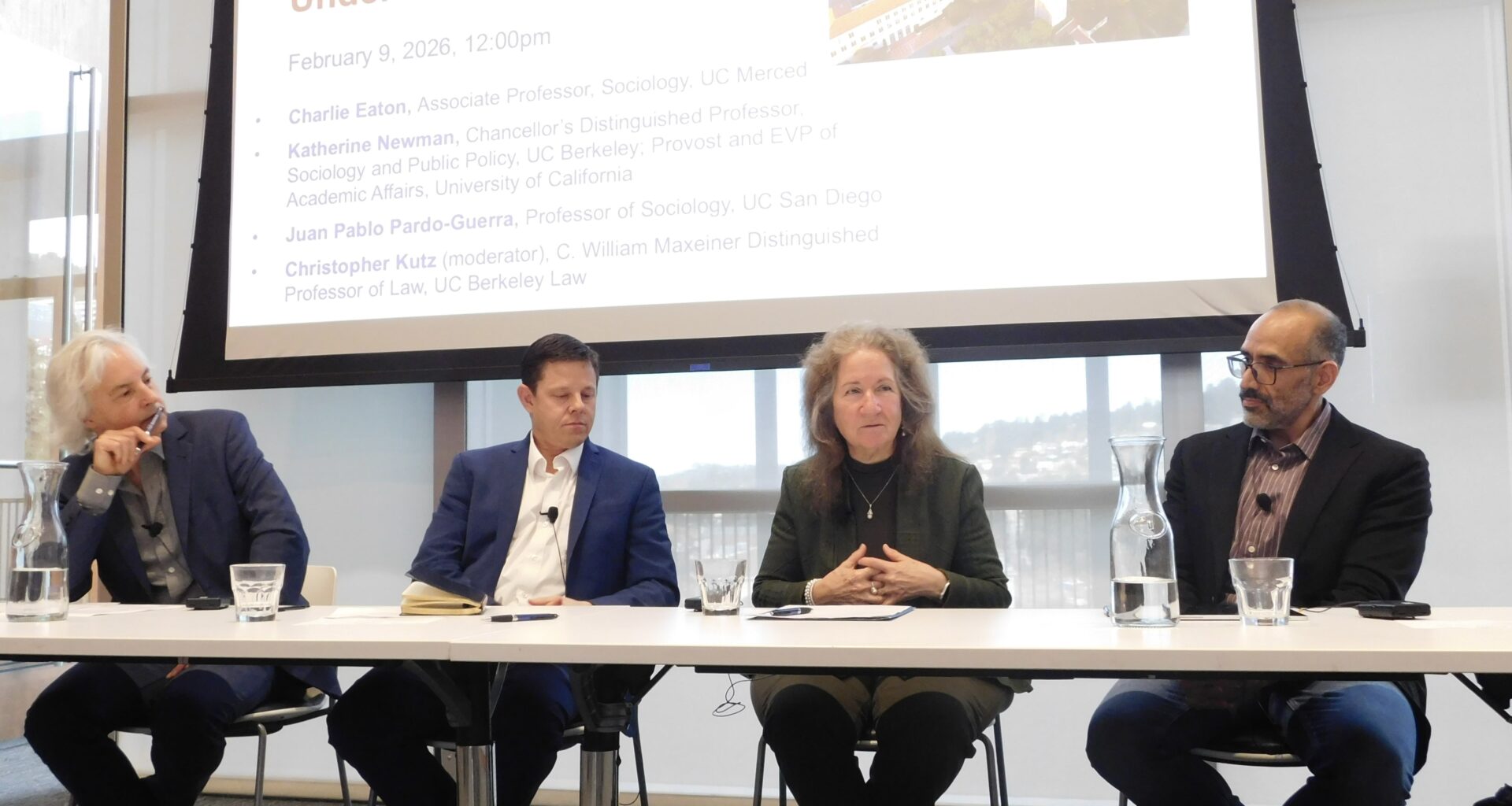
As such, several University of California leaders and scholars gathered recently for a Social Science Matrix panel exploring the risks facing public higher education and what they mean for students, employees and the UC system’s future.
The panel featured UC Provost and Executive Vice President of Academic Affairs Katherine Newman, who is also a UC Berkeley sociology and public policy professor; UC Merced Sociology Professor Charlie Eaton; and UC San Diego Sociology Professor Juan Pablo Pardo-Guerra. The discussion was moderated by Berkeley Law Professor Christopher Kutz.
The challenges facing the UC system are staggering, Newman said.
“More than 1,600 federal research grants across the UC were suspended, cancelled or delayed over the course of a year,” she said. “This is a very serious matter for our colleagues, who are holding those grants and trying to advance their research through them.”
A proposed cut to the federal facilities and administrative (F&A) rate — from roughly 60% to 65% in medical schools to 15% — threatens the infrastructure that supports laboratories and research administration, she said.
“It’s also a direct harm to California’s economy because UC is the second largest employer in the state,” Newman said.
Pardo-Guerra outlined four structural risks arising from this changing landscape: the erosion of the historic partnership between science and the state; the direct financial fallout for campuses; institutional inertia; and fragmentation within universities themselves.
“The generous funding that we received from the federal government — the idea that science is autonomous and support for basic research is fundamentally good for society — is evaporating quickly,” he said. If indirect cost funding declines, universities may face deferred maintenance, fewer faculty lines and staffing cuts across disciplines, he added.
Student access is also at risk. The Department of Education cancelled $350 million in funding for minority-serving institutions (all nine undergraduate UC campuses are federally designated Asian American and Native American Pacific Islander-Serving Institutions, and five are Hispanic-Serving Institutions). The cuts represent more than $12 million in support, including for the 40% of UC students who are first-generation. Meanwhile, the Graduate PLUS loan program — relied on by more than 7,000 UC graduate students — is being phased out, threatening affordability.
Newman emphasized that the UC has mounted a proactive response. A coordinated federal relations effort in Washington has helped push back some proposed funding cuts in Congress. At the state level, UC is working with state lawmakers to advocate for a bond that could provide billions to fund scientific research in California. “What we have learned,” she said, “is that we cannot be solely reliant on the federal government.”
Eaton focused on the political forces behind recent attacks on universities, arguing that they stem less from broad public opposition and more from a subset of wealthy elites. These actors, he said, see academic research and policy ideas — from financial regulation to antitrust enforcement — as threats to their wealth and status.
Still, he noted that polling shows strong public opposition to major funding cuts to higher education.
The panelists agreed that universities must adapt, but through collective action rather than retreat.
“Whatever approach will work should come from an honest, difficult, collective discussion about the future of the university — not a constant reliving of a past that is here no more,” Pardo-Guerra said.