
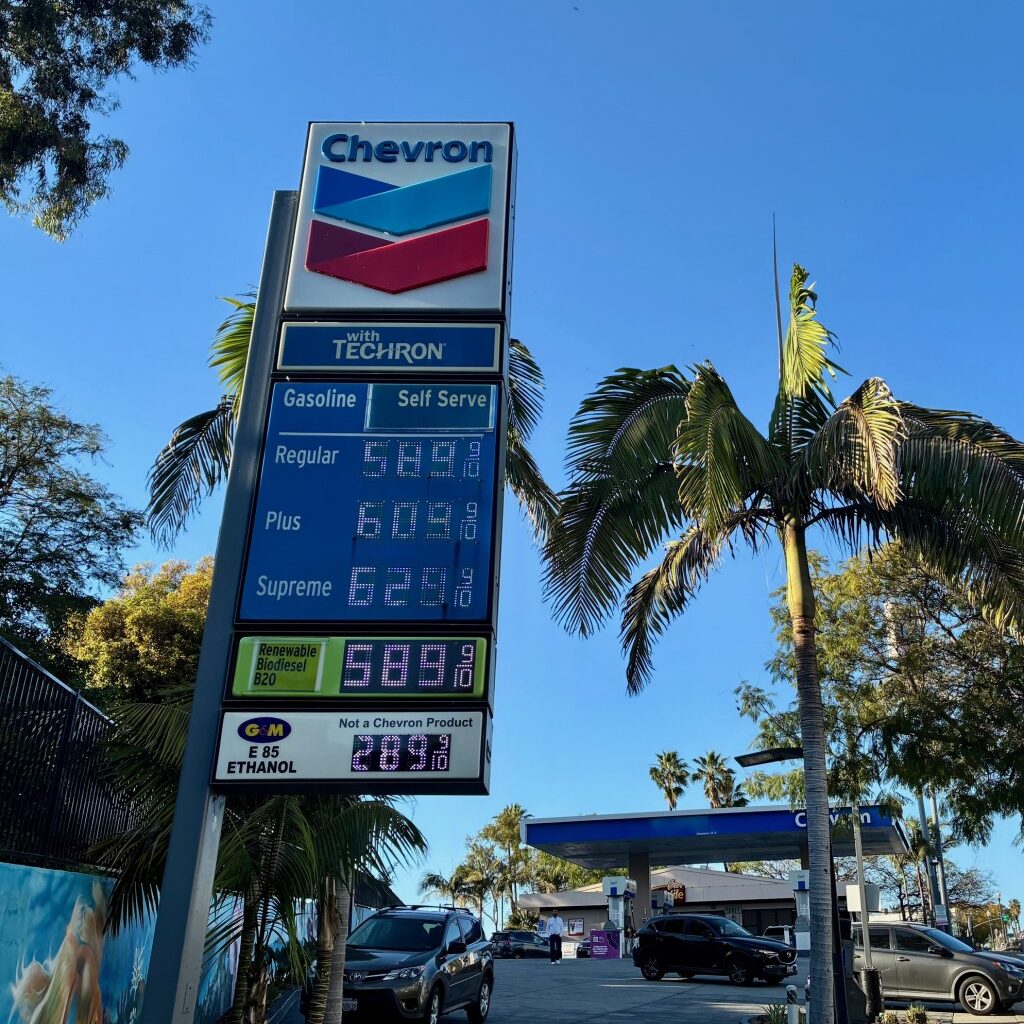
The squeeze on oil imports and exports in the Middle East keeps sending gas prices higher. But fuel analysts say the economic repercussions from the war in Iran may soon be seen in shops, grocery stores and potentially in higher air fares.
“It’s a wave on all fronts,” said Denton Cinquegrana, chief oil analyst at the Oil Price Information Service, which provides data and forecasting on global energy.
In the San Diego area, the average price for a gallon of regular on Thursday stood at $4.894, according to AAA. That’s eight cents higher than the day before and 20 cents higher than last Saturday, when airstrikes from the U.S. and Israel first commenced.
The average price for a gallon of diesel in San Diego on Thursday jumped 15 cents compared to Wednesday. The primary fuel for commercial truckers and shippers has gone up nearly 33 cents in the past three days.
“The economy runs on diesel, the global economy runs on diesel,” Cinquegrana said. “Out-of-state truckers are going to have to charge diesel fuel surcharges to their customers that they’re delivering to (places like) Target, Walmart and the grocery store chains. And they’re going to pass it on to their end users.”
Aviation fuel prices have also taken a corresponding leap, which may likely lead to airlines increasing their ticket prices.
Gas prices were already heading up before the airstrikes, as California refiners recently started their annual transition from winter-blended fuel to the state’s more expensive summer formula, but the war in Iran super-charged things.
“You’re not special in California,” Cinquegrana said. “It’s happening everywhere.”
The AAA national average for a gallon of gas climbed to $3.251 on Thursday — up 27 cents compared to one week ago. The national average for diesel has soared almost 41 cents in the past seven days.
Traffic has come to a practical standstill in the Strait of Hormuz, where tankers carrying about 20% of the world’s petroleum products typically pass through.
According to estimates by Reuters, at least 200 tankers and cargo ships remained at anchor in open waters off the coast of major Persian Gulf producers such as Iraq, Saudi Arabia and Qatar.
Officials in Iraq say the country has reduced its oil production by more than half since the war started.
Futures trading for Brent crude — the international benchmark price — closed the formal trading day Thursday at $85.41 a barrel. That’s 18.6% higher than five days earlier.
West Texas Intermediate — the benchmark price for U.S. oil futures — hovered around $67 before the airstrikes started. WTI futures closed the day at $81.01.
The price shock rattled the stock market.
The Dow Jones Industrial Average fell 785 points Thursday, a drop of 1.6%, while the S&P 500 fell 0.6% and the Nasdaq composite declined 0.3%.
Until the fighting stops, fuel analysts say the prices will keep rising.
“Gas prices will continue to trend higher … and diesel will continue its jump for at least several more days,” Patrick DeHaan, head of petroleum analysis at GasBuddy, said on X.
In another post Thursday morning, DeHaan said, “With today’s market moves, it’s likely just a matter of time” until gas prices in California hit $5 a gallon.
There is one bit of positive news — despite the high prices, most analysts don’t see any fuel shortages on the horizon.
“Inventories are fine in most of the country, even California,” Cinquegrana said. The concerns center on “what’s coming; what’s the next shoe to drop.”
The pain at the pump is especially acute for drivers in California.
The Golden State has the highest price for gas in the country. The statewide average on Thursday came to $4.81, with Washington in second place at $4.449 and Hawaii in third at $4.432, according to AAA.
California also has the highest excise tax on gasoline of any state in the country, charging 61.2 cents per gallon.
California has often been described as a “fuel island” that is disconnected from refining hubs in the U.S., lacking inbound pipelines from other states and requiring a unique blend of specially formulated gasoline to reduce air pollution.
Some 63.5% of oil in California refineries in 2024 came from foreign sources, according to the California Energy Commission.
With prices rising, Marie Montgomery, spokesperson for the Automobile Club of Southern California, offered some tips to help drivers stretch their gas dollars.
“Make sure your tires are properly inflated, adopt a smooth, even driving style that maximizes your fuel economy,” she said, plus consolidate your errands to avoid making multiple trips in your car.
Apps from organizations such as AAA and GasBuddy can direct drivers to gas stations with the lowest prices.
“It’s always helpful to have some kind of an online tool to help you shop around, especially when prices are moving quickly,” Montgomery said.