
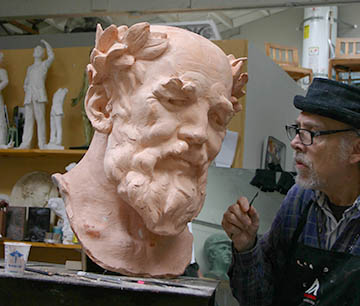
 Daub working on a portion of his “Land and Community” sculpture. File photo. The Sculptor’s Obsession and Triumph Through Art
Eugene Daub Portraits, Medals, and Monuments (2025) is a biography about the esteemed sculptor who lives in San Pedro, California with his wife, artist Anne Olsen Daub. The book was realized thanks to communal patronage and the editorial team’s shared dedication to honoring Daub’s important body of work.
The book recounts an artist’s obsession and determination to become a sculptor in the face of daunting challenges. Written by Wolfgang Mabry, based on multiple interviews with Daub, it charts his early history as a 16-year-old high school dropout trying to find his way in the world.
Primarily self-taught, Daub has become a leading figure in monumental bronze sculpture, liturgical works and medallic art. Portraits, Medals, and Monuments provides an in-depth view into Daub’s dedication to sculpting and his ingenuity to succeed in a competitive arena.
The contemporary figure sculptor is best known for his portraits and figurative monument sculpture created in the classic heroic style, where he memorializes heroes who have shaped the American landscape. Daub’s sculptures reside in three of the nation’s state capitols and in the National Statuary Hall in the United States Capitol. His work appears in public monuments and permanent collections in the United States and Europe.
You can also see many of his works locally in the Harbor Area, including statues and reliefs of Joe Hill, Harry Bridges, founder of the International Longshore and Warehouse Union or ILWU, the Los Angeles Port Police, and Phineas Banning, each adding to the cultural and historical fabric of the community.
The book opens with several shorter contributions: a foreward by Rosa Lowinger, author, curator and art conservator — “Tribute In Form: The Sculpture of Eugene Daub;” “The Conversation” by Ron Linden; “On Medallic Art” by George S. Cuhaj; and Wolfgang Mabry wrote the biography. Daub also provides his eloquent gratitude for the team on this dedication. It is of note that throughout this retrospective, each contributor respectfully imparts how Daub’s prolific works engender the spirit of his historical subjects.
Early in his life Daub’s ingenuity stood out. Mabry tells how Daub, after realizing he had no interest or aptitude for a business career, in 1960, at about age 18, enrolled in the Ivy School of Professional Art. The young artist rode the bus along with University of Pittsburgh and Duke University students. Daub noticed their books and went to the library to check out the texts they were reading. Daub’s innovation and trust of his own instincts have provided him success, recognition and numerous awards. He reasoned out his education and employment (often freelancing) to the greatest benefit for his family and his career as an employable and valuable sculptor.
After he obtained a job at the Franklin Mint as a staff sculptor in 1975, Daub immersed himself in research for these historical pieces. This work provided him the education in American and world history that he never received as a student.
The biography includes photos of Daub’s earliest work at the Franklin Mint, as a sculptor of bas-relief for medals and small sculpture. It encompasses an extensive range of decades’ worth of monuments — including liturgical sculpture — a form close to his heart, portraits (ceramic and relief) and the recent installation of artwork for the LA Metro Station at San Dimas, which he collaborated on with his wife, featuring themes of conservation and the joys of walking. The three sections — Portraits, Medals, and Monuments — are separate categories documenting 50 years of mostly public sculpture and providing comprehensible descriptions of Daub’s meticulous process in creating his pieces. In all, the book features more than 200 high-quality, dimensional photos that reveal Daub’s skill in evoking his subjects’ inner force.
It’s no exaggeration to state that all of Daub’s sculptures are striking. For one special piece, Corps of Discovery (2000, bronze and granite, 18 feet high, base 21 feet in diameter, unveiled in Kansas City, Missouri.) Daub won the commission to begin work on a larger-than- life historical monument for the Lewis and Clark Centennial Commission. The Corps of Discovery depicts Meriwether Lewis, William Clark, their young Shoshone guide, Sacagawea, an enslaved African American man named York, and Lewis’ Newfoundland dog Seaman, with some of the Corps articles. The project took five years to complete and demanded an equally large amount of research.
History explains the ways the journey was frought with colonial issues; while initially exploratory, it laid the groundwork for future Euro-American settlement, resource exploitation and cultural loss. Yet Daub’s monument highlights something more. It emphasizes equal collaboration and agency among its subjects, consciously countering historical hierarchies and power imbalances rooted in colonialism.
It is a sculpture in the round, with Lewis, Clark and Sacagawea facing one direction and York and Seaman facing the opposite direction. Importantly, Daub represented the core leaders of the group that undertook this historical exploration, rather than only its namesakes. He honored the work of Sacagawea as their invaluable language guide, the assistance of York to the expedition’s purposes, and the value and possibly protection that four-legged Seaman provided. This complete representation encapsulates the conscientiousness of Daub’s body of work that Mabry conveys throughout the book.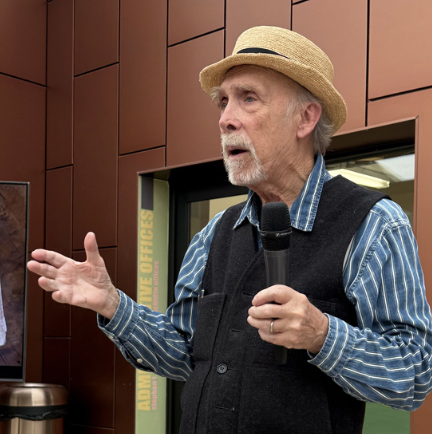 Eugene Daub gives a talk on his book at the Palos Verdes Art Center. Photo courtesy of the artist.
Portraits, Medals, and Monuments positions Daub as an innovative and intuitive artist with a dedication to tradition, which has led to Daub becoming one of the most influential figures in contemporary medallic art, as well as the sculptural world.
About the book, Daub said, “I feel blessed!”
He continued that he feels fortunate and grateful in so many many ways for the book itself that presents and preserves 50 years of work.
“I feel grateful to have people like Alfred Nodal in my life, who suggested we make the book and then proceeded to do it,” said Daub. “I’m grateful to the book team, Andrea Serna, editor, Suzanne Matsumiya, graphic editor and designer, and James Allen, strategic adviser and consultant. I’m grateful to Wolfgang Mabry for his writing skills in telling the story about my early struggle to become a sculptor. I’m also grateful to Rosa Lowinger and Ron Linden for their wisdom and kind words in the introduction.
And finally, my wife Anne, whose help is constant and unflagging.”
Daub hopes the book will be an inspiration to anyone who has thought of changing their occupation in mid-life, but felt the terror of failure, of failing their family and losing what they have.
“I wish I could offer a reasonable formula,” he said. “I never had one. My formula was an obsessive desire to become an artist. Coupled with desperation, fear and doubt. Add to that … more than a little luck and good health than I deserve.”
Details: To purchase Eugene Daub Portraits, Medals, and Monuments, go to: https://eugenedaub.com or in person at the Random Lengths News office.
Like this:
Like Loading…
Related