
Tantalizing windows into Hawaiian history pop up all around the world, and sometimes in the most unlikely places.
Take, for example, a cache of documents about Hawai‘i that was gathered by a British imperialist named Sir Joseph Banks, then purchased by a Gold Rush magnate named Adolph Sutro and ended up at a commuter college in California.
That’s because British exploratory vessels expanding their empire in the Pacific in the 1700s and 1800s hauled away many treasured objects. They were often given as gifts or bartered in exchange for Western trade goods that Hawaiians at the time viewed as rare and valuable.
Many of the oldest documents, first-person accounts about Hawai‘i in the 18th century, ended up lodged in archives in the far-flung corners of the British empire, in Australia, New Zealand, Canada and Great Britain, along with precious featherwork, carved objects and distinctive weapons. Other things landed elsewhere in Europe as wealthy collectors and curiosity-seekers sold things from place to place, from museum to museum, or later made it to the U.S. mainland.

Ideas showcases stories, opinion and analysis about Hawaiʻi, from the state’s sharpest thinkers, to stretch our collective thinking about a problem or an issue. Email news@civilbeat.org to submit an idea or an essay.
A good example of this phenomenon is a new exhibit opening in London at the British Museum, which runs until late May. It showcases some 150 ancient artifacts of Hawai‘i that crossed the ocean and never came back.
Then there’s the Sutro collection, housed at San Francisco State University, in the southwestern part of the city, about 8 miles north of San Francisco International Airport.
It’s a large manuscript collection that once belonged to Banks, a wealthy British landowner who pursued Pacific exploration as his particular hobby. He went to Tahiti as a young man and though he never came to Hawai‘i, he was effectively the man on the switchboard for the British Empire in the Pacific as it aggressively expanded in the 1700s.
He helped lay the groundwork for Great Britain to colonize Australia, New Zealand and Western Canada. He even came to be known in some circles as the Father of Australia, partially because he was an avid cheerleader for the mass transport of British convicts to Australia once the Americans began turning away shiploads of British criminals during the revolution.
Banks personally financed some of the scientific enterprises in the Pacific, including in Hawai‘i, which frequently gave him the pick of its most interesting natural specimens and handcrafted objects, then called “artificial curiosities,” when explorers returned home.
He also paid observers to gather details about the places where they found them. This allowed Banks, who was essentially an amateur botanist, to cement his reputation as a learned scholar, holding the position of president of the Royal Society, a prestigious scientific association, for 41 years.
He ended up with a voluminous correspondence with people all over the world. After his death, the letters were auctioned off in parcels by his relatives, with documents flung around to some 150 private and public archival collections in Great Britain, Australia, New Zealand and the United States.
The largest portion in North America, some 10,000 items, is at Sutro because a bibliophile named Adolph Sutro had owned a stake of the Comstock Lode, a massive silver ore deposit in Nevada. He could buy antiquities sight unseen and arrange to have them shipped to California. Sutro, who was unusually public-spirited for the day, became mayor of San Francisco and planned for his papers and relics to be displayed in a grand library downtown, according to Mattie Taormina, director of Sutro Library and former president of the Society of California Archivists.
But Sutro died in 1898 and his Banks materials ended up in a warehouse in San Francisco’s business district, where some were damaged in the devastating 1906 earthquake and fire.
Eventually, however, the surviving papers made their way to the SFSU campus. And that’s why I went to San Francisco. I’m on a hunt for the missing pieces of Hawai‘i’s history.
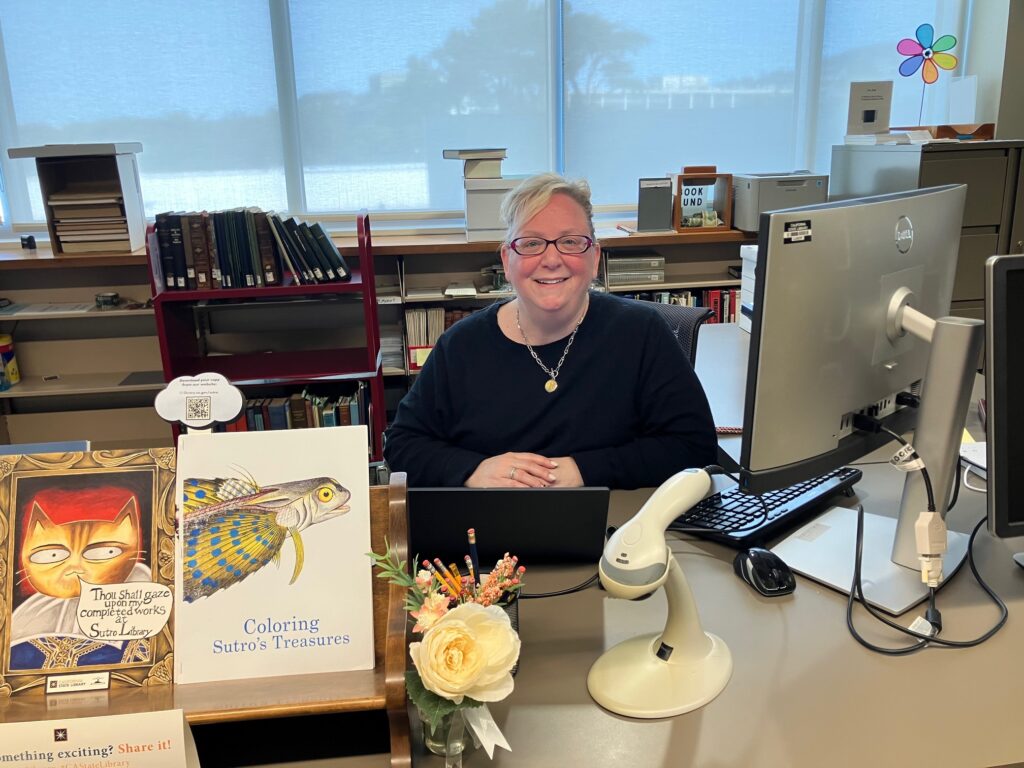 Mattie Taormina, the director of the Sutro Library at San Francisco State University, has become very familiar with the Banks collection. (Kirstin Downey/Civil Beat/2026)
For some years I have been working on a biography of King Kaumualiʻi of Kauaʻi, and the research has taken me many places around the world. The first known and documented contact between Europe and Hawai‘i actually happened on Kauaʻi in 1778 when Capt. James Cook and his crew landed here. Cook’s death the next year, in 1779, has attracted much hagiographic attention over the years but the rest of the story of this important set of first encounters remains much less well known.
After Cook died, the expedition’s command shifted to Capt. Charles Clerke, who was a distinguished navigator in his own right.
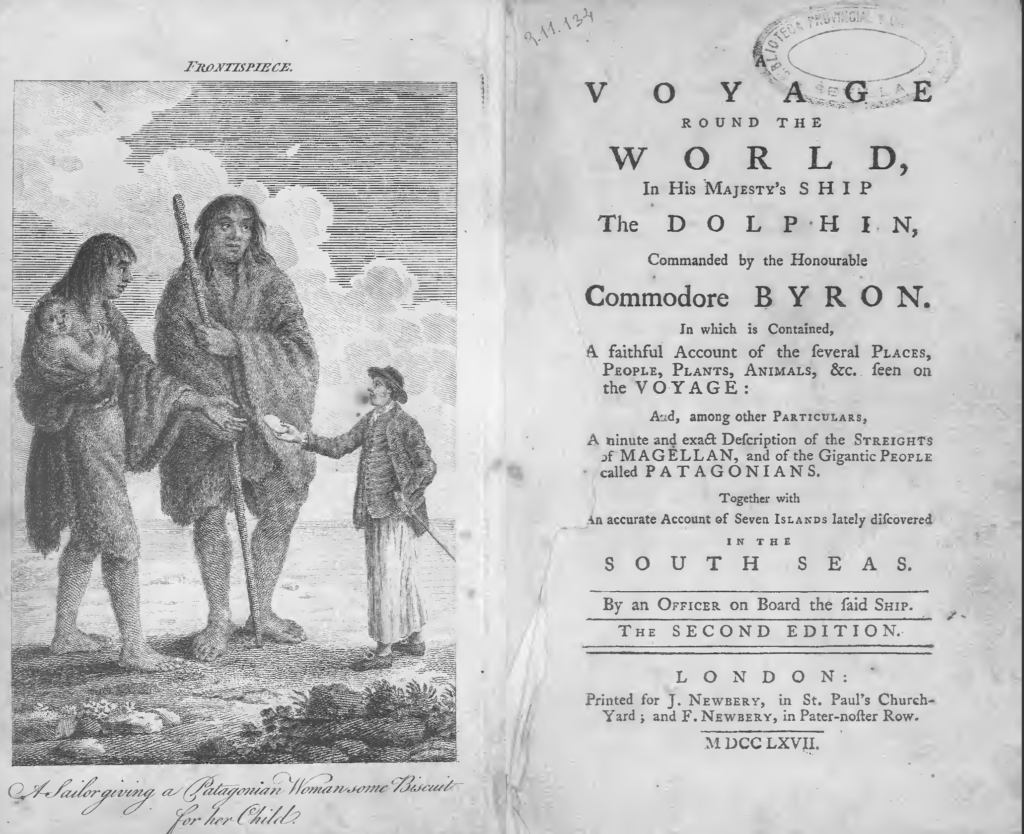
It was Cook’s third circumnavigation but Clerke had made the trip four times. He is believed to be the anonymous author of a book about his first circumnavigation in 1764, “A Voyage round the World in His Majesty’s Ship the Dolphin,” published in 1767. That book impressed Banks so much that the British botanist implored the British Admiralty to allow him to join a new expedition led by Cook to the Pacific, according to Banks’s biographer Toby Musgrove, author of “The Multifarious Mr Banks: From Botany Bay to Kew, The Natural Historian Who Shaped the World,” which was published in 2020.
Banks joined Cook and Clerke on that expedition, which was Cook’s first and Clerke’s second. They went to Tahiti, New Zealand and Australia.
The voyage sparked Banks’s lifelong fascination with Oceania. He was never again able to return but he became a man obsessed. He subsequently knew and heard much more about what was happening in the Pacific than almost any other person in that era.
Banks’ patronage meant that, over a period of about three decades, many ships that landed in Hawai‘i and returned to London had a few crew members who were actually in Banks’s employ. Merchants consulted him for his advice. Naval officers leaned on him for patronage. When they would return to London after voyages that lasted for years, Banks’s home on Soho Square became a first stop.
The Sutro collection is essentially a vast overview of the era of peak British imperialism, with tidbits from all over the world. Documents discuss a British plan to capture Panama from Spain to build a canal there; reveal the disturbingly high mortality rate among the convicts being shipped to Australia; ponder the big profits to be made in the Chinese opium trade; and discuss how the British negotiated with the Ottoman Turks to allow them to “procure the most perfect” of the sculptures from the Parthenon.
And the Sutro Collection also contains some interesting information about Hawai‘i.
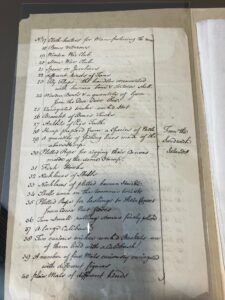
A handwritten inventory of items that Archibald Menzies brought back from Hawaiʻi on a voyage to the islands in the late 1700s. The list is among the Banks’ collection at the Sutro Library. Click image to enlarge. (Kirstin Downey/Civil Beat/2026)
An exchange of letters shows that Banks paid a botanist named David Nelson 35 pounds a year to travel with Cook on his third voyage, when he landed in Hawai‘i. That meant that Nelson was the first botanist to set foot on Hawai‘i to collect plant specimens, specifically done for Banks. Clerke was acting as Nelson’s supervisor on Banks’ behalf, according to letters at the Sutro Library.
Nelson collected more than 130 specimens, which were given to Banks and then to the British Museum of Natural History, where they became an object of study, according to University of Hawai‘i researcher Harold St. John.
Banks was pleased with Nelson’s work and sent him out again on another voyage he orchestrated. This time it was with Capt. William Bligh, on a voyage to gather breadfruit samples in Tahiti. Nelson ended up dying of disease in the aftermath of the famous mutiny and, according to the Sutro documents, Banks settled up with his family.
Physician Archibald Menzies, who traveled to Hawai‘i five times between 1787 and 1794, partially thanks to Banks’s patronage, provided Banks with a list of at least 30 items he had brought back from the islands on his last trip, which included a feathered helmet, cloaks and necklaces; a large sample of tapa cloth; wooden and stone war clubs; objects made with human bone; wicker baskets; jewelry and fine mats. The inventory is at Sutro.
The Duke of Portland wrote to Banks to thank him for what Menzies had delivered, saying the items would be given to, yes, you guessed it, the British Museum.
There is a brisk correspondence between Banks and the London Missionary Society, which had reached out to Banks for help in establishing a Christian beachhead in the Pacific.
Banks was not a religious man. He was a libertine, something of an 18th-century Jeffrey Epstein, and not inclined to endorse the stern moral code the missionaries were trying to introduce. The missionaries’ restrictions were partially for religious reasons and partially as a way to curtail sexually transmitted diseases introduced to Tahiti. These diseases decimated people with more relaxed sexual codes of conduct in the era before antibiotics were invented.
Thomas Haweis, a clergyman leading the London Missionary Society, told Banks that Tahiti was rapidly becoming depopulated. He told Banks that when Cook had first visited in 1769, he had estimated the population at 204,000, but that only about 7,000 Tahitians remained alive in 1802, he wrote.
In the correspondence at Sutro, Banks does not seem to have acknowledged any British responsibility for that problem. He was probably actually somewhat irritated by the missionaries and their preaching about the risks of casual sex.
But Banks clearly saw British evangelizing as another path to imperialism, and he was inclined to help where he could.
It didn’t exactly work out as he expected. Tahiti ended up becoming a French colony.
But Tahitian Christians, influenced by the British missionaries, brought the new religion to Hawai‘i and introduced the ali‘i to it, which caused a profound cultural and religious shift in Hawai‘i. That created a foundation for the American missionaries who followed in their path in the 1820s, who proved useful as teachers, helping introduce universal literacy.
The Hawaiian ali‘i might have been more willing to accept those ideas, which also included literacy to read the Bible and compose religious journals, because the Tahitians had already done so.
That literacy meant that Hawaiians were able to record their own version of their history. That gave us Samuel Kamakau, Davida Malo and Stephen Desha, among others, which provide an important counterfactual narrative to the official British story of what happened when Cook arrived in the islands.
So perhaps, unknowingly, Banks served a useful purpose to Hawai‘i, one he never would have imagined.

Sign up for our FREE morning newsletter and face each day more informed.
Sign Up
Sorry. That’s an invalid e-mail.
Thanks! We’ll send you a confirmation e-mail shortly.