

Long Beach residents can now receive harm reduction supplies like fentanyl test strips and overdose reversal medication for free — in the mail.
This represents an expansion of the city’s harm reduction program, launched in December 2023, which already offers in-person pick-up of supplies at several locations. More than two years later, the health department has distributed over 6,500 doses of Narcan — an opioid overdose reversal medication — and over 21,000 test kits to check for fentanyl and xylazine — a veterinary tranquilizer that has made its way into the illicit drug supply.
Mailing supplies will allow the health department to reach more and different people, said Ish Salamanca, with the Long Beach Department of Health and Human Services. The hours and locations of the department’s distribution sites don’t work for everyone, Salamanca said. And discreetly delivering the kits by mail allows the city “to reach folks who might feel a little stigmatized” picking up supplies in person.
In a November 2024 city council meeting, council members recommended expanding access to harm reduction resources in order to address what Councilwoman Suely Saro called “the crisis of our time.”
“We don’t want to take our eye off the ball on fentanyl and opioids,” Mayor Rex Richardson said in the meeting.
Months later, council members allocated $70,000 from the California Opioid Settlements, a pool of money from pharmaceutical companies and others found responsible for fueling the opioid epidemic, to fund a pilot program to mail fentanyl detection kits to 5,000 residents.
Now that pilot program is live. Within hours of the launch, Salamanca said he had received 30 requests to mail kits, compared to the five to ten requests that come in daily for in-person pick up.
Preliminary data show that fentanyl-related overdose deaths are declining in Long Beach, which the health department partially attributes to expanded prevention efforts, and free testing and overdose reversal supplies.
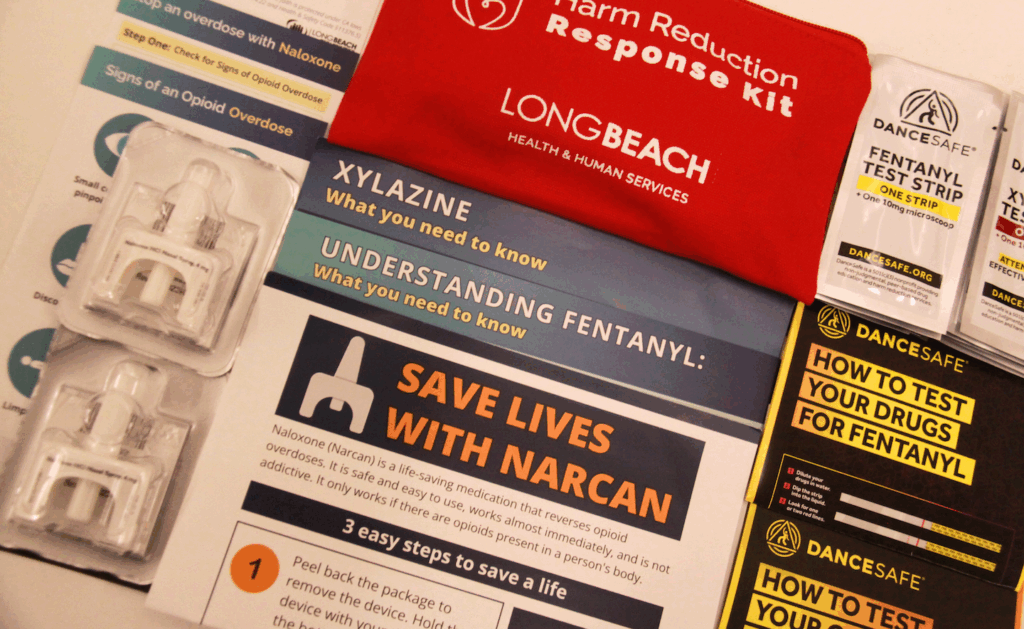 An example of a harm-reduction kit being distributed by the city of Long Beach. Photo courtesy the city of Long Beach.
Yet non-fatal overdoses are “not dropping as much as I would want them to,” Salamanca said. And while the city’s efforts have been focused on people experiencing homelessness and using substances, he is also “seeing folks overdosing at their homes or residences,” he said, according to data from first responders.
Despite all the inroads Salamanca and his team have made, “there’s a huge hurdle that we’re about to have to overcome, which is stigma,” he said, describing future plans to hold workshops and presentations in settings ranging from high schools to senior living facilities. While the focus on fentanyl has increased awareness of its dangers, Salamanca called for broader, more transparent conversations on substance use and access to resources.
Long Beach residents can order (and customize) harm reduction kits from the health department and access resources here.x