
If you live in the Sacramento region and have any amount of outdoor space, there’s a reasonably good chance you have a fruit tree — or two… or more — on your property. This time of year, you see them all over, lush green trees dotted with orange or yellow fruit.
If you do have fruit trees, there’s also a good chance a lot of it goes to waste. Citrus season is a time of abundance; some might even say overabundance.
Matthew Ampersand of Find Out Farms saw this excess. He also saw the need to feed people with food insecurity. The solution is simple: Harvest the fruit and close the hunger gap. Executing the solution is less straightforward. That’s why he started Community Fruit.
Ampersand corrals a pool of a few hundred volunteers to help the effort, though only a few dozen are active at any time. As residents submit their trees for harvest, he organizes groups, sometimes as small as one or two people at a time, to go out and pick fruit from the trees.
During citrus season, groups go out every week, sometimes multiple times a week. In the fall, they get a lot of persimmons.
“In the summertime, it’s a little less. Folks don’t want to share their peaches as much as they want to share their lemons,” Ampersand said.
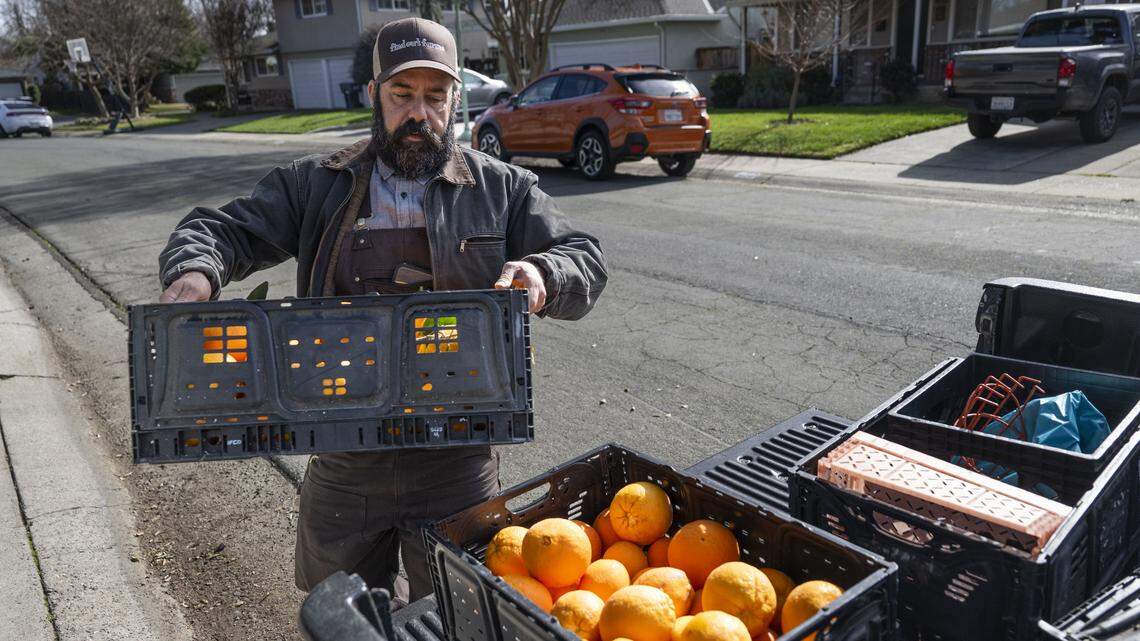
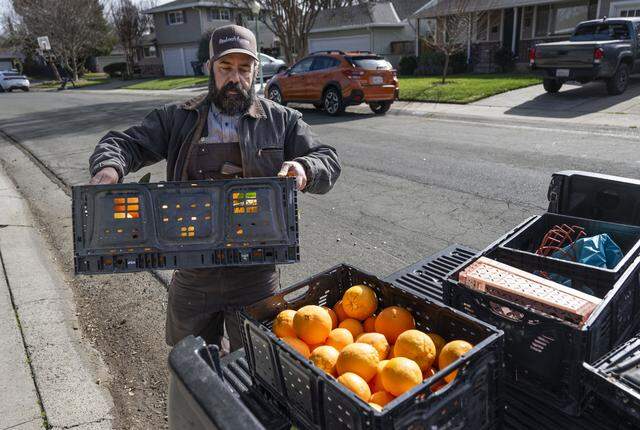 Matthew Ampersand, founder of Community Fruit based in Oak Park, loads oranges that his team picked in River Park on Monday, Feb. 23, 2026. HECTOR AMEZCUA hamezcua@sacbee.com
The fruit is distributed to Wellspring Women’s Center, Neighbor Program, NorCal Resist and occasionally River City Food Bank. They in turn get the fruit to those in need.
On a sunny morning last week, four volunteers from State Street Bank and Trust Company showed up at the farm, ready to get picking. State Street offers employees four days a year above and beyond their paid time off to engage in volunteer work.
Max Daly has been with State Street for 10 years and is the organizer of this group of volunteers.
“I kind of started the partnership with Community Fruit. I don’t remember how I found it, but I reached out to him and slowly started gathering volunteers. I’ve been doing it for like three years now,” he said.
The fruit is harvested using pickers, basket-like cages with clawed tips to catch the fruit, on extendable poles. More delicate, thin-skinned fruit like mandarins and Meyer lemons require a more hands-on approach using snips.
Harvested fruit is graded. “Firsts” are wholly intact fruit that can be donated. “Seconds,” ones where the stem may have been torn out or that’s cracked but still edible, are fair game for the volunteers to take. “Bin” fruit is anything that is too damaged or rotten to be used, and goes into the compost.
On this day, the volunteers will visit six sites, harvesting oranges and lemons. First stop is a private residence in River Park.
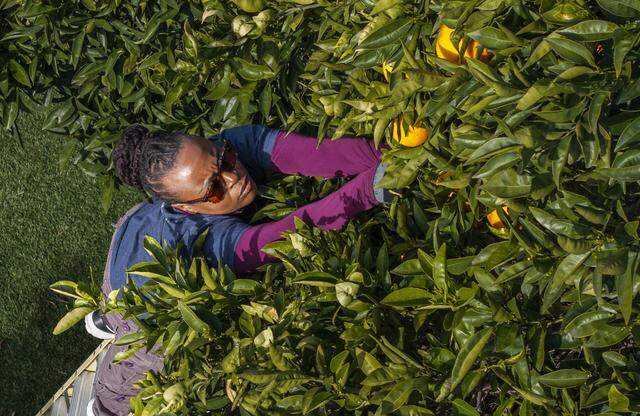 Kelle Byrd, of Stockton, a volunteer with Community Fruit based in Oak Park picks oranges at a home in River Park on Monday, Feb. 23, 2026. HECTOR AMEZCUA hamezcua@sacbee.com
Kathy Ulm has lived in the home since 1993. The two large navel orange trees in her backyard predate her. This is her first year working with Community Fruit.
“He answered my email really quickly. We’ll do this every year if we can, because we obviously can’t get to all of it,” she said.
As the volunteers get to work, the trees rustle from the tension of fruit being pulled from their branches. There’s an occasional thud as fallen fruit hits the ground. The air is perfumed with orange essence.
The fruit is packed into crates, which weigh about 50 pounds apiece once full. Ampersand estimates they’ll get at least 400 pounds from this property alone.
Xuan Fernando has been going on State Street’s Community Fruit excursions since Daly started them.
“I think it’s a great way just to get out of the office, and you’re doing something great for the community. The programs that he sends fruit to get a lot of food donations, but it’s not fresh food donations,” she said.
What I’m Eating
My friend Sara diligently organizes semiregular outings to various restaurants around town. She thoughtfully always includes me in the invitations, and I nearly always have a conflict.
However, when she put out a date this past weekend for Smile Market 2, a fast-casual Korean place in La Riviera, I was delighted that I was free.
Confusingly, Smile Market 2 also shows up as Smile Restaurant 2 in Google Maps and Smile Food 2 on their receipts, but you get the idea. It used to be an extension of its eponymous sister market around the corner on Bradshaw Road, but has since eschewed nearly all retail operations in the name of food service. According to photographic evidence, they’ve been enjoying their grand opening for at least five years.
The restaurant is a no-frills affair, a vacuous space with fluorescent lights and vinyl flooring. Smile is mainly known for variations on two Chinese-Korean fusion dishes: jajangmyeon ($12.95), thick noodles dressed in black bean sauce with pork, and jampong ($16.95), a spicy seafood noodle soup.
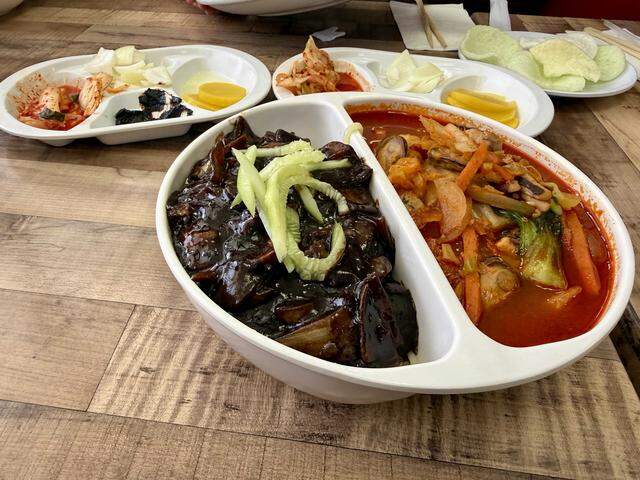 La Riviera’s Smile Market 2 serves up a house combo of jajangmyeon, noodles dressed in black bean sauce, and jampong, a spicy seafood noodle soup, for $18.95 on Saturday, Feb. 28. Sean Timberlake stimberlake@sacbee.com
Can’t decide? No problem, simply opt for the House Combo ($18.95), with one of each in a bifurcated bowl.
We were given a modest selection of banchan: some kimchi, pickled daikon, fresh onion and pastel-hued shrimp chips. Then came the noodles.
I cannot overstate the sheer immensity of the servings. Not only was it more than I could eat at lunch, it was more than I could have eaten in a couple days. You certainly get your money’s worth.
The noodles are chopstick-challenging, though scissors are provided to cut them down for easier eating. The jampong was abundant with calamari, octopus and mussels, if a little overboiled for my tastes. I still took home a quart container of each.
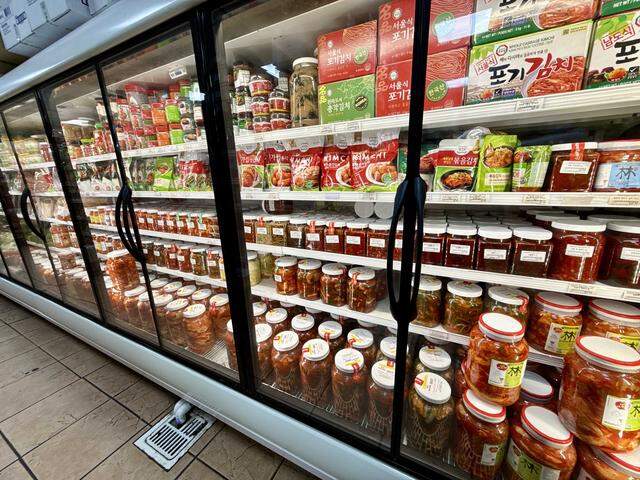 La Riviera’s Smile Market at 2950 Bradshaw Road sells a wide variety of kimchi, including a version they make in house. Sean Timberlake stimberlake@sacbee.com
After, on recommendation from another friend, I had to pop into Smile Market 1 to admire the wall of kimchi and pick up a tub of the fresh, crisp housemade stuff for $7.99.
Smile Market 2
Address: 9545 Folsom Blvd., La Riviera
Hours: 11 a.m.-3 p.m., 4 p.m.-9 p.m. Mondays and Wednesday-Friday; 10 a.m.-9 p.m. Saturdays and Sundays
Phone: 916-376-7217
Vegetarian options: Limited; the cream cheese wonton seems to be about it
Noise level: Moderate when we were there, but I imagine it could get loud if busy.
Loading…
Openings & Closings
After over 15 years in business, Fair Oaks sushi restaurant Yui Marlu announced its closure on social media on Sunday. The post said that it was a “difficult decision” and that they “did not make it lightly,” going on to thank customers’ patronage.
Another sushi concept, Elk Grove’s Hello Temaki, announced it was shuttering last week. The final day was initially set for Feb. 28, but due to “overwhelming support,” Hello Temaki will stay open an extra week, planning to close on March 7.
Mati Modern Greek Cuisine opened Friday in the Roseville location formerly housing Pete’s Restaurant & Brewhouse at 3003 Douglas Blvd. in Roseville. In a post on its social media, Mati touts a “fresh take on Greek flavors, a warm atmosphere, and a space designed to bring people together.”
Related Stories from Sacramento Bee