
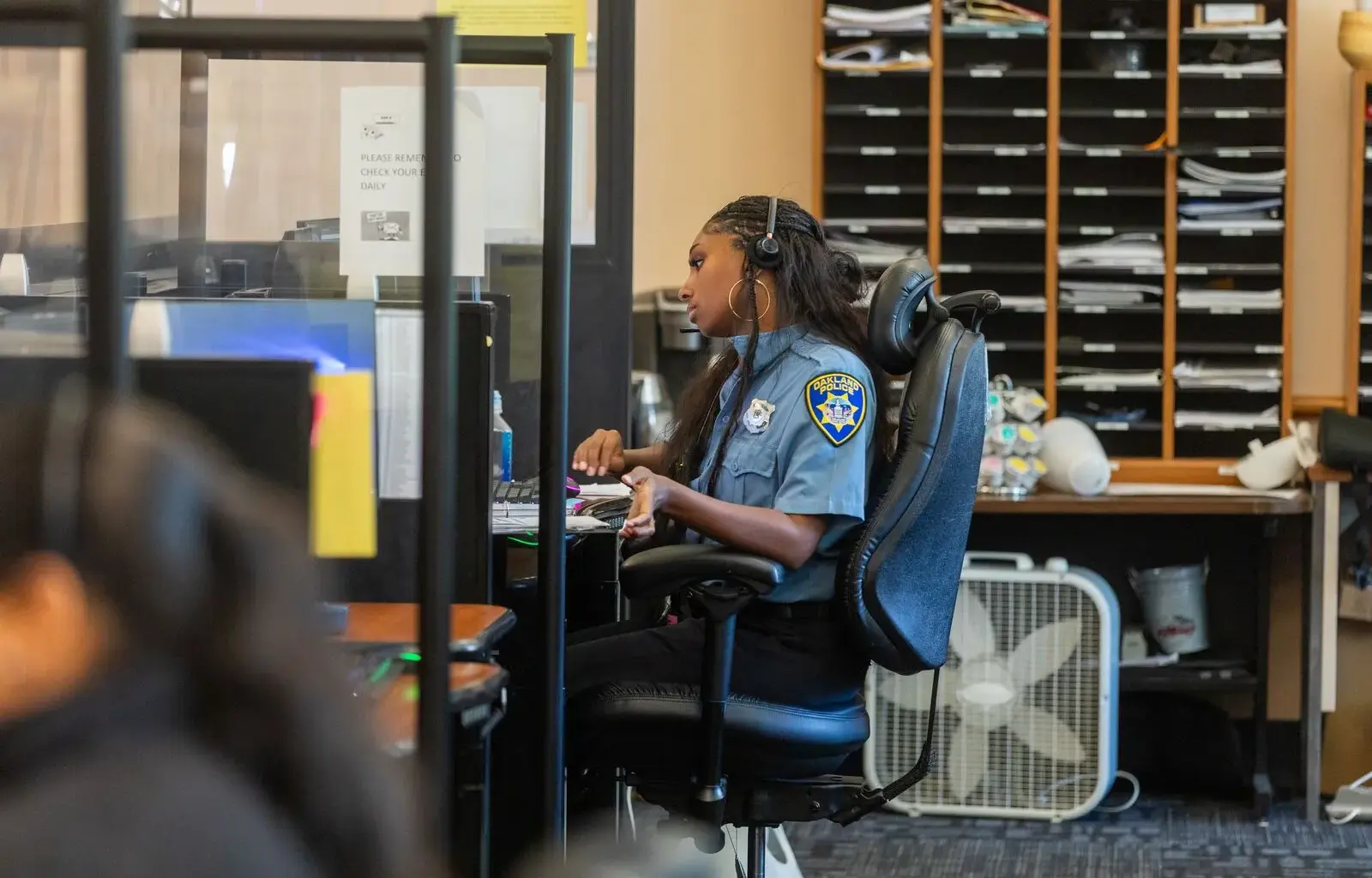
Last year, Oakland’s city auditor warned that Oakland is seriously understaffing its 911 dispatch center. The report echoed multiple other audits and investigations going back nearly a decade, showing that OPD’s emergency call center has lacked adequate staffing, undermining its ability to quickly pick up calls and send officers to respond to emergencies.
Although there was some improvement in performance last year, understaffing is still a problem today, and it’s burning a hole in the city’s overtime budget.
OPD is budgeted for 78 dispatchers, but according to recent reports, the 911 call center only has 66 positions filled. 10 dispatchers are currently on different types of leave and nine dispatchers are trainees, according to OPD. Three out of the seven supervisor positions are currently vacant.
All told, overtime is being used to cover 27 dispatcher positions, or roughly 34% of the division’s budgeted jobs.
This is not much better than where the department landed at the end of the last fiscal year. Between April and June of 2025, OPD reported that it was using overtime to back fill 32 dispatcher positions.
Overtime spending on the communications unit, including 911 dispatchers, is still relatively small compared to the amount of overtime used by other OPD divisions. But the department reports that the communications unit burned through over $2.6 million on overtime last year. The communications unit is projected to spend a similar amount on overtime in this current fiscal year, which ends in June.
Antoinette Blue, chapter president of SEIU Local 1021, has served as an OPD dispatcher for seven years. Throughout that entire period, the city has relied on mandatory overtime to staff dispatcher positions, she said.
“When we’re working constantly, it really does bog down the dispatcher; it impacts them,” Blue told The Oaklandside. She added that dispatchers do “a hell of a job compartmentalizing.”
City leaders have started to scrutinize OPD overtime use following a report from The Oaklandside that revealed the department’s failure to document how one senior officer racked up hundreds of thousands of dollars in overtime. A City Council subcommittee will be discussing the issue at a meeting on March 10.
Staffing the emergency call center has been a longstanding problem for Oakland
In 2014 and 2015, the amount of time it took dispatchers to answer 911 calls was higher than the national and state standards, according to a nearly decade-old investigation by the Oakland City Auditor. The auditor found that callers would become so frustrated by the lack of response that they would sometimes just hang up. That report blamed understaffing, large call volumes, low pay, and out-of-date technology.
At the time, OPD’s Bureau of Services Deputy Director Virginia Gleason speculated that many people undergo training in Oakland to become dispatchers and then leave to work at other agencies where they have better pay and fewer mandatory overtime hours.
Since 2020, there have been two reports by the Alameda County Grand Jury that found Oakland was failing to meet state standards for 911 response times. Those reports cited several problems, including understaffing.
In 2023, NBC reported that Oakland’s average 911 answer time was the second worst in the state. The California Governor’s Office of Emergency Services warned the city that summer it was at risk of losing state funding if it didn’t improve its 911 response times.
City officials were hit by a scandal that same year when Oakland’s Human Resources Department was revealed to have not processed hundreds of applications for 911 dispatcher jobs between 2022 and 2023.
This appeared to mark a turning point for the city. OPD assured councilmembers at the time that they were making progress in reducing vacancies and slashing the time it takes to hire dispatchers. And in 2024, the city boasted about upgrades to the emergency response center, thanks in part to $2.5 million in extra funds scrounged up by the mayor and other officials. By September 2024, the city reported answering 51% of 911 calls within 15 seconds. This was still below the state standard of 90%, but it marked a significant uptick over the prior year.
Meanwhile, OPD’s dispatcher vacancy rate remained stubbornly high. Between 2020 and 2025, the rate ranged between 14% and 24%.
Last October, the City Auditor published another investigation that raised concerns about Oakland’s dispatcher system, including the fact that there aren’t enough dispatchers answering calls. The auditor pointed to a 2019 study that found Oakland needed a minimum of 105 full-time dispatchers to handle the city’s call volume. In the following years, the volume of calls increased while staffing remained well below the recommended minimum level.
In addition to being expensive, Oakland’s most recent audit found that longer dispatch shifts exhaust workers, making it more likely that people will commit errors. Oakland dispatchers have complained about overtime dampening their enthusiasm for the job, and one who was interviewed by the auditor said that it leads to “a lot of burned-out dispatchers.”
The typical shift for a dispatcher is roughly eight to 10 hours, but it can be extended up to 16 hours if the emergency response center is understaffed. Blue said Oakland dispatchers are averaging 12-16 hours per day.
The amount of overtime used by dispatchers varies year by year, but it’s consistently high. In 2017, dispatchers worked an average of 10 hours of overtime per week, resulting in 521 total overtime hours, according to the recent city audit. In 2021, dispatchers logged a total of 452 hours of overtime, which averaged out to 8.7 hours per week per dispatcher. In 2015, KQED reported that some dispatchers worked so much overtime that they increased their base pay by 50%. According to Blue, dispatchers currently work an average of 14-20 hours of overtime each week.
Blue said the city is actively recruiting dispatchers and that the department has received a lot of interested applicants due to media reporting about the staffing issues. She added that she understands community members are frustrated with delayed calls, but that the performance of dispatchers is “100% improving.”
“The people behind the 911 calls, the only thing we’re focused on is getting the community the help they need,” Blue said. “Understand that no emergency falls by the wayside. We care about every single call.”
We asked OPD what the department is doing to hire more dispatchers and retain existing staff. Officials did not provide responses before publication.
The city is currently advertising dispatcher positions as a “featured” opportunity on its website with a salary ranging from $107,000 to $118,000, plus benefits.
“*” indicates required fields