
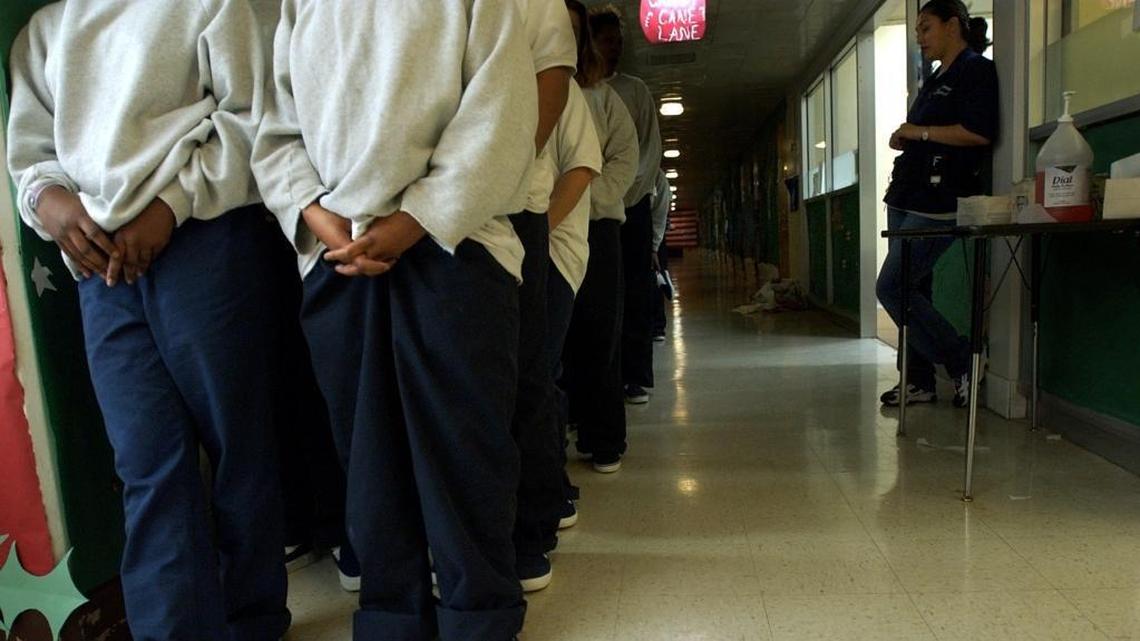
Young girls of F Unit line up to go to breakfast as they are monitored by a deputy probation officer, right, at the B.T. Collins Juvenile Center in Sacramento in 2001.
Jose M. Osorio
Sacramento Bee file
Two bills that would permit more touch in California detention facilities passed out of a key committee Tuesday.
The Hug Act, authored by Assemblymember Isaac Bryan, D-Jefferson Park, would make it a right for incarcerated youth to hug a visitor. The Humanizing and Uniting Generations Safely (HUGS) Act, authored by Assemblymember Mark Gonzalez, D-Los Angeles, would allow for more nonsexual physical contact between adults locked up in California prisoners and their visitors. The two lawmakers came up with the bill ideas separately, and decided to be co-authors on each other’s bills, according to Gonzalez’s office.
“My interest in this issue came at a very young age when I used to visit my brother when he was incarcerated,” Bryan told the Assembly Public Safety Committee during a hearing for his bill, AB 1646.
Bryan said that first experience when he was 10 years old led to an ongoing relationship with juvenile facilities, including a visit to the Los Padrinos Juvenile Hall in Los Angeles during Christmastime last year. He said when he asked some teenagers what changes they might want to see at the facility, he was surprised by their answers.
“A group of them, you know, kind of collectively said, you know, we really wish we could hug our moms,” he said in an interview Wednesday. “They’re like, 13 or 14 years old, and my mouth hit the floor. I couldn’t believe what I had just heard.”
Los Padrinos is part of an extensive network of juvenile detention facilities that operate on the state and local level. Although some juvenile halls allow for hugs, and the state Office of Youth and Community Restoration has issued guidance encouraging hugs, Bryan said his office’s research turned up stories of policies prohibiting them along the length of the state.
“We know it’s a statewide problem, but we know it’s not a problem everywhere, which is a reminder that this can and should be done,” he said.
Bryan brought a few of the Los Padrinos boys’ mothers to testify Tuesday, including Leticia Diaz, whose son Peter has been in the facility for the past two years.
“She often cries sitting across from him, and he wants to comfort her with a hug, but if he does, he is not able to see her for three weeks,” read a translator following Diaz’s testimony in Spanish.
Although there was no formal opposition for the bill, the Chief Probation Officers of California testified about their concerns with the bill.
“There are at times safety measures that would warrant changes to be made in a given visitation circumstance,” said Danielle Sanchez, the group’s legislative director, adding that making a hug a “right” would open up concerns for litigation.
The bill passed with full Democratic support. Neither Republican on the committee cast a vote on the measure.
More touch for incarcerated adults, too
Gonzalez, a member of the Public Safety Committee, did not testify on his HUGS Act, AB 1645, since it passed via the consent calendar, an opportunity given to bills with no opposition.
Whereas adults with visiting rights in California prisons are allowed a brief hug at the start and end of the visit, they may not have “excessive contact,” which Gonzalez said can be a confusing term.
According to the bill’s analysis: “Instead of prohibition on bodily contact with limited exceptions, this bill would prohibit CDCR regulations from unreasonably restricting the ability of incarcerated persons or their visitors to have nonsexual physical contact throughout the visit.”
The bill defines “nonsexual physical contact” to include things like hand holding, kissing, hugging, feeding and holding of the incarcerated person’s minor children.
Both bills will now go to the Assembly Appropriations Committee for review.
This story was originally published March 4, 2026 at 2:26 PM.
Related Stories from Sacramento Bee

The Sacramento Bee
Kate Wolffe covers the California Legislature for The Sacramento Bee. Previously, she reported on health care for Capital Public Radio in Sacramento and daily news for KQED-FM in San Francisco. She is a graduate of UC Berkeley.