
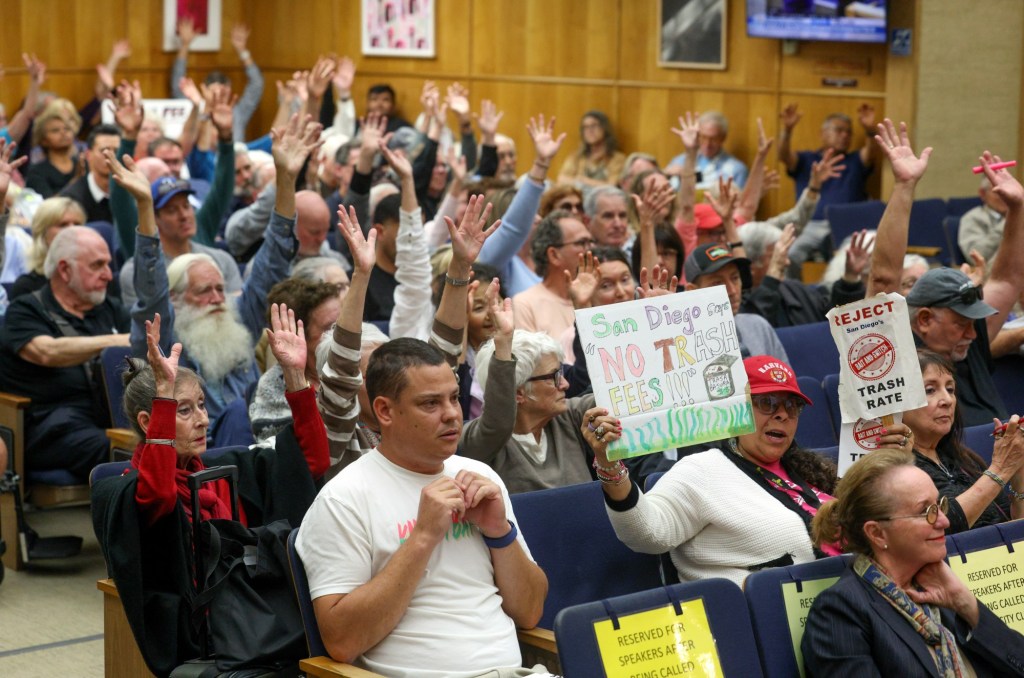
The announcement Monday by the Lincoln Club Business League that it would seek to place a measure on the November ballot that would cancel for two years the city’s new fee on trash collection for more than 200,000 single-family homes is an overdue milestone. The extraordinary bad faith shown by eight San Diego elected leaders — Mayor Todd Gloria, City Attorney Heather Ferbert and City Council members Joe LaCava, Sean Elo-Rivera, Jennifer Campbell, Kent Lee, Vivian Moreno and Stephen Whitburn — in orchestrating the fee’s imposition deserves such a dramatic rebuke.
In 2022, voters who were asked to consider amending the City Charter to allow the fee were told it would be $23 to $29 a month, a modest sum that led to Measure B’s narrow approval. But in June 2025, the basic fee was set by the council at $43.60, going up to $55 in July 2027. Gloria, incredibly, claimed the reason the fee was so much higher was due to demands for additional services made by city residents at “hundreds of community meetings.”
His perfidy didn’t stop there. The mayor is one of the many Democrats who argue that it is a moral imperative to make voting as easy as possible. Under a state law enacted by voters in 1996, a local fee can be blocked if more than half of those affected confirm their opposition after receiving a formal notice from the city that imposed it. But the notice sent last spring was so vague and confusing that few people used it to object. Of course this was a calculated power play, not a bureaucratic botch.
For her part, in March 2025, Ferbert completely betrayed her 2024 campaign promise to avoid political machinations as the city’s top lawyer. She said that Measure B’s language about “city forces” providing trash collection services somehow superseded a 2006 City Charter amendment approved by 60% of voters that specifically allows outsourcing of city services under a “management competition” process. While it is universally accepted that a state law can’t supersede that state’s constitution, and a federal law can’t supersede the U.S. Constitution, Ferbert calculatedly interpreted the City Charter — San Diego’s constitution — to the direct benefit of Gloria and public employee unions.
The fact that the city won’t outsource services and save money even though trash collection has been successfully privatized in many cities can’t be emphasized enough. The city’s poor fiscal picture would be much improved if elected leaders had heeded not just voters’ enthusiasm about outsourcing but their 66% support for a later-invalidated 2012 ballot measure that stopped providing most new city hires with extremely costly defined-benefit pensions. Instead, voters’ wishes were ignored in favor of municipal unions’ wishes.
Stopping the trash fee for two years should only be the first step toward forcing change on City Hall. Taxpayers are ready to back carefully vetted ballot measures mandating — not allowing — outsourcing and implementing 2012’s pension reforms.
They are unlikely to agree with Elo-Rivera’s view — reported by Voice of San Diego — that anyone who suggests repealing the trash fee “should be a pariah in any serious San Diego circle and not be considered a member of the problem-solving community.” A politician who ignores voters’ wise counsel on outsourcing and pension reforms thinks he gets to decide who belongs to “the problem-solving community.” Feel free to laugh or groan or both.