
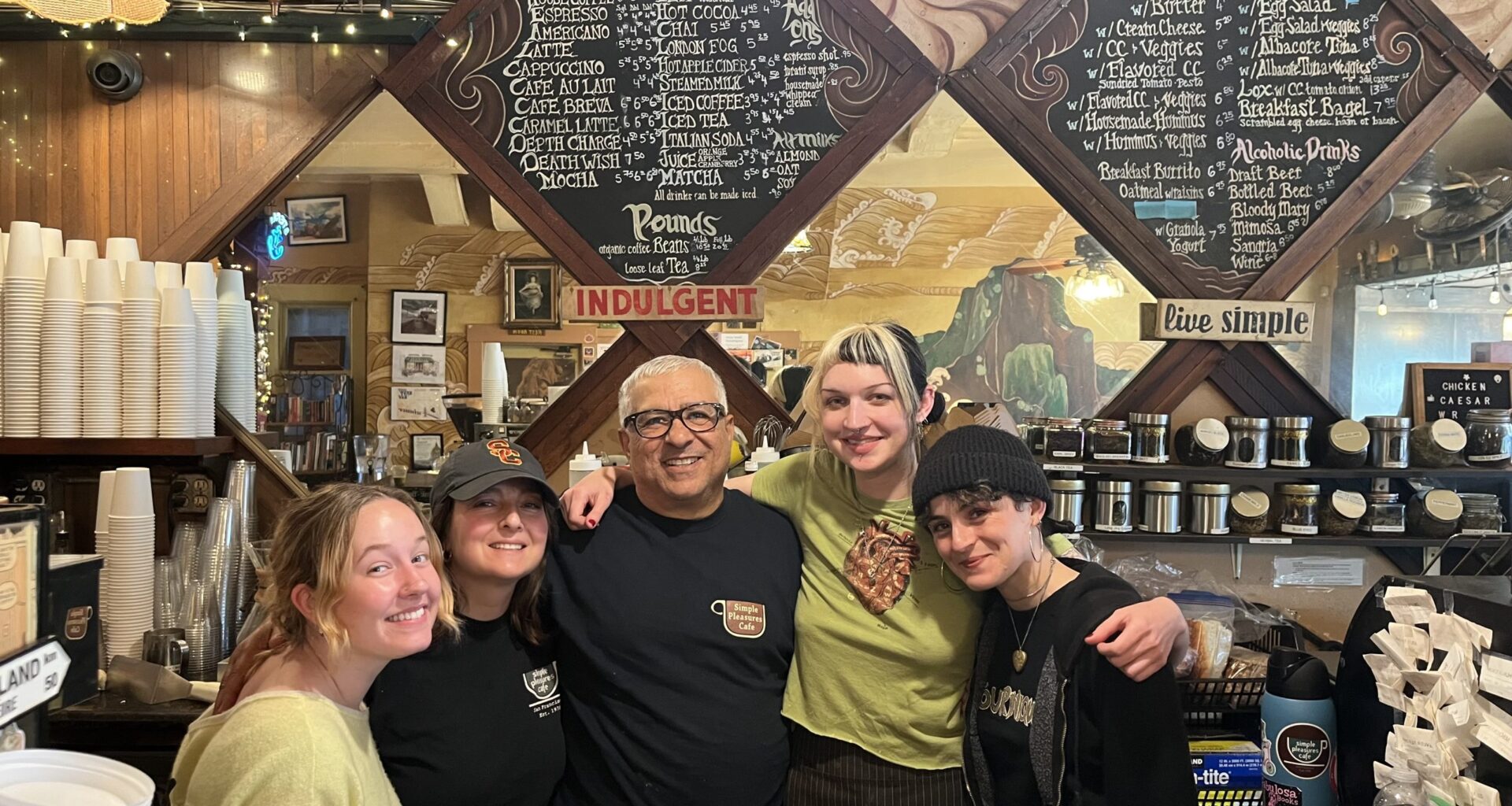
I’m not sure I made the best first impression on Ahmed Riad.
It was a rainy afternoon in the Outer Richmond, and I was meeting a friend for coffee at Simple Pleasures on Balboa Street. The cafe’s wood panelling makes for a good, cozy place to meet and discuss, you know, Bohemian things.
Behind the counter was Ava, a classmate of mine from elementary school. Ava knew my friend from a past job.
“Wait,” she said. “How do you guys know each other?” The three of us spoke at some length for some time.
Also behind the counter was Ahmed Riad, who’s owned Simple Pleasures since 1994. Riad was busy, hunched over the counter, silently working with his hands. We were holding up the line.
A few days later I ran into Riad and his wife Diana Riggio at an event for owners and enthusiasts of San Francisco’s legacy businesses. (They were the former, I the latter). “I remember you,” Riad said, adding that he recalled thinking: “Move along!”
I imagine also: “Back to work Ava!”
But he didn’t prod, he said, because he’s seen it all before. Holdups created by welcoming friends, we agreed, is a natural consequence of running a cafe where “people hang out.” Although he’d like to run the place with a degree of efficiency, he recognizes that moments like those are what make his cafe special among the Richmond’s many, many coffee shops.
“I know it sounds corny to say, but it’s really built by customers,” Riad continued on a recent Monday, in between greeting regulars. He wouldn’t have it any other way.
Originally from Egypt, Riad came to San Francisco in the 1980s and found work as a barista at the North Beach institution Caffe Trieste, which had been a stalwart of a certain fad called “espresso” since 1956 and was still one of the only places in San Francisco that offered this relative oddity.
Riad trained under the auspices of Giovanni ‘Papa Gianni’ Giotta, first learning the ropes behind the counter and, eventually, techniques for roasting coffee beans. He recalled Giotta and other coffee mentors with a real fondness.
He later trained with an “all-timer espresso repairman, who was, like, old school San Francisco. Like, seriously, old school San Francisco. You feel the salt of the city.”
When Riad and the repairman visited the Outer Richmond around the early 1990s for a job at Simple Pleasures, he marveled at the cafe, which had been there for nearly 15 years.
They had arrived for the job in the evening. The outer avenues were dark and quiet, not a soul outside. But inside the cafe, people were dancing, drinking coffee, and listening to music by candlelight.
“I just immediately looked at it, and I’m like, that’s home,” he said.
The “hippie anarchists from the ‘70s” who founded the place had built an institution like those he remembered in Egypt.
“Where I come from, people hang out in cafes … If you’re not working, you’re not sleeping, you are in a cafe. All the time,” he said. “It was such a strong community that just immediately reminded me of home.”
Riad took over Simple Pleasures a couple of years later, and opened up his own roastery next door. He kept most of the decor, added some benches, tweaked the menu here and there. Soon after, he met Riggio, who was a regular customer.
She was working nearby at the Cliff House, and taking courses in chemistry at San Francisco State. The cafe “became my hangout,” she said, and a study spot.
“Smart and pretty,” Riggio recalls him saying one day, wiping down the table next to hers.
“We were friends for many years until we weren’t,” she said. They married in 2001, and have run the cafe together since.
There is, of course, a healthy dose of nostalgia in every cuppa served at Simple Pleasures: for the cafes of Cairo, the maestros of Italy, the beatniks of North Beach.
But there is also a real present current sustaining the place, in the form of the people who keep hanging out there — those who attend the open mic nights and regularly scheduled hangouts and the free or low-cost tutoring sessions which the cafe serves as a venue for.
“I don’t know of any places left that look like this anymore,” Riad said.
So, I don’t feel too bad about distracting Riad’s employees. It seems I’m not alone.
“The main complaint that people will have — ‘Oh, you talk to somebody too much,’” he said. “There’s a balance between taking too long with one person and serving the next person.”
And, now that we’re on more familiar terms, I’ve come to learn that Riad, too, can tend to talk at some length for some time. At times he’s apologized for his loquaciousness.
“I’m sorry,” he said at the end of our interview. “Every time you talk to me it takes so long. It’s like you asked me ‘what time is it now?’ and I’m telling you how to make a watch.”
Guess it’s the cost of doing business.