
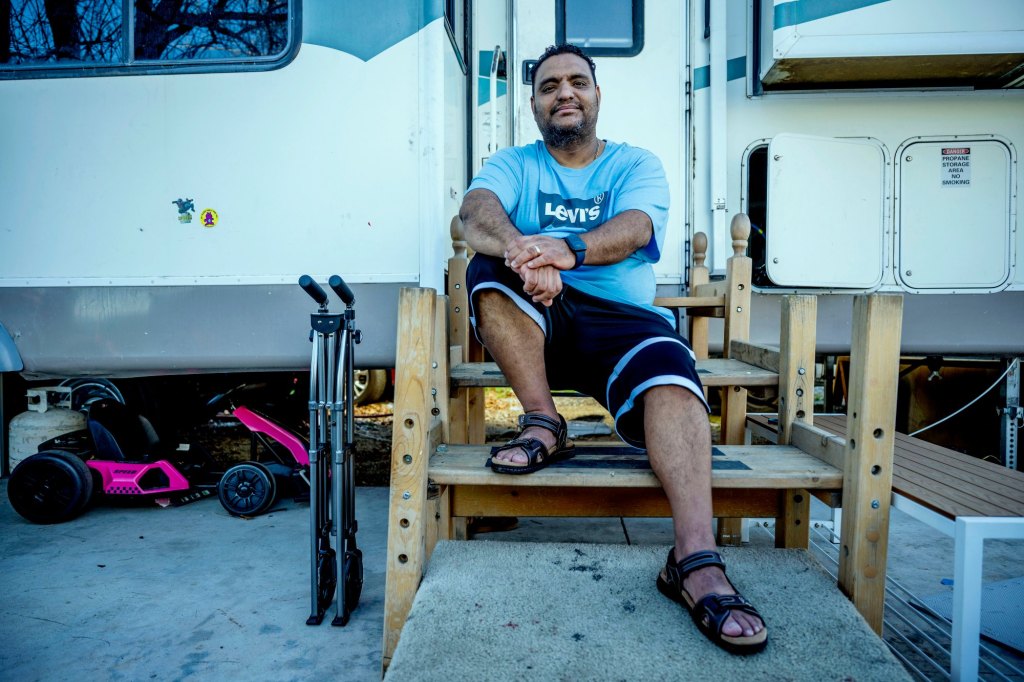
Herman Rovelo-Gallegos fled to the U.S. six years ago with his wife and young children from Honduras, where he said gangs killed his brother and tried to kill him, too.
In the U.S., Rovelo-Gallegos followed the rules. He filed his asylum application on time. He got work authorization, a Social Security card and a driver’s license. He wore an ankle monitor for more than a year and attended his immigration court hearings and check-ins. He has no criminal record.
Immigration and Customs Enforcement arrested him anyway. On Jan. 5, they took him as he was making an Amazon delivery to a customer on Camp Pendleton. He was jailed for more than a month at Otay Mesa Detention Center, where he said he wore the same set of clothes for 20 days in a row and got sick from the food.
The detention was unlawful, Rovelo-Gallegos’ attorney later argued in court, alleging that ICE denied him due process — they failed to give him adequate notice of why he was being detained, and they failed to give him an interview in which he could respond to his detention, both of which were required by federal regulations. On Feb. 11, a San Diego federal judge agreed and ordered his immediate release.
Rovelo-Gallegos won his freedom by filing for habeas corpus, a court petition that challenges the legality of a person’s detention. He’s one of thousands of noncitizens around the country who have turned to this eight-century-old legal tool to challenge ICE’s campaign of mass arrests.
From last January to this February, about 1,400 such immigration-related petitions have been filed in the U.S. Southern District Court of California, which covers San Diego and Imperial counties, according to the U.S. Attorney’s Office. More than 24,000 petitions have been filed nationwide since President Donald Trump took office, according to Habeas Dockets, a website that tracks such cases.
Noncitizens detained by ICE say in the petitions that they were arrested without proper justification and in violation of due process rules, as well as ICE’s own regulations. Federal district judges have overwhelmingly agreed with them.
The Union-Tribune reviewed dozens of San Diego federal judges’ opinions on these cases and found that the district court has, the vast majority of the time, either ordered ICE detention centers to immediately release the petitioners or ordered immigration courts to give them a bond hearing.
Despite the repeated court orders, neither ICE nor immigration courts, which are overseen by the Trump administration and operate separately from the judicial branch, have appeared to change their practices.
The number of habeas petitions filed continues to rise every month in the Southern District Court, and they repeat similar or identical language and arguments as petitions that have already been decided.
In response to questions from the Union-Tribune, a Department of Homeland Security spokesperson said the Trump administration is “applying the law as written.”
 Noncitizens held at Otay Mesa Detention Center have increasingly turned to habeas corpus petitions to request release, alleging their detention is unlawful. (Nelvin C. Cepeda / The San Diego Union-Tribune)
“No lawbreakers in the history of human civilization have been treated better than illegal aliens in the United States,” the spokesperson said. “Additionally, it should come as no surprise that more habeas petitions are being filed by illegal aliens — especially after many activist judges have attempted to thwart President Trump from fulfilling the American people’s mandate for mass deportations.”
Immigration arrests have occurred at workplaces, during traffic stops, outside Home Depot, and while washing a car in a driveway, habeas court orders filed in the Southern District show. Some were arrested at Camp Pendleton as they were making deliveries or dropping off ride-share passengers. And many were arrested while attending required ICE check-ins and immigration court hearings.
Longtime immigration attorneys said this is the first time in decades, or ever, that they have had to file habeas corpus petitions for their clients.
“The last time I filed a habeas petition was in 2005, until all of this came down,” said Rekha Sharma-Crawford, second vice president of the American Immigration Lawyers Association. “So yeah, I think it is completely not normal.”
What’s unusual during this administration, attorneys said, is that noncitizens who normally would have been granted bond or a bond hearing while their immigration proceedings continue are now systematically being denied it. Some people are being held for indefinite amounts of time in immigration detention. And noncitizens who are doing everything ICE told them to do — attend check-ins and court hearings, for example — are still being arrested.
“Basically, this is the only way that you can fight back,” San Diego immigration attorney Bashir Ghazialam said of habeas petitions.
Revoking release without reason
Many who have filed habeas corpus petitions are noncitizens who first entered the U.S. years or even decades ago. They were inspected by immigration officials when they arrived and were eventually released, often with conditions they had to follow, such as attending ICE check-ins.
Among those who have filed successful habeas petitions was a Guatemalan man who fled to the U.S. in 2024 because of extortion and threats from a criminal group and was granted humanitarian parole by the U.S. government one month before Trump took office. Eight months later, he was arrested while attending his required immigration court hearing, without getting a chance to be heard or being provided reasons why his parole was terminated.
A Laotian permanent resident who was convicted of drug possession and discharging a firearm decades ago wasn’t deported at the time because Laos wouldn’t issue him a travel document. Since then, he has followed all the rules, not committing any more crimes and attending all ICE check-ins for 25 years, according to court records. In August, ICE arrested him at his check-in appointment without explaining why or giving him a chance to be heard.
“President Trump and Secretary (Kristi) Noem are now enforcing the law and arresting illegal aliens who have no right to be in our country, and reversed Biden’s catch and release policy,” the DHS spokesperson said in an email. “If an immigration judge finds an illegal alien has no right to be in this country, we are going to remove them. Period.”
But once the government releases somebody from immigration detention, it isn’t allowed to simply re-detain somebody later, as the Trump administration is doing now, district court judges say. Judges have referenced the court case Saravia v. Sessions, which concluded that “once a noncitizen has been released, the law prohibits federal agents from rearresting him merely because he is subject to removal proceedings.”
Federal law only allows ICE to re-detain somebody in a few specific cases, such as if the person broke the rules of their release. If ICE re-detains somebody, its rules also say it must explain the reasons why and provide an interview in which the person can respond to those reasons.
“Government agencies are required to follow their own regulations. Courts have found that when ICE fails to follow its own regulations in revoking release, the detention is unlawful, and the petitioner’s release must be ordered,” U.S. District Judge James E. Simmons Jr. said in an October opinion granting a habeas corpus petition.
Too long in detention
Also at issue is how long ICE is keeping detainees locked up: Many are filing habeas petitions after being detained for nearly a year, or longer.
Prolonged and indefinite detention is a key tactic of Trump’s immigration enforcement, attorneys said, because it makes it more difficult for people to fight their cases. It’s harder to keep in contact with attorneys and family while in detention, and the rough conditions of incarceration help to discourage people from fighting to stay in the U.S., attorneys said.
But district court judges have noted that case law and federal statutes prohibit ICE from detaining people indefinitely or for prolonged periods of time.
A Ukrainian man and a Russian woman brought their two daughters to the U.S. in December 2024 seeking asylum. They were detained at Otay Mesa Detention Center, and their daughters were taken from them and put into foster care, according to court records. Their asylum claims were denied in early January 2025, and they were ordered to be deported — a decision they appealed.
By the time they filed a habeas petition last month, more than a year had passed since they were detained, and they were still locked up at Otay Mesa, still separated from their daughters in foster care, and still waiting to hear back on their appeal. While in foster care, one of their daughters was diagnosed with post-traumatic stress disorder and depression due to being separated from her parents, according to court records.
U.S. District Judge Ruth Montenegro agreed that their due process had been violated and ordered a bond hearing for the couple. The outcome of that hearing, or whether it has occurred, is not publicly available.
Among other case law, Montenegro cited the 9th U.S. Circuit Court of Appeals, which in 2018 said of immigration detention laws: “We have grave doubts that any statute that allows for arbitrary prolonged detention without any process is constitutional … Arbitrary civil detention is not a feature of our American government.”
In 2001, the U.S. Supreme Court said in a Louisiana case, Zadvydas v. Davis, that it’s “presumptively reasonable” to detain a noncitizen who has been ordered to be deported for up to six months. Once those six months pass and if the noncitizen can show deportation is “no longer reasonably foreseeable,” continued detention is no longer permitted by law, the court held.
Bond hearing denials
It’s also become much less common under Trump for noncitizens to get a bond hearing pending their immigration proceedings, attorneys said. That’s a decision left up to immigration court judges, who are under Trump’s authority within the Department of Justice.
Under Trump, immigration courts have been denying bond hearings to noncitizens who had first come to the U.S. without being inspected by immigration officials and have since lived here for many years. Immigration judges have claimed they are applying for admission to the U.S. and therefore are subject to mandatory detention per federal law. But federal district court judges have said that assumption is incorrect.
In November, the U.S. Central District Court of California ruled in a class-action case, Maldonado Bautista v. Santacruz, that these noncitizens are not meant for mandatory detention and are entitled to a bond hearing. The chief immigration judge, Teresa Riley, last month told immigration judges in an email to ignore the court’s order.
Even after a federal judge orders a bond hearing, attorneys said they are now finding that immigration judges will more frequently deny them bond at the hearing, and the government’s attorneys will consistently appeal any bond granted. Attorneys also said they have seen immigration judges recently broaden the definition of who they consider to be a flight risk.
Immigration bond denial rates by month have risen since last summer, from less than 50% in June to more than 62% in December, according to data from Syracuse University’s Transactional Records Access Clearinghouse.
‘No future for them in Honduras’
Rovelo-Gallegos doesn’t know whether ICE is going to deport him — when he pulls up his immigration file on ICE’s online portal, it’s blank.
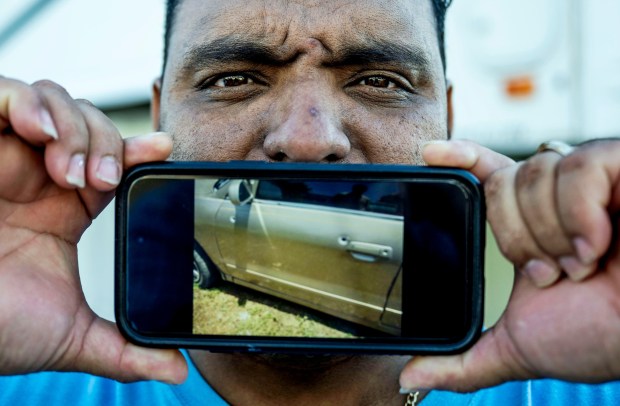 Herman Rovelo-Gallegos, 41, with a photo of his bullet-riddled car after a Honduran gang tried to kill him more than 10 years ago. (Terry Pierson, The Press-Enterprise/SCNG)
“I feel really hopeless in continuing to be in this country at this point,” he said. “I don’t know if I’m going to receive a letter tomorrow saying, ‘Your case is dismissed, you have to leave.’”
Whatever happens, returning to Honduras is not an option. His 15-year-old son and 7-year-old daughter would have to go back multiple grades in school, and it’s not safe there, he said. “There’s no future for them in Honduras,” he said.
He and his wife have worked hard to provide a better life for them in the U.S., but it hasn’t been easy.
Rovelo-Gallegos has worked as a gardener, warehouse worker, door installer and a delivery driver, sometimes leaving home at 4 a.m. and returning late at night. His family and extended family lived doubled up in a rented two-bedroom house and recently moved to a mobile home park in San Jacinto after their landlord raised the rent. His detention by ICE also set him back financially — he couldn’t earn income for his family while locked up, and he needs to repay a loan he took out for a lawyer to get him released from Otay Mesa.
“We are not criminals,” he said. “We come to this country looking for a better life for our families, and we are trying to do our best to be in a safe place.”
Staff writer Alex Riggins contributed to this report.