
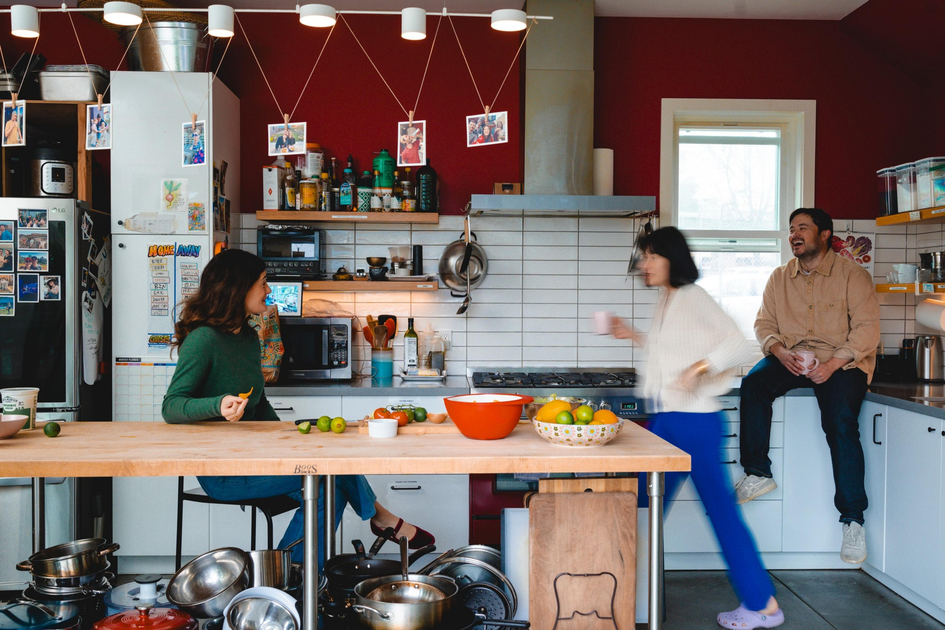
Erica Bliss and her husband were living in Nairobi, Kenya, when she heard about Radish, a co-living compound in Oakland. Her first thought on sharing a home with a bunch of other couples: hard pass.
“No, this sounds too weird. It doesn’t sound like it’s for us,” she recalled.
But Radish founders Phil Levin and Kristen Berman, a married couple, were longtime friends, not to mention persuasive salespeople. They pitched Bliss and her husband on the private units in the North Oakland complex, set amid a big shared yard with a stone firepit, hot tub, sauna, and outdoor shower.
Having a ready-made community, designed around both structured time together and spontaneous hangs, attracted Bliss. She had her mom fly in from Seattle to check out the place. After her mom gave the green light, Bliss and her husband became investors in the LLC that owns Radish and, in 2018, its first residents.
“It really is one of those ‘sliding door’ moments in life,” she said. “It changed how I think about community and how I want to live my life.”
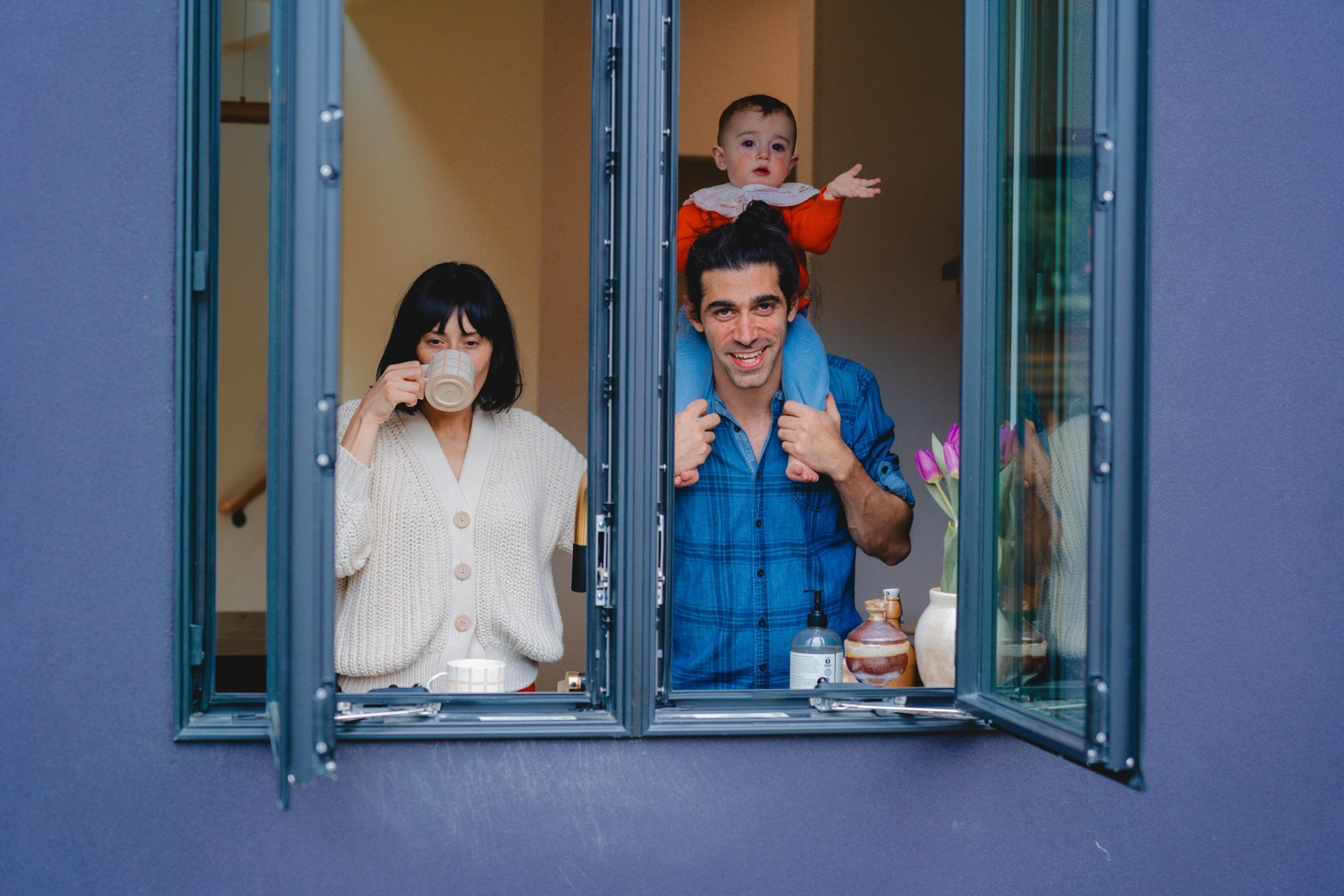 As residents started families, it was time to move on to bigger homes in new co-sharing communities. | Source: Hannah Franco Creative
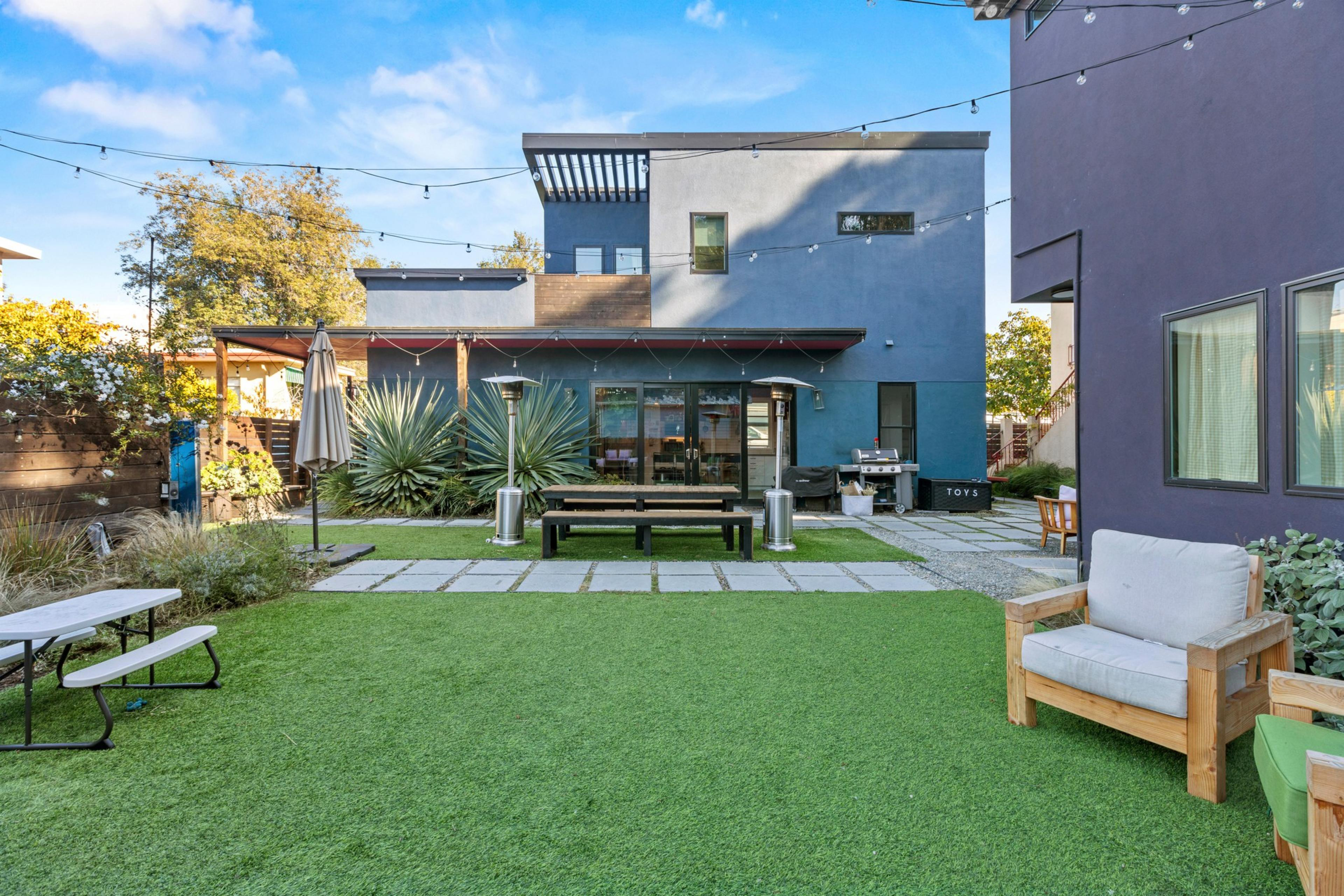 On nice days, the Radishes eat dinner al fresco. | Source: Steph Dewey
Six weddings, eight children, and more than 2,000 shared meals later, the 28-person Radish crew is breaking up. They’re all moving to other newly formed East Bay co-living properties, which they call “Radellites.”
With the original Radish community uprooting, the group has been focused on how to sell their four-structure compound, which has seven individual units, not including the communal “Blueberry” ADU. Fittingly for such an unorthodox living situation, they aren’t going the regular real estate route. The property isn’t listed on the MLS database, and there’s no agent or even a formal asking price (though they’ve set a guideline of $4 million to $6 million).
 The little Radishes order their foamy milk drinks during “baby happy hour.” | Source: Bree Sees U
But judging by the packed open houses, there is strong interest in the communal lifestyle. A few more tours (opens in new tab) are scheduled, and the group will host virtual Q&A sessions. There’s a referral to a co-buying specialist at the ready to help interested parties understand the implications of buying a home with 20 of their closest friends.
Levin emphasized that the initial buyers would likely be a small, core group — much like Radish at the beginning — with others added over time.
“There’s party throwers and party goers,” Levin said. “The party throwers are the ones that are showing up because they need to figure out whether this is a party they want to throw.”
Found their ‘unicorn’
You can probably guess what group Levin and Berman are in. The couple spent two years scouring Bay Area real estate listings for the right site for a co-living compound. A behavioral scientist, Berman knew that
maintaining quality relationships is key to longevity and happiness.
And co-living is an increasingly popular way to do that, especially for young adults living in expensive urban centers. In 2024, the U.S. co-living market was estimated at just under $8 billion, according to Grand View Research. That number is expected to more than double by 2030. Though student housing makes up a third of that, the trend is expected to grow most quickly among young professionals seeking affordability and a sense of community.
There are more than 20 Bay Area co-living communities, according to the Foundation for Intentional Community (opens in new tab), from a crypto-hacker house in the Mission to a community of 55-plus residents along the Oakland waterfront. But Radish is one of the most visible, with write-ups in The New York Times (opens in new tab), Vox (opens in new tab), and Architectural Digest (opens in new tab).
Back when Radish was still a seedling of an idea, Levin and Berman piloted their theory by renting a nine-bedroom Hayes Valley mansion with some friends. As their cohort began settling down and considering having children, they wanted to keep the community together, even if that meant one roof would no longer suffice. “Our general perspective was we would find something and then convince folks to move,” Berman said.
When they saw a duplex and a fourplex that backed onto the same one-third-acre lot near Oakland’s Temescal neighborhood, they knew they had found their “unicorn.” With one other investor on board, the couple bought the property for $1.8 million in 2018, according to public records. Over the last eight years, the LLC has put $1.3 million into upgrades.
There are 21 investors in all; 13 are current or former residents, and eight have never lived there but are general supporters of the community. There are also Radishes who just pay rent, which is then distributed among the LLC’s owners.
Among the first upgrades were the outdoor amenities, which the couple knew would be key to getting their San Francisco pals to cross the Bay Bridge.
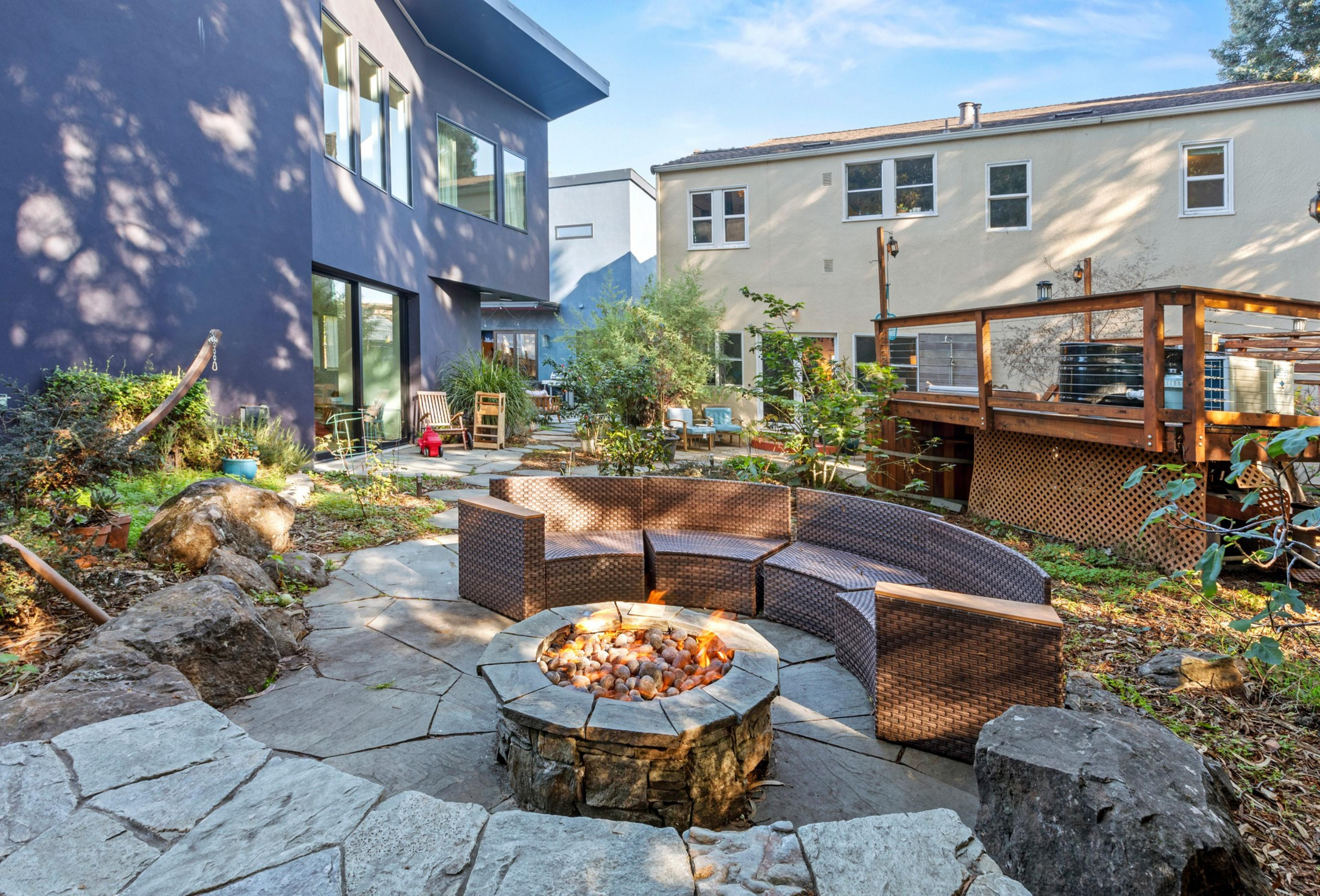 Outdoor amenities include a fire pit, hot tub, sauna, and shower. | Source: Steph Dewey
“If we’re going to all live together and be able to pool our resources, we want to be able to have things that we couldn’t afford as individuals and that we wouldn’t want to take care of as individuals,” Levin said. “A big cedar hot tub is a good draw.”
Sharing food costs and cooking duties also proved to be a winning formula. Each unit has its own kitchen, but everyone pays into a food fund for commonly used items, which are bought in bulk. Residents can prepare meals in their private units or use the communal kitchen in Blueberry, which also has a living room, media lounge, and coworking space.
Since Radish’s early days, dinner has been a group event. The meal is set at 7:30 p.m., a time that has remained consistent even as children have been born into the community. Rather than starting dinner earlier, they added a “baby happy hour,” at which the kids run around the fenced-in yard and can roll up to the window of the Fig, another recently built ADU, to order foamed milk drinks. Kids eat dinner in their own homes and go to bed before their parents reconvene for a leisurely meal.
With the current roster of 20 adult Radishes, each person is responsible for making dinner — or contributing to a chef for hire — once every three weeks or so.
“You can basically get out of it, which is good for everyone,” said Levin. “No one wants me to be cooking.”
Cleanup is also a communal affair among the seven to 12 adults who typically make it to any dinner. A community account pays for a weekly cleaning service that scours the common spaces.
“We basically created a system by which it’s hard to argue about the things that you would most likely argue about,” Berman said, “and that has helped immensely.”
The after-party
As the kids have gotten older, the group realized it was time to move the party elsewhere. The three new Radellites still feature shared spaces but have bigger individual units for growing families. They won’t be within baby-monitor distance of one another anymore, but all are within a short drive.
“I sort of don’t believe in the forever home,” Levin said. “I think you need different containers based on different stages in your life.”
Berman and Levin imagine Radish could be attractive to a multigenerational family, as well as a group of friends. They’re giving parties until June to submit offers, and the Radishes will vacate by the end of the year.
“I think you could wait five years and probably not see another property like this come on the market,” said Levin. He would know. He has turned his passion for co-living into Live Near Friends, a business specializing in buying multi-unit properties.
 The living room in the Fig, an ADU added to the property that is used as a private home. | Source: Steph Dewey
The complex’s one-of-a-kind nature makes it hard to price, according to East Bay real estate agent DJ Grubb, who is not involved in the deal and viewed the property online. If it were a traditional sale, the fourplex could go for between $1.2 million and $1.5 million, and the duplex would likely get about the same. Blueberry and Fig could be worth about $825,000 a pop if sold separately.
There’s added value from the shared outdoor spaces, but the complication of buying with multiple owners limits the potential buying pool.
“You are relying on the next guy,” said Grubb. “If he doesn’t pay his portion or his debt service, you’ve got to pick it up.”
Though the Radishes are marketing the property as a co-living space, Grubb thinks it could also be of value to an institution, such as a university or a housing-related nonprofit like the Ronald McDonald House, given its proximity to UCSF Benioff Children’s Hospital.
“It’s a tremendous amount of facility for the money,” he said.
Adding to the complicated value proposition is a tenant in one unit of the fourplex who predates Radish and is not moving out. Berman said she considers the tenant, who doesn’t have access to the communal spaces, a neighbor.
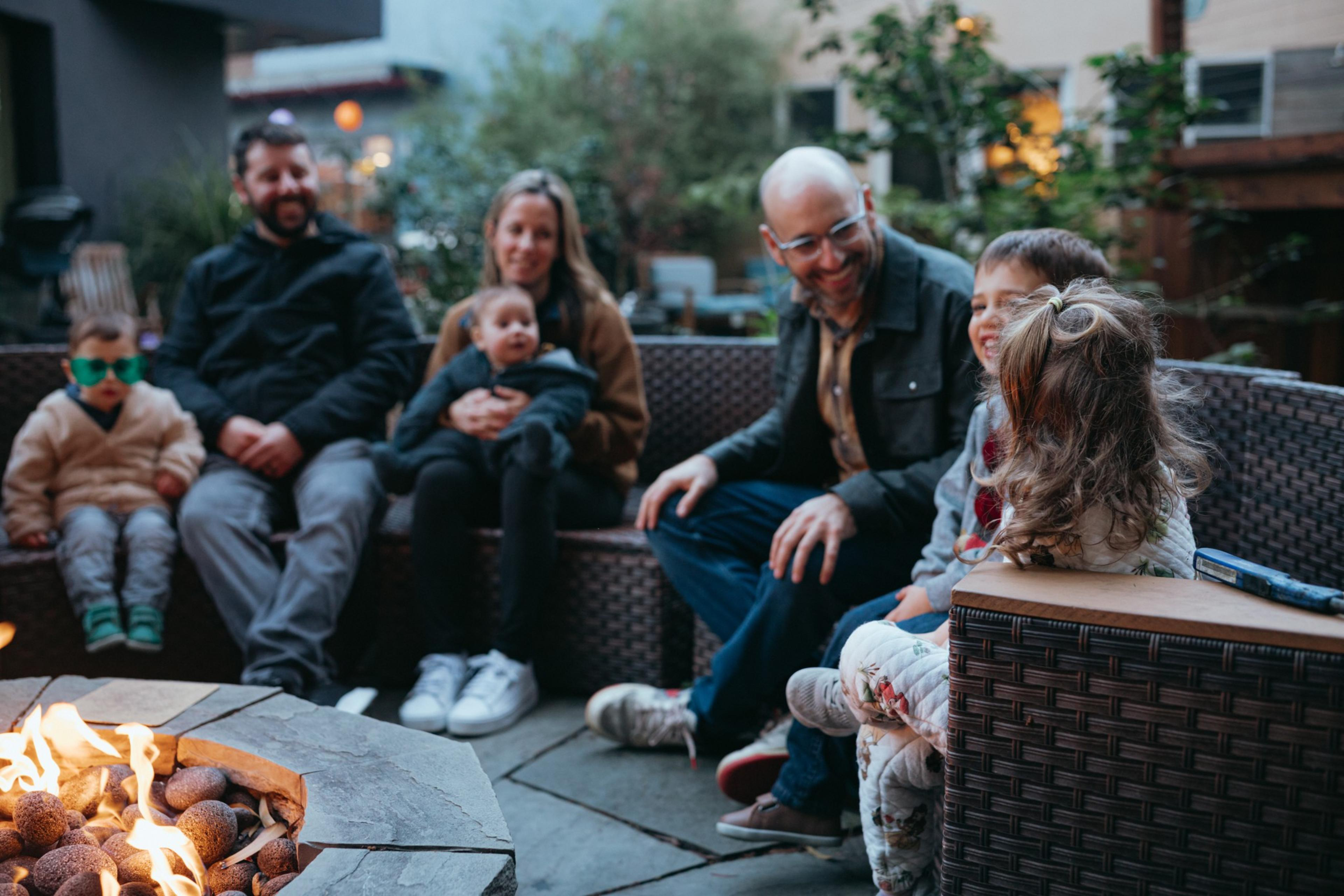 When Radish started in 2018, there were no children. Over the years, eight have been born into the communal lifestyle. | Source: Bree Sees U
The holdover occupant does not seem to be deterring buyers — groups of 75 have filled each open house, including San Jose couple Russell and Ashley. They loved that Radish is ready-made for co-living. The married pair, who did not wish to reveal their last names, said they have no qualms about going in on a major purchase with friends, or facing the inevitable conflicts that could arise.
Instead, their biggest issue is that they aren’t sure they have enough people committed to filling the space. But they’re sold on co-living, especially as remote work and AI make human connection at home even more important.
“You remember your childhood, when you’re around your siblings and your parents, and every day is chaos, and you love them, but you don’t necessarily like them,” Russell said. “It’s that good, human-contact lifestyle that just disappears when you become a professional.”
Berman is happy knowing that more guests are coming to the co-living party, even if they don’t end up buying her former home.
“I just hope that people, even if they don’t get Radish, are going to coordinate because of this sale, come together, and be like, ‘This is the thing we want to do. And we’ll try to find a property to do it,’” she said.