

Oakland County enjoys a collaborative bipartisan political climate, a thriving small business community and a cohesive approach to growth and support for low-income families and individuals to find solid financial footing.
That’s County Executive David Coulter’s perspective, shared at Thursday night’s State of the County address at Oakland University. Coulter said he believes the Republicans and Democrats working for the county “are more cohesive and collaborative than those at most of the state and national offices,” adding that they provide an example for others to follow.
His speech was intended to make people feel good about the county, he said.
Not everyone did. Commissioner Mike Spisz, an Oxford Republican and the minority caucus leader, called it a basic speech that “touched all the heart strings: kids, veterans and animals.
But he said it had no real detail or future outlook and skipped such hot-button issues as conflict-of-interest and financial disclosure questions facing county officials or plans to spend more than $350 million to move an estimated 700 county employees to downtown Pontiac.
The county hasn’t had a flawless year. The bacteria legionella bacteria is still being found in county campus buildings’ plumbing; fallout from the Zaydlogix contract scandal lingers and county and local officials are grappling with concerns about ICE investigations and fear among residents. County officials will also face tough budget choices as $244 million from the federal COVID-19 relief American Rescue Plan Act ends on Dec. 31.
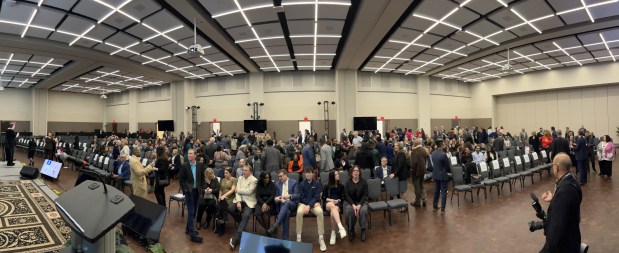 People gather at Oakland County’s State of the County speech on March 5, 2026, at Oakland University’s Oakland Center. (Peg McNichol/MediaNews Group)
Coulter said belt tightening is in the county’s future and acknowledged that county residents, like many in the country, are worried about the future.
Attendees to the invitation-only event, which was livestreamed on social media and YouTube, included Michigan Attorney General Dana Nessel, Secretary of State Jocelyn Benson, Macomb County Executive Mark Hackel and Wayne County Executive Warren C. Evans.
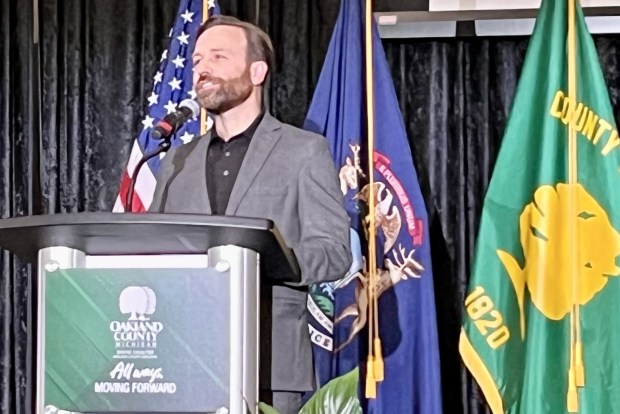 Former Michigan Lt. Gov. Brian Calley, now CEO of the Small Business Association of Michigan, introduces Oakland County Executive Dave Coulter and the State of the County speech on March 5, 2026. (Peg McNichol/MediaNews Group)
Coulter highlighted affordability, from free bus rides for the county’s 53,000 military veterans to initiatives that helped 14,000 families eliminate $9 million in medical debt last year and will eliminate more than $6 million in medical debt for 6,300 residents. The county paid $2 million to the Boston-based non-profit Undue Medical Debt to help the residents.
Eliminating medical debt allows people who need preventative or critical health care support to see their doctors without fear, Coulter said.
He also said that the county’s $500,000 partnership with Virginia-based SAVI to ease the student-loan burden for 3,200 residents by reducing their student-loan debt by an average of $46,000 per student, which Coulter said, giving the students an average of $142 more to spend or save each month
Addressing high housing costs, Coulter said, is essential for stabilizing people with lower incomes and reducing homelessness. The county invested $20 million – $18 million from ARPA funds – into the new Housing Trust Fund for public-private partnerships to create new housing. So far, the fund has added 1,100 units of affordable housing including some rental properties in such communities as Pontiac, Hazel Park, Southfield, Rochester Hills, Auburn Hills, Ferndale and Royal Oak Township.
“We’re not leaving anyone behind,” he said.
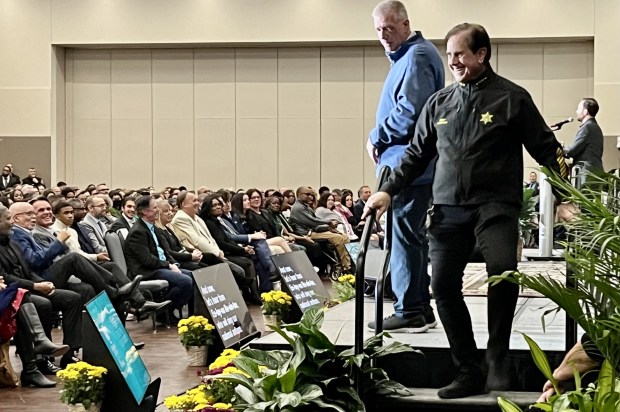 Oakland Sheriff Michel Bouchard at the State of the County speech on March 5, 2026, at Oakland University’s Oakland Center. (Peg McNichol/MediaNews Group)
The latest program is Oakland Connects, which employs community health workers dedicated to helping residents struggling with homelessness, medical issues, financial distress or accessing social services. The program replaces the Nurse-on-Call hotline to help residents find benefits and resources from 14 partner agencies until they are stable.
Coulter, citing U.S. Department of Housing and Urban Development statistics, said the county’s homeless population has dropped from a peak estimate of 1,000 people to 357 in 2025. Pontiac resident Sean Preston and Waterford Township resident Robin McGregor, both community activists, said they believe the homeless number is higher, because HUD’s annual counts cover limited areas and result in estimated figures.
“In a state where even the most innocuous legislative initiatives too often succeed or fail on strict party-line votes, Oakland County’s elected leaders collaborate and compromise, adopting annual budgets by unanimous, bipartisan votes,” Coulter said. “We continue to believe that our county government can improve the lives of all our residents – and we’re proving it every day.”
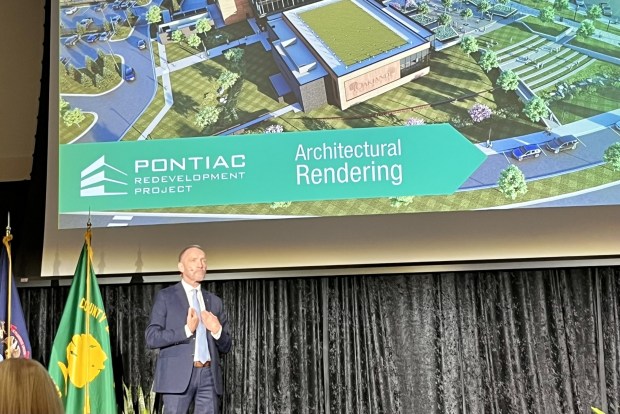 Oakland County Executive Dave Coulter delivers his State of the County speech on March 5, 2026, at Oakland University’s Oakland Center. (Peg McNichol/MediaNews Group)
Coulter emphasized the county’s ranking as the most prosperous for businesses in the state.
The county has a per-capita income of $93,579 according to Federal Bank figures from 2024, the highest in the state, and a median income of $97,760, according to U.S. Census figures for 2024.
Nationally, per-capita income in 2024 was $73,204 and $63,690 statewide, according to census figures.
Republican Brian Calley, chairman of OU’s board of trustees, introduced Coulter and focused on the county’s business influence.
Calley highlighted two county programs: Oakland 80, the county’s drive to ensure 80% of Oakland County adults achieve a college degree or certified training by 2030; and Oakland Thrive, a non-profit developed in 2022 to support small-business owners with coaches and consultants.
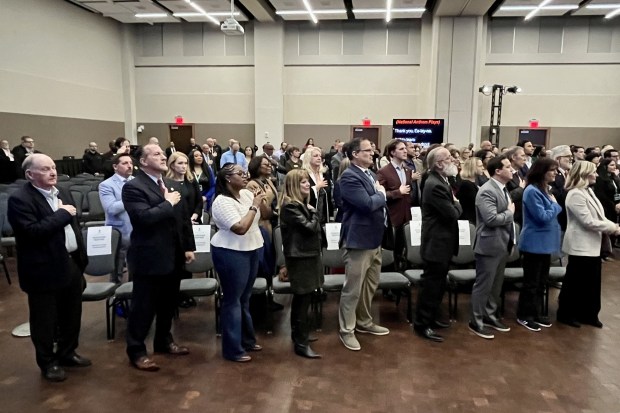 Oakland County officials recite the Pledge of Allegiance at the State of the County speech on March 5, 2026, at Oakland University’s Oakland Center. (Peg McNichol/MediaNews Group)
Calley is the CEO of the Small Business Association of Michigan and former lieutenant governor under Gov. Rick Snyder.
He praised Coulter for producing balanced annual budgets with bipartisan support since 2019, one key to the county’s triple-A bond rating, the highest possible. This means the county is financially stable and qualifies for lower interest rates when borrowing money.
Coulter’s overall message, beyond building and maintaining a robust business climate?
“The mission of the county is to make a better life for us all,” he said.
He noted the county has more engineers, foreign investment and people with advanced degrees along with some of the safest and most desirable neighborhoods in the nation. He noted the U.S. Census Bureau has tracked rising populations in all of the county’s 62 municipalities for the first time in recent memory. The county’s estimated population is 1,296,888 in 2025, up from 1,274,371 in 2024, an increase of 1.76%
Coulter attributed the increase to immigrants choosing to live in the county, whether they came for an education and decided to stay or fled a war-torn country or wanted to be closer to family members.
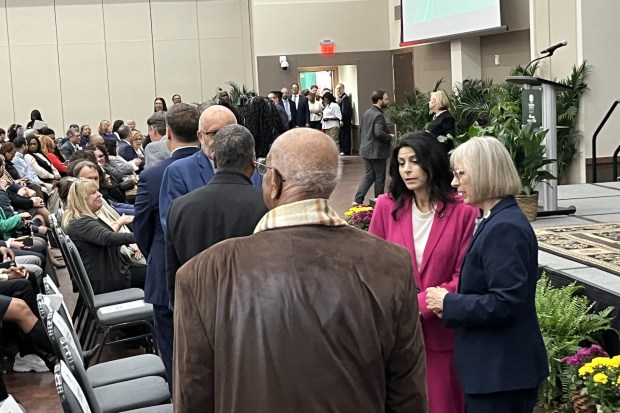 People gather at Oakland County’s State of the County speech on March 5, 2026, at Oakland University’s Oakland Center. (Peg McNichol/MediaNews Group)
After his speech, Coulter said the county will not engage in any contracts with U.S. Immigration and Customs Enforcement and the U.S. Border Patrol.
The county’s business landscape includes offices for more than 800 foreign-owned firms with Astemo Americas, American Rheinmetall and Teradyne creating hundreds of jobs, he said.
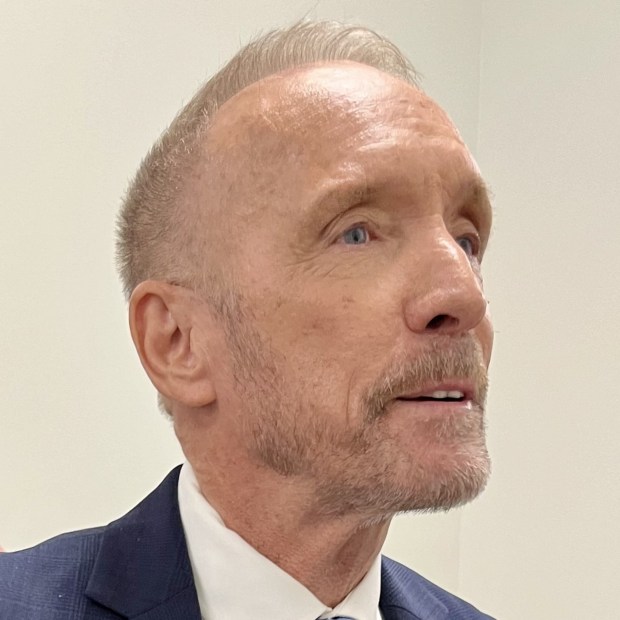 Oakland County Executive Dave Coulter listens to a reporter’s question after giving the State of the County speech on March 5, 2026, at Oakland University’s Oakland Center. (Peg McNichol/MediaNews Group)
Coulter said the county’s workforce development team is crucial to supporting those companies, so it can connect job seekers to employment.
“We want our young people to stay in Oakland County,” he said.
That means making sure transportation is available, he said, adding the public-transit system has so far provided more than seven million trips and will expand with 16 new SMART buses on order that will provide another 100,000 rides.
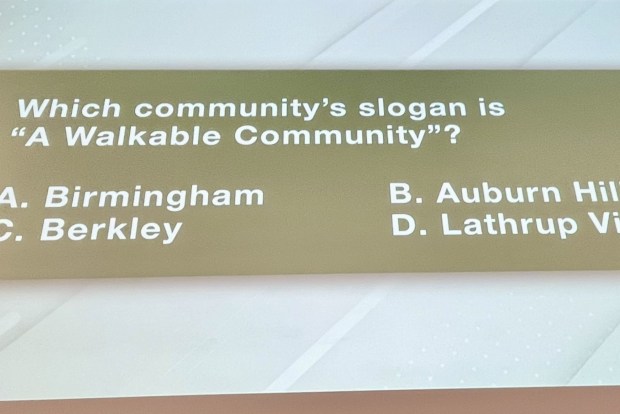 Trivia questions were displayed before Oakland County’s State of the County speech on March 5, 2026, at Oakland University’s Oakland Center. (Peg McNichol/MediaNews Group)
Commissioner Gwen Markham, a Novi Democrat and chair of the Southeast Michigan Council of Governments board, said she wished Coulter talked more about SMART’s expansion and how it will serve residents throughout the county.
County Commission Chairman Dave Woodward, a Royal Oak Democrat, said Coulter explained how the county programs are improving residents’ lives.
“These things don’t happen by themselves, but when the executive and the board are committed to using every resource available and adopt an ‘all of the above; strategy to make people’s lives better – there is nothing we can’t achieve together,” he said, adding it proves “once again, while Washington and Lansing are broken, we get things done in Oakland County.”