
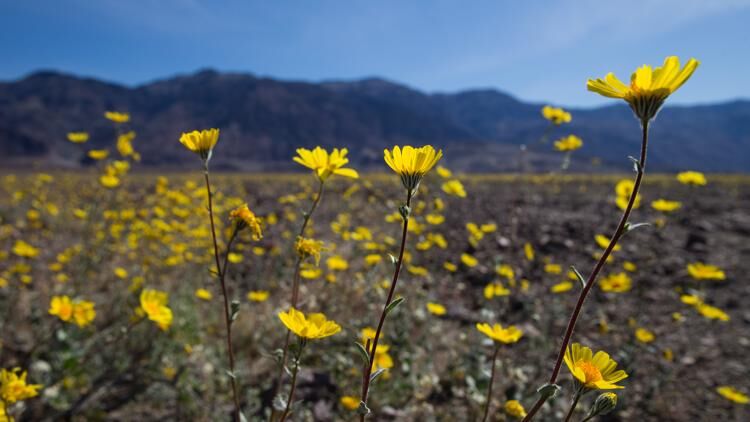
Recent heavy rain in California’s Death Valley, one of the hottest and driest locations in North America, has burst into bloom, with wildflowers blooming across the valley.
It’s what experts call a “superbloom,” a rare event that happens roughly every 10 years and right now, according to the National Park Service, Death Valley is having the “best bloom year since 2016,” and many sprouts have not yet flowered.
According to the National Park Service, the most “showy” desert wildflowers are annuals because they are short-lived. They complete their entire life cycle in a single year and must be replanted each year.
Oddly enough, their shortened life span actually ensures survival.
Death Valley sees about two inches of rain per year.
In some years, no measurable rainfall is recorded.
Wildflower seeds in the region can remain dormant for years, waiting for rain to create the perfect conditions for blooming.
“Rather than struggle to stay alive during the desert’s most extreme conditions, annual wildflowers lie dormant as seeds,” NPS officials posted on their website. “When enough rain finally does fall, the seeds quickly sprout, grow, bloom and go back to seed again before the dryness and heat return.
Although “superbloom” isn’t an official term, and scientists don’t agree on a single definition, it is generally used on the rare occasions when wildflowers bloom in notably high numbers after heavy rain.
Park officials use the term to describe conditions when “so many flowers are present that they appear as swaths of color across the landscape, rather than isolated plants.”
Park officials note that wildflowers in lower elevations bloom between mid-February and mid-April. Mid-range elevations between 3,000 and 5,000 feet see wildflower blooms between mid-April and early May. High elevations between 5,000 and 11,000 feet see wildflowers bloom between mid-May to mid-July.
Current bloom locations as of March 7:
North Badwater Road (between CA190 and Badwater Basin): Desert Gold, Brown-eyed Primrose
South Badwater Road (near Ashford Mill): Desert Gold, Sand Verbena, Five Spot, Brown-eyed Primrose
Highway 190 (between Stovepipe Wells and Furnace Creek): Gravel Ghost, Phacelia, Desert Gold, Mojave Desert Star
Beatty Cutoff: Phacelia, Desert Gold, Gravel Ghost
Death Valley’s most recent superbloom occurred in 2016, with previous superblooms observed in 2005 and 1998.
Denver Gazette newspartner 9NEWS contributed to this story. To read more about the superbloom and other stories, visit 9NEWS.