
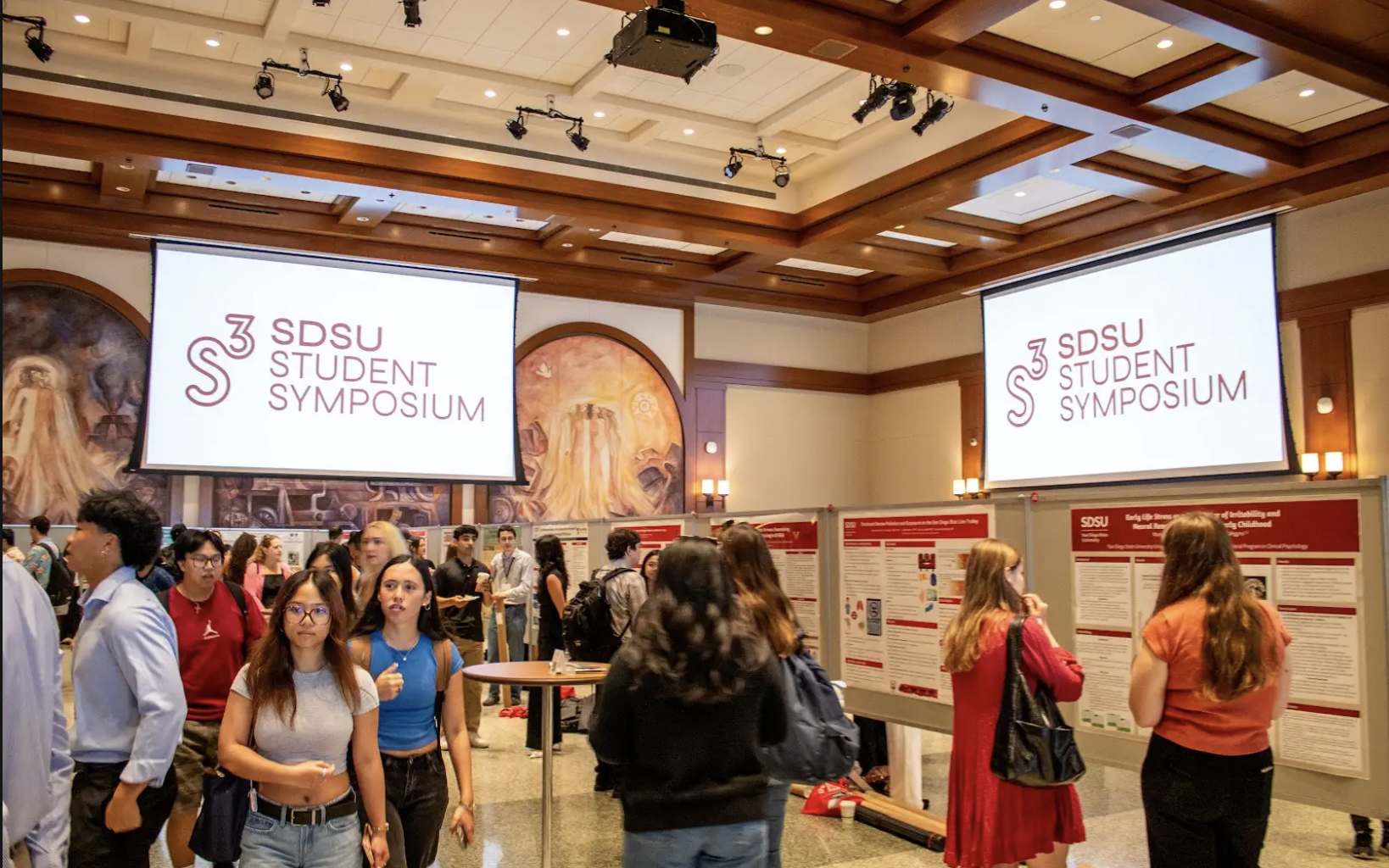
Around 600 SDSU students presented their research last week at SDSU’s Student Symposium, an annual showcase event for students to highlight their projects across a variety of disciplines.
The symposium ran from 11 a.m. to 5 p.m. on Feb. 27, in the Student Union and Student Services West.
On March 6, top presentations were honored, with SDSU giving some winners up to $500 in cash, totaling $20,000.
Liam Walters, a senior studying environmental science, presented research that he conducted during the summer. He spent six weeks in Indonesia, researching behavioral differences in monkeys from different altitudes and habitats.
He said that research is necessary because of its prevalence in all jobs.
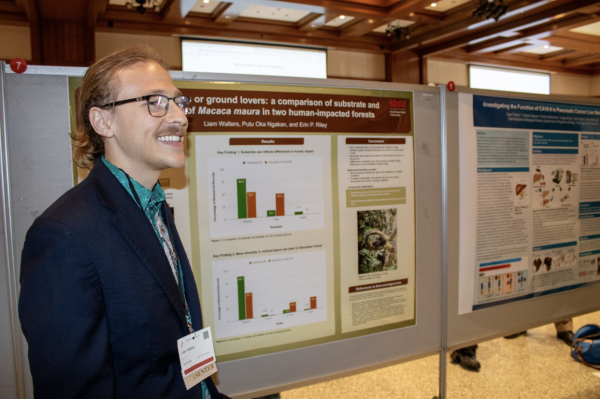 Fourth-year Liam Walters presents at the SDSU Student Symposium (Roman Fong)
“No matter what career you go into, there’s some aspect of research that goes into it,” he said. “You have to network with people, you have to talk to people that you didn’t want to talk to before or that maybe you didn’t get to talk to before. And then you learn how to compile your work into something digestible.”
Outside of research, Walters said that his time in Indonesia opened him up to more post-grad interests.
“I had really no interest in primatology before this and going there just gave me so many new experiences and actually gave me a career path that I’m really interested in following in college,” he said.
Tori Walters — a psychology master’s student unrelated to Liam Walters — presented on the factors that can lead to depression and suicide over time.
She said that overall, research is meant to clarify questions that people have and provide scientific insight in different areas.
“We’re not trying to sabotage anyone or trick them,” Walters said. “We’re trying to help people, and we understand that it’s really hard, but we’re trying to help everyone. We’re trying to contribute something.”
As a first-generation master’s student, she said that the learning curve during the research process was huge. Additionally, Walters said she originally wanted to study a different topic, but had to pivot due to a small sample size.
“I was a little bit disappointed, but going into the research and starting to understand the research process and then reading a lot of the literature, I really started just to love it,” she said. “At one point it just really was exciting. And then I was like, ‘Oh my God, I actually understand this at a different level.’”
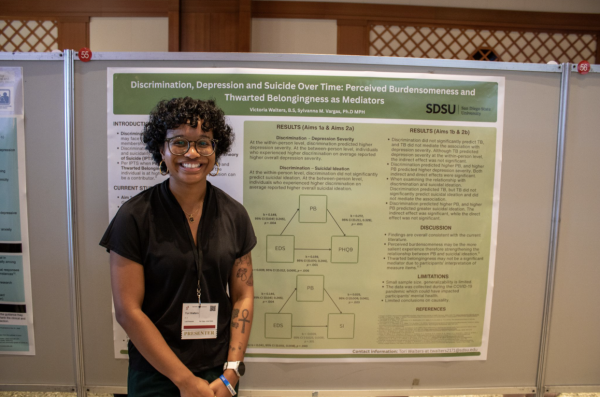 Master’s student Tori Walters poses in front of her research presentation (Roman Fong)
Liam Walters said that it took him a bit of adjusting too, even though he had previous interest in the work.
“I would say all research starts off like, ‘What the heck is going on here?’” he said. “At first, I was like ‘I don’t know what’s going on.’ And then by the end of it, you get to compile a new poster that any person can digest, which is kind of cool.”
Velma Chavez, a program coordinator for the Center for the Advancement of Students and Academics, tabled for the center at the symposium. CASA provides support for students who want to go into STEM-related fields.
She said that research is important for all students, whether they are conducting it or consuming the results.
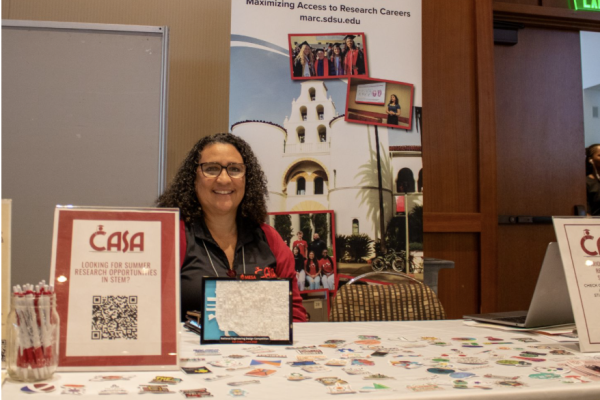 Velma Chavez tabling for CASA in Montezuma Hall (Roman Fong)
Chavez also acknowledged the reality that many research grants are being cut across the nation.
The Daily Aztec previously reported on cuts to research grants from the National Science Foundation and the National Institutes of Health. SDSU researchers had over $42 million in grants cut in 2025.
Chavez told The Daily Aztec that some of the programs CASA previously offered have been terminated.
“Students who now have to go work full-time because they’re not getting funding to do the research or the funding for supplies in the lab,” she said. “We’ve lost millions of dollars in funding for the federal government, and I don’t think people realize how that impacts everybody, not just the one student in the lab.”
Due to NSF grant terminations, Liam Walters’ program has been cut for the next year.
“This was the last year that it could be done because it got cut,” Walters said. “I had friends that are like in the environmental science sector that were like, ‘Oh, I would love to do that research opportunity,’ And it’s just not happening again, because there’s not enough money.”
He said he hopes a restoration of funding will give more students opportunities like his.
“Having the money to be able to do these research experiences is so important for students,” he said. “It changed my life, and I’ve heard like so many people say that their study abroad, their research, it changed their lives. So it’s giving students direction.”
Tori Walters’ research wasn’t affected, but she knows people who have been impacted.
“A lot of their research has either been cut or they’re not getting paid as much as they used to, and they’ve been given more work because other people had to get left to go,” she said.
“I think it makes me a little bit scared for my future research because it kind of brings me the question as like, oh, am I going to be able to keep doing this?”
Litigation to restore NSF funding is still underway, and SDSU has already recovered an estimated $11.86 in NIH funding through numerous grant appeals.