
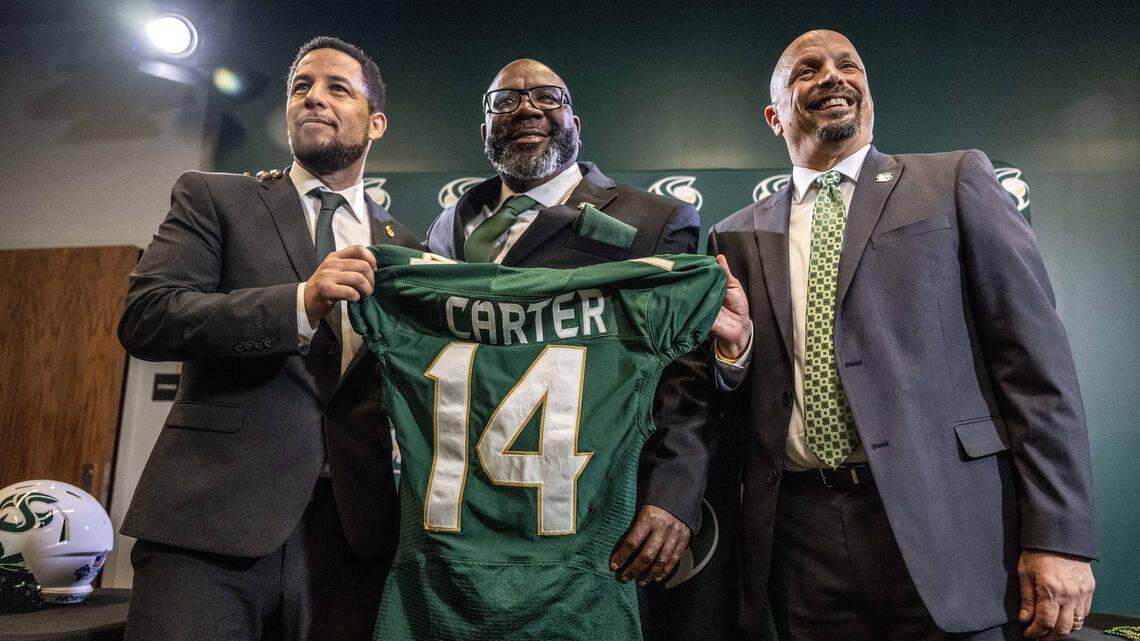
New Sacramento State football coach Alonzo Carter stands alongside university president Luke Wood, left, and athletic director Mark Orr during his introductory news conference on Dec. 18, 2025.
HECTOR AMEZCUA
hamezcua@sacbee.com
A few weeks before Sacramento State announced it is moving into the upper echelon of college football, the Football Bowl Subdivision, the university tapped a consulting firm in Georgia to put a dollar amount on the value of its sports programs.
University leaders cited that study, by Collegiate Consulting of Atlanta, to help them justify the $23 million it will cost them to join the Mid-American Conference, one of 10 FBS leagues. Collegiate Consulting’s analysis cited an “annual economic impact” of $194.4 million tied to Sac State joining the MAC, with University President Luke Wood extrapolating that to $972 million over five years.
National sports media, including CBS Sports and a Los Angeles Times columnist, cast doubt on the study’s methodologies and findings almost immediately. Students also began expressing skepticism about the multimillion-dollar price tag to join the MAC.
Now, a copy of the analysis obtained by The Sacramento Bee under the California Public Records Act shows the FBS projections make up only a tiny portion of the study’s 38 pages: a total of two paragraphs and one chart. The remainder focuses mainly on quantifying the economic benefit created by the Sac State athletics department in recent years.
Sac State also released documents showing the study’s cost — $50,000 — and timeframe, with Collegiate Consulting’s contract signed on Jan. 12 and the final report dated Feb. 16 — the same day Sac State publicly announced the MAC move.
The study makes clear that the $194 million figure encompasses the economic impact of the entire Sac State athletic program with football at the FBS level for one academic year. This school year, the athletic program’s economic impact is about a third of that, it states.
The study defines economic impact as everything from ticket sales and other direct payments, to the value associated with being on a TV broadcast, to visitor spending at Sacramento businesses stemming from athletics, to estimations of what athletic department social media accounts are worth, to athletes salaries’ once they graduate and join the workforce (in California, the study presumes).
After reviewing the study, The Bee spoke to university Athletic Director Mark Orr about what it does — and doesn’t — say, and about why university leaders believe the FBS move will provide a return on Sac State’s $23 million investment.
Game guarantees: How much can Sac State expect?
The university is making the leap from its current NCAA Division I level, the Football Championship Subdivision, to FBS in the same season the team will play under its third football coach in as many years — and in the same year the school had intended to build a new, FBS-ready football stadium off campus at Cal Expo.
Since announcing the MAC deal, Wood has touted that “football is paying for football,” a reference to the “guarantees” Sac State will be paid to play upper-level football programs on the road. These fees are to be used to pay a sizable chunk of the entry fee into the MAC, with the university then being able to keep them thereafter.
One of the most reliable revenue streams a college football program can obtain is a game guarantee — money that bigger schools pay to smaller schools in order to host a home game with no “return” game hosted at the smaller school. Sacramento State solidified its first with a trip to Hawaii Nov. 28, Hawaii athletics announced on Friday. The amount Sac State will get for that trip wasn’t disclosed.
The Collegiate Consulting study showed Sac State received a total of just around $1 million in game guarantees for each of its past two seasons as an FCS school: $1.03 million in 2023-24 and $958,000 in 2024-25.
But the study did not itemize projected game guarantees for the university’s first year in the FBS. Instead, it said Sac State’s broader “athletics external revenue” would grow to $16 million, about double the annual revenue Sac State has recorded in that category since 2022.
The Bee asked Orr specifically about game guarantee revenue Sac State might get in upcoming seasons.
“As an FCS (team), where we were at, probably the highest you could get as an FCS institution is about $600,000 per game,” Orr said. “There’s been guarantees at FBS schools … you can get closer to $1.5 to $2 million per game. So you’re talking double, sometimes triple the amount of game guarantee you can get as an FBS school.
“Now, we just went FBS a couple weeks ago, so obviously we are just a few months from the start of the season. So this first year, you may not get as many game guarantees as you can in year one, but over the course of the next five years, I anticipate us having significant game guarantees. … And certainly a noticeable bump from previous years.”
The logistics of other opponents Sacramento State will find for guaranteed games are still being hammered out as the school finalizes its 2026 schedule, set to be announced before the end of the month.
“I think a lot of it is going to come down to what dates you have available, where you’re at, what’s your location, what conference you’re coming from,” Orr said. “Obviously we’re not going to be able to play any MAC schools in non-conference, but we can play Pac-12, Big Ten, we can play SEC and those kinds of” teams.
“So we’re going to reach out to see what dates are available and try to get games on the schedule.”
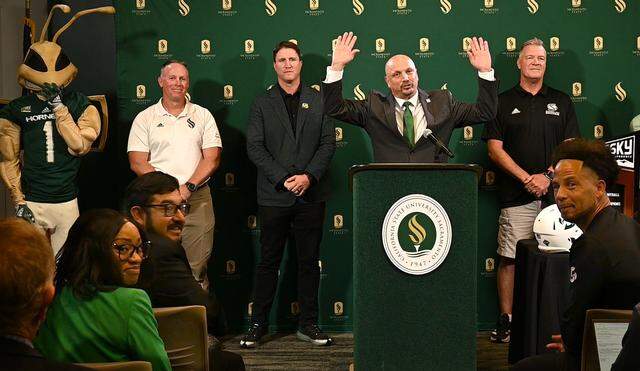 Sacramento State athletic director Mark Orr, center, excitedly announces Thursday, Sept. 26, 2024, plans for a new 25,000-seat, multi-use football stadium. Lezlie Sterling Sacramento Bee file Study relies heavily on ‘AVE.’ What’s that?
The Collegiate Consulting study focuses largely on branding and visibility through a metric known as advertising value equivalency (AVE), which measures how much advertising would cost with equivalent exposure. It mentions using AVE in streaming, social media, print journalism and television broadcasts.
Essentially, AVE for a football program on TV is a projection of what it would cost to advertise to the same sized audience on a typical nationally televised broadcast. For example, if 1 million people watch a game on TV, AVE projects what it would cost to run an advertisement to 1 million people for the average length of a football game.
The Collegiate Consulting webpage provides additional context for its calculation of AVE. But that page also points out the metric’s limitations.
“While AVE provides a market-based valuation of exposure, it does not measure realized revenue generation or specific consumer behavioral outcomes,” the webpage reads. “Its use is intended to approximate the relative value of potential earned media visibility.”
Additionally, the study states that it uses AVE to determine “return on investment” using a formula that includes a three-times multiplier of the AVE. Multipliers, the report says, are used to account for the “direct,” “indirect” and “induced” effect of Sacramento State’s spending on athletics.
Use of the term “return on investment” also suggests that the “economic output” created by Sacramento State will return directly to Sacramento State. But portions of the study make clear that numerous figures are calculated as the economic benefit to the Sacramento region as a whole, or even the statewide economic benefit to California. The Bee has posted the study in its entirety at sacbee.com.
What AVE also doesn’t account for is sentiment, or the different value in winning a game by 40 points vs. losing a game by 40. It assumes all exposure is good, not addressing the fact that a losing football program is going to generate less revenue than a winning one, while both get the same exposure on a national broadcast.
It’s also unclear how AVE is calculated in the overall projections. The study says the move to the FBS will generate a projected $120 million in the first year through the “broadcast exposure impact” line item, which was $8.3 million in 2025-26 and just under $3 million in 2024-25.
There’s no calculation within the study explaining the $120 million figure that’s more than 14 times larger than the previous year and 40 times larger than two years prior.
In the recent CBS Sports story about the study, Collegiate Consulting director Russell Wright explained that the $120 million figure was based off estimates using existing MAC football teams’ TV numbers. But CBS Sports’ own analysis of TV viewership data showed $120 million as an inflated total, leaving Wright to revise the estimate downward, from $120 million to a range of $80 million to $109 million.
Collegiate Consulting then did an about-face on social media, posting to X the following morning that the firm stood by its original figures. Then, at some point in the past week, Collegiate Consulting deleted the post standing by those figures.
Wright on Saturday responded to The Bee’s requests for comment with an emailed copy of Collegiate Consulting’s valuation methodology that is posted on its website. Responding to follow-up questions Saturday evening about why the post had been taken down, Wright said, “I have no idea” and added that Collegiate Consulting’s social media pages are run by a third party.
Regardless of what the AVE numbers say, Orr said the exposure of FBS and playing in the MAC will bring significant benefits to the school.
“I’ve taken it that it is a projection, and certainly something that I think is a useful tool for us,” Orr said. “But it’s not the be-all, end-all.”
New stadium options are part of the study
Sac State’s stadium situation has slid to the background since the FBS move was announced. Orr and Wood have said there will be improvements made to the program’s existing on-campus facility, Hornet Stadium, to facilitate the move, including new locker rooms, more end zone seating and more padded seats for fans.
Since Wood took over as president in 2023, the university has essentially considered three stadium options: bulldoze Hornet Stadium and build a new, bigger stadium at the same site; build a new venue off-campus; or upgrade Hornet Stadium in a way that expands its current 21,000-seat configuration to fit at least 25,000 spectators.
Wood and Orr in September 2024 announced plans for the first route, saying the school would build a new venue to replace Hornet Stadium at the current on-campus site.
In August, they said they were exploring an off-campus option: a partnership that would turn the former horse racing grandstand at Cal Expo into an FBS-ready stadium. Formally, the arrangement opened an exclusive negotiating window between Sac State and Cal Expo.
Orr has said the school is still considering long-term options at Cal Expo. In the meantime, the university is prepping to play its 2026 games on campus.
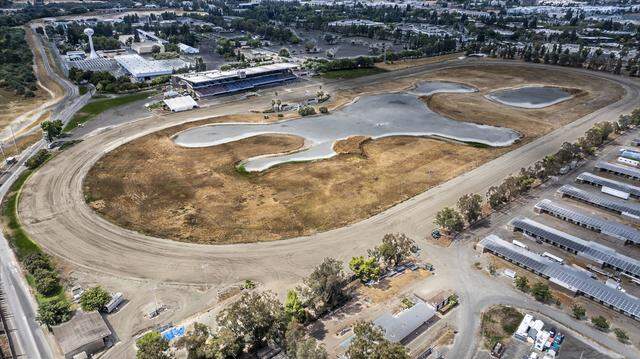 The Cal Expo horse track, photographed on Aug. 26, 2025, sits idle after an announcement about three months before that the 170-year tradition of horse racing at the State Fair would end. HECTOR AMEZCUA hamezcua@sacbee.com
The stadium situation is addressed in the Collegiate Consulting study, in the final section of its 38 pages. The study signals a move to Cal Expo, roughly 3 1/2 miles north of campus, would be less economically impactful than building a new venue on campus.
The study estimates the cost of renovating the former horse racing grandstand at Cal Expo at about $171 million, while construction of an on-campus stadium would run between $250 million and $300 million. But the economic impact of each, determined by a complex set of factors and multipliers, were noted as $261.4 million for a Cal Expo stadium and $458.1 million for one on campus, suggesting the on-campus venue would provide nearly twice the economic benefit.
Wood said the Cal Expo project, which would cost roughly 60% to 70% of a new on-campus stadium, would be paid through a revenue bond.
A California government website defines public agency revenue bonds as a form of borrowing: “In return for the bond proceeds, the borrower promises to pay the investors/bondholders the principal amount plus a specified rate of interest over the life of the bonds based on the bonds’ debt service payment schedule. In this way, a bond is similar to a complex loan.”
There’s been no update since fall on how a new football venue would be bankrolled.
Will Hornets be able to succeed right away in FBS?
The football program being good in 2026 — and generating revenue from ticket sales, merchandise and other streams that flow strongest when a team is winning — would help pay for the transition to the MAC.
But Orr knows that can’t always be counted on when a program first makes the jump from FCS to FBS.
“I think obviously you always want to have success. I would also say making the jump from FCS to FBS, most schools aren’t widely successful on the field in the first year. So certainly I want to manage some of those expectations,” Orr said. “At the same time, I like our recruiting class, I like our team, and it’s going to be a whole new conference, a whole new set of teams.”
Success while making the jump is possible. Fourteen programs elevated from FCS to FBS from 2009 to 2023, NCAA records show. Seven were .500 or better in their first season, while the other seven won three games or fewer. Ten programs had .500 finishes or better within their first three seasons.
“In terms of how it affects the bottom line, yeah, of course. If you’re winning games, certainly more fans come out and people buy tickets and those kind of things,” Orr said. “If you’re losing, not as much. I do think our fan base and certainly our students on campus are so excited about FBS football and have been loyal even when we’ve had tough seasons. I do think we have a good core of fans here that are going to support us, that are excited about it.”
At the same time, Sac State football has seen mixed results in the past few years. Coach Troy Taylor prior to departing for Stanford led the Hornets to three straight FCS playoff appearances, with the team going 23-1 in Big Sky Conference play from 2019 through 2022.
Taylor’s successor Andy Thompson started off 8-5 (4-4 in Big Sky) with another FCS playoff berth in 2023, before going 3-9 (1-7 in Big Sky) in 2024.
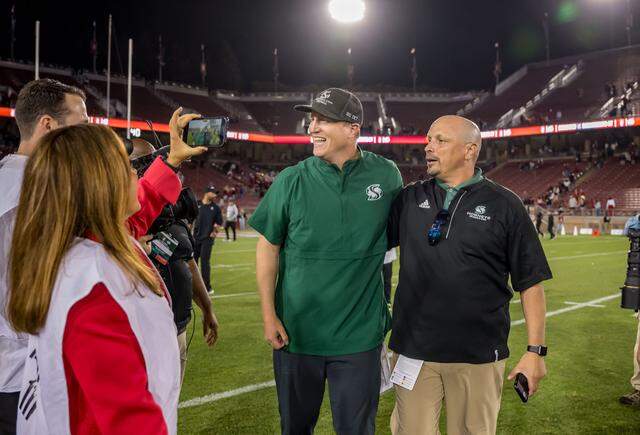 Sacramento State Hornets coach Andy Thompson and athletic director Mark Orr celebrate after their 30-23 win over the Stanford Cardinal in the NCAA college football game Saturday, Sept. 16, 2023, at Stanford University. Xavier Mascareñas Sacramento Bee file
Brennan Marion brought the Hornets a winning record in 2025 (7-5, 5-3 Big Sky) in his first season as head coach, but left for the University of Colorado to serve as offensive coordinator under Deion Sanders. Some players who had verbally agreed to join Sac State decommitted after Marion left.
Sac State in December hired current coach Alonzo Carter, who since taking over has emphasized increasing “the size, athleticism and length of the team” through the transfer portal and freshman recruiting.
The bigger playing field
Sac State’s $23 million commitment to playing in the MAC isn’t its only financial commitment. It also comes as the university has agreed to pay travel costs for MAC teams coming to Sacramento and forfeit its share of conference revenue distribution, including TV money, for all five years of the deal.
Student skepticism is being driven in part by faculty salaries within the academic affairs budget decreasing and the unknowns of new football stadium costs and financing.
In a recent interview with The Bee’s LeBron Hill, President Wood described athletics as a way to future-proof the institution from unreliable tax revenue streams.
“The environment around us has shifted,” Wood said. “We have less state support, we have less federal support. We have every university in the country essentially advertising in our region now because there are so few students to go around. So if we don’t modify and change who we are then, we will fall in the same challenges that (these universities) are in.”
The Collegiate Consulting study estimated the economic impact of Sacramento State athletics in 2025-26 fiscal year at $66 million and 2024-25 at $61 million.
FBS football triples those amounts, Orr noted.
He also points out that $194.4 million in economic impact might be on the low side.
Orr mentioned San Jose State and the University of New Mexico as comparison points. Collegiate Consulting conducted studies estimating those universities’ economic impacts at $225 million and $240 million, respectively.
Regardless of the numbers, the exposure of Sac State being one of 138 FBS teams “is huge for us,” Orr said.
“It helps us in student recruitment, enrollment, retention, corporate partnerships, ticket sales, all the different that things we’re trying to do draw people and folks into Sacramento State Athletics, Sacramento State football and our university,” Orr said. “So I do believe exposure certainly helps us in several areas within our athletic program, football program and university as a whole, that can generate revenue.”
Related Stories from Sacramento Bee

The Sacramento Bee
Chris Biderman covers sports and local news for the Sacramento Bee since joining in August 2018 to cover the San Francisco 49ers. He previously spent time with the Associated Press and USA Today Sports Media Group, and has been published in the San Francisco Chronicle, The Athletic and on MLB.com. He is a current member of the Baseball Writers’ Association of America and former member of the Pro Football Writers of America. The Santa Rosa native graduated with a degree in journalism from the Ohio State University.