
Olivia Allen-Price : And he was really quite dressed up.
Henry Lie (on phone call): Yeah, I was coming from a job interview, so.
Olivia Allen-Price (on phone call): Oh, I was gonna say, did you put the tie on for me, or?
Henry Lie( on phone call): Yeah, just for you. (laughing)
Olivia Allen-Price: Henry’s getting a master’s degree in urban planning, and what became apparent as we spoke is he sees the city in a way that most people might not. He just notices things. And not too long ago, he was making his way through San Francisco.
Henry Lie: I was driving on Van Ness one day.
Olivia Allen-Price: Right near City Hall.
Henry Lie: I, like, saw the Superior Court of California.
Olivia Allen-Price: And a few blocks away, the U.S. District Court for Northern California. Not far from that.
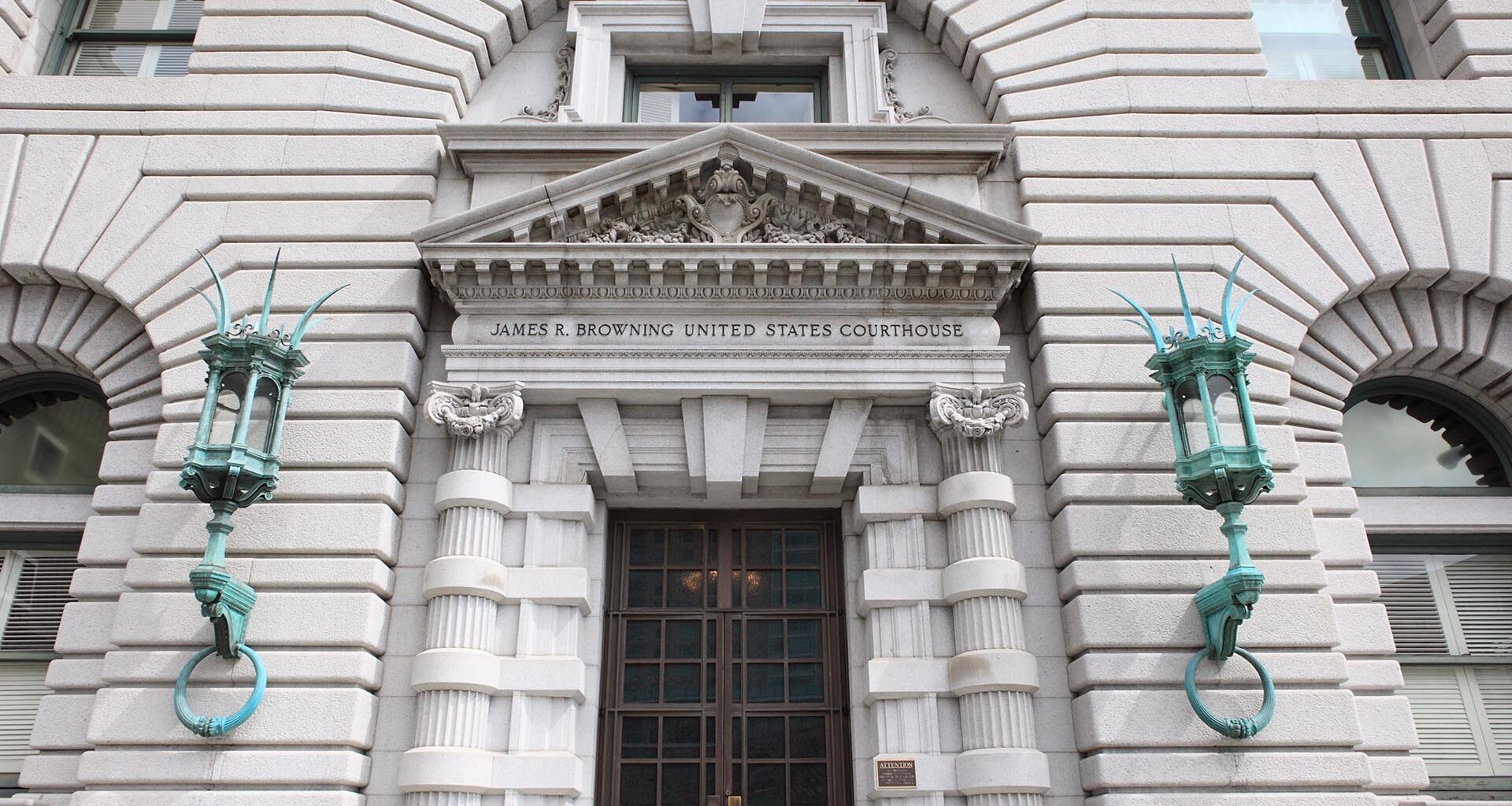
Henry Lie: The U.S. Court of Appeals for the Ninth Circuit.
Olivia Allen-Price: And finally…
Henry Lie: The California Supreme Court.
Olivia Allen-Price: He discovered practically all levels of court on both the state and federal sides are found right here in San Francisco. Henry wrote in to ask us why.
Henry Lie: It seemed like in other states, other regions, they were located in like state capitals or like much larger cities.
Olivia Allen-Price Why aren’t more of these courts in Sacramento or Los Angeles? On this one, I decided to slide into the DMs of Molly Lacob. She’s the deputy general counsel of operations here at KQED. She’s a former litigator and is a little bit of a legal nerd. Welcome, Molly.
Molly Lacob: Hi, Olivia. I guess I am a legal nerd. And when prepping for this, I realized I think I’ve appeared in every superior court in the Bay Area. We used to do that in person before we had all this technology.
Olivia Allen-Price: Not in handcuffs, I assume.
Molly Lacob : (laughs) No, I was a willing participant. I walked in and out.
Olivia Allen-Price: Okay. Good. So I got to be honest, you know, this was a question that was not on my radar at all. So first up, is it unusual to have this many courts in one place?
Molly Lacob :Generally speaking, yeah, it is pretty unusual. And a lot of that boils down to the history of the state of California and the city of San Francisco, as well as the development of the West Coast in general. And then another fun fact is that we are the only city and county in the state California. So every other county in California is made up of multiple cities. It’s just us in San Francisco County. You’ll see that on our seal, on all of our paperwork. It’s the city and county of San Francisco. So by default, all county courts and really any other county agency and building are going to be located in the city of San Fransisco.
Olivia Allen-Price: Give us, so maybe step back a teeny bit, because I think some listeners — ahem, myself — might need a little bit of like a civics refresher …
Molly Lacob: What the heck is a district court about?
Olivia Allen-Price: Yes.
Molly Lacob: Like Schoolhouse Rock,
Olivia Allen-Price: Yes. Like Schoolhouse Rock. What is happening here?
Molly Lacob: Okay, so we have a state court system and we have federal court system. And then within both of those, we have civil disputes and we criminal disputes. Easiest way to think about it is, do you want money or do you jail time?
So if I want to sue you, it is most likely going to be a state action. It’s rare to have a federal civil action against somebody, it’s certainly possible. And those are mostly business disputes though. It’s rare to have, you know, Molly dislikes Olivia, she’s filing a lawsuit. So I say, I want to file a lawsuit against you. And then I think about it. And I think, okay, well, where did you do the thing that I’m so mad about? Or where do you live? And that’s typically where we decide to venue a court case. And then for criminal cases, it’s really just, where did you do the really bad thing?
That’s kind of like the high level, how we work our way through the court system.
District courts are the lowest level of federal courts. And then there’s an appeals court, which is the Ninth Circuit, and then the U.S. Supreme Court. Similarly, on the state side, there are also three different levels of courts. The lowest court level is the superior court for the county, in this case, San Francisco, which again, San Fransisco is a city and a county. Uh, and then we have the first appellate district for the state of California here in San Francisco. There are six appellant districts in California. And then the state Supreme Court. And as Henry mentioned, all of those courts are really within a couple blocks of each other. If we really, really wanted to see this lawsuit through of Molly doesn’t like Olivia, we could hear the entire thing over several years though, on foot. We could walk to each courthouse and never have to leave downtown.
Olivia Allen-Price: Do you always have to start at the bottom as a lawyer? Like, do you have to file with a small court first? And do they even bother hearing? Are they ever like, “No this goes up the chain. This is above my pay grade.”
Molly Lacob: Yeah. No, that’s a really, really good question. You have to start at the bottom and then you can appeal to what, you know, mid-level, if you will. It’s either the first district for California or the Ninth Circuit and then appeal up to the State Supreme Court or the U.S. Supreme Court.
You’ll have to have a little more than just, ‘I don’t like it’. You will have to reason as to why the outcome was wrong. And also, they can decline to hear your appeal. So the lower level courts, the superior court. Or the Northern District, they can’t decline to take your case. As a defendant, you can move to have the case thrown out, or you can have it moved to have it summarily settled with various motions, but they have to take it. The appellate courts do not. Most cases get rejected. So like I mentioned with the US Supreme Court, there’s 8,000 petitions. They take 80.
Olivia Allen-Price: And the ones that they’re rejecting, they’re like, okay, lower courts, ruling stands.
Molly Lacob: Yeah, so at whatever level you get rejected, be it at the appellate level or at the Supreme Court level, if it doesn’t get picked up, the lower court’s ruling stands.
Olivia Allen-Price: All right, Schoolhouse Rock is over. That was fun, right? When we come back, it’s on to Henry’s question. How did so many of these courts end up in San Francisco? Stay with us.
Sponsorship Break
Olivia Allen-Price: So we’ve covered that we have a lot of courts here in San Francisco, more than nearly any other city. Henry, our question asker, wanted to know how they all landed here.
Molly Lacob: So when California became state, which was in 1850, and we are the 31st state in the country, Congress decided that we needed to have two district courts. A lot of states actually only have one district court, but Congress realized that California was a pretty large state. So they divided it into the Northern District of California and the Southern District of California. And so, in 1850… The Northern District established San Francisco as its hub. And that’s because in 1850, it truly was the hub. It was the political hub of the state, it was the population hub, it was an economic hub. That’s why we have a massive port. Maritime law was a really big deal. And so we were seeing maritime disputes back then. And Sacramento wasn’t the state capital at that point. And the state capitol moved around back and forth, as did the state Supreme Court, because there was a little bit of a power struggle between all the cities in Northern California.
Olivia Allen-Price: The state capital moved a lot when California was a baby state. Monterrey, it was in San Jose, it was in Vallejo, it was in Benicia.
Molly Lacob: Rumor has it that the state legislature was tired of the Supreme Court moving around. It had gone down to LA. It would be in San Jose. They would hear cases in Sacramento. They would hear case in San Francisco. And so they ordered the state Supreme Court to move to come to the Capitol. And the justices said, ‘No, we don’t want to.’
Olivia Allen-Price: The Bay Area is nice. Sacramento’s hot.
Molly Lacob: Um, literally though, that is actually the rumor is that the climate played into their decision. I don’t know if you have spent a summer in the Sacramento Valley. I actually grew up there. It’s hot and they didn’t want to do it. And so they didn t show up. And so the state finally said, OK, I guess you reside in San Francisco.
Olivia Allen-Price: I mean, if you think about the wardrobe you have to wear in court, it kind of checks out. You don’t want to be in formal attire in multiple layers on a 90-degree day in a place that’s not air conditioned.
Molly Lacob: Yeah, I do not recommend Sacramento in the summer with no air conditioning. Zero out of five stars.
Olivia Allen-Price Okay, so it’s weird that the state Supreme Court is here, but what about the Ninth Circuit Court? That’s the federal court. That’s just one step below the Supreme Court. How big is the Nineth Circuit Court, and why is it in San Francisco?
Molly Lacob: The Ninth circuit is huge. It encompasses Alaska, Arizona, California, Hawaii, Idaho, Montana, Nevada, Oregon, Washington, Guam, and the Northern Mariana Islands. Geographically, that is massive. And then from a population perspective, it’s just under 20% of the United States. Almost 60 million people reside within the Ninth Circuit. So a big proportion of litigation in the U.S. Is also coming through the Ninth Circuit. It’s in San Francisco because all of those states and territories I just rattled off, most of them didn’t exist when the Nineth Circuit was founded. Some were admitted almost a hundred years after California was to the United States. So San Francisco was the obvious economic hub at the time. But also from a legal perspective, the other states and territories didn’t exist as U.S. States and territory.
Olivia Allen-Price: So it sounds like the State Supreme Court and the Ninth Circuit are kind of the two more unusual courts to have here. Are there any others that are surprising to find in San Francisco in 2026?
Molly Lacob: I don’t think anything else is particularly unusual in regard to location. Having the Northern District seat here also makes a lot of sense.
Olivia Allen-Price The Northern District being that first level of federal court.
Molly Lacob: Yeah, We do see a lot of really interesting activity through the Northern District, and that’s because of our local tech industry. So all of the major lawsuits between the big tech companies, Apple versus Samsung, Oracle versus Google, Waymo versus Uber, all of those cases are being heard in the Northern district. So we do get some really interesting ones, but it makes sense. A district court is supposed to hear the litigation from their region, and what do we have in our region?
Olivia Allen-Price: Tech.
Molly Lacob: Big, juicy tech disputes.
Olivia Allen-Price: Yeah. And I imagine, I mean, this is kind of a juicy place to be following legal matters.
Molly Lacob: Oh yeah, I think we’re gonna see a lot of AI litigation that’s gonna be venued here because if you are upset with what’s happening with OpenAI or Gemini, the bulk of them are located here. We’ve got a bunch of them located literally around the corner from our office where we’re recording this. And so to the extent that that evolves or devolves rather to litigation. We’re going to see it coming through the San Francisco courthouse.
Olivia Allen-Price: Molly Lacob is the deputy general counsel of operations at KQED. Thank you, Molly.
Molly Lacob: Oh, thank you for letting me nerd out.
Olivia Allen-Price: We just announced the date for our next night of Bay Curious Trivia. It will be on April 8th. Come on down to KQED’s headquarters in San Francisco’s Mission District. You can enjoy some drinks, play our super fun trivia game, and meet the Bay Curious team. Every question in our trivia is Bay Area themed, so be sure to brush up by binging old episodes, yeah? Tickets and details are at kqed.org/live. You can come with friends or come solo and we’ll pair you up with a team. I hope to see you there!
Henry Lie: Big thanks to Henry Lie for asking this week’s question.
Henry Lie: Bay Curious is made in San Francisco at member-supported KQED.
Olivia Allen-Price: Our show is produced by Katrina Schwartz, Christopher Beal and me, Olivia Allen Price. With extra support from Maha Sanad, Katie Springer, Jen Chien, Ethan Toven-Lindsey and everyone on Team KQED. Some members of the KQD podcast team are represented by the Screen Actors Guild, American Federation of Television and Radio Artists, San Francisco, Northern California Local. I’m Olivia Allen-Price, have a great week.