
If last week’s results were unexpected, LSU baseball’s struggles against Sacramento State over the weekend were something much more alarming.
In a three-game series with the Hornets, the Tigers won 15-4 on Friday, but dropped Saturday’s contest by a score of 5-4 and lost 6-1 in Sunday’s finale. The losses put LSU’s record at 12-5 with just one more nonconference game remaining before Southeastern Conference play.
Here are five takeaways from a frustrating weekend for the Tigers.
The difference between Friday and the rest of the weekend for the offense
After Wednesday’s loss to UL, junior Jake Brown said that LSU went back and watched every pitch from the defeat to evaluate swing decisions and what the offense needed to improve upon.
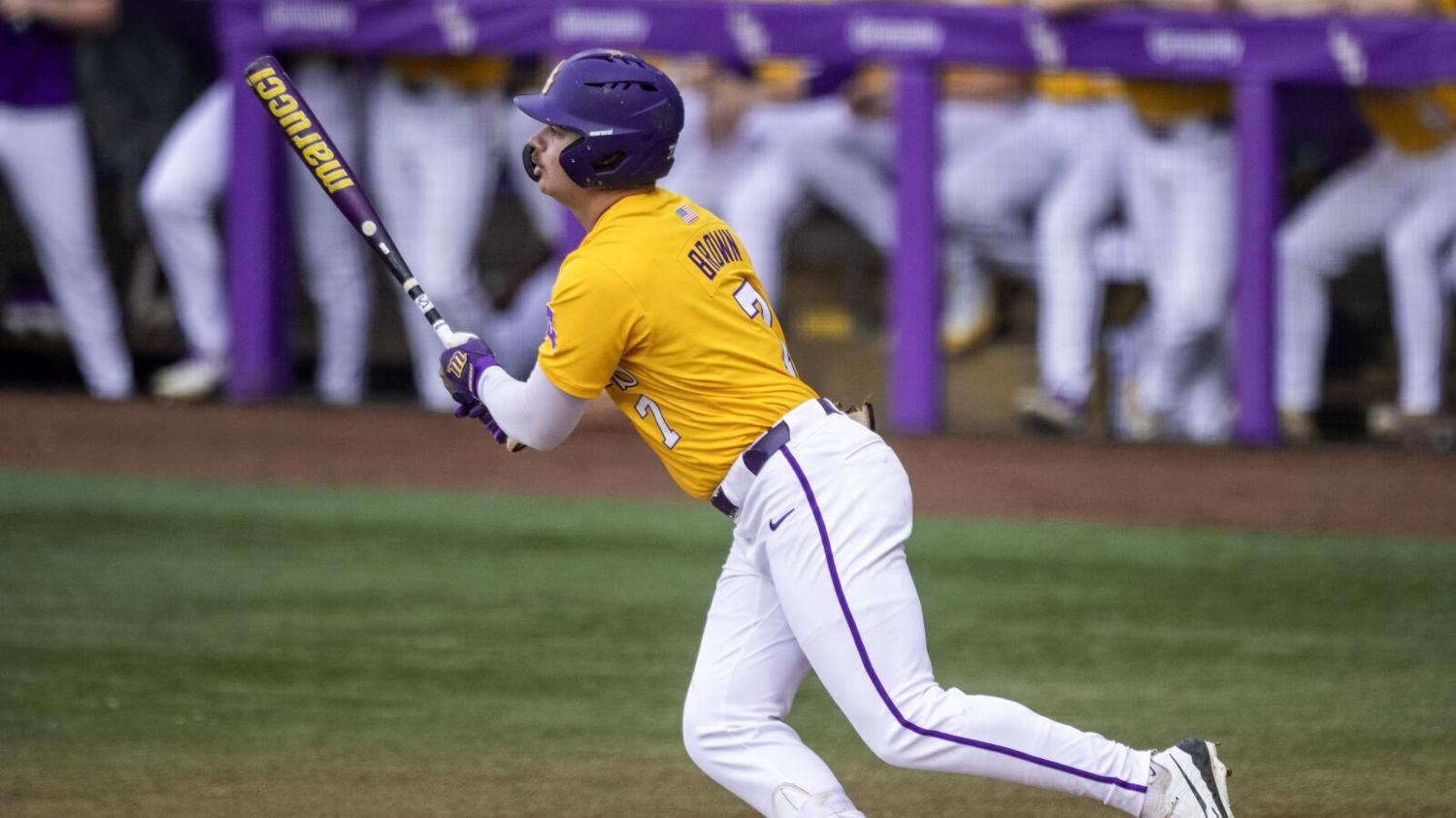
The film session worked. LSU smacked 10 extra-base hits and launched six home runs in Friday’s win. Brown hit three homers in his first three at-bats.
“We watched what we did good, what we did bad,” Brown said. “It’s just knowing we’re a really good team whenever we do these things right, so let’s focus on those and eliminate everything else.”
But the Tigers reverted to their struggles over the next two games. They stopped hitting the ball hard on Saturday and had trouble getting on base Sunday. LSU struck out 11 times in the second game of the series and only walked twice the next day.
It’s worth noting that LSU hit the ball with greater authority on Sunday and ran into some tough luck. But the Tigers’ attack still wasn’t playing up to the standard they’ve already reached at times during nonconference play. The series finale was the second time they had failed to register an extra-base hit in their last nine games.
“We need to score more runs. I mean, it’s nothing different than we talked about going into the weekend,” Johnson said on Sunday. “Tonight, the summary is this: you get a good at-bat, then you have a bad at-bat and then you have a good at-bat with a bad result, and hit the ball hard at somebody. It’s not going to produce any runs.”
How Casan Evans has improved, and what he still wants to work on
One of the few bright spots over the weekend was Evans, the sophomore right-hander who tossed five perfect innings on Friday before Sacramento State put a few runs on the board against him in the sixth.
He dominated Hornets hitters with a wipeout slider and a fastball that consistently sat in the mid-90s and touched 98.7 mph. The performance was, in part, the result of a mechanical adjustment Evans has been trying to make.
On Friday, he focused on not rushing through his windup. Evans has found that pausing for an extra split second at the top of his delivery before going down the mound has helped with his command.
“We found that works better for me,” Evans said. “I’m able to throw more strikes and hit the spots that I want to.”
Even if Evans’ delivery has improved, he is still working on his slider. It’s a pitch he’s been trying to find the right shape for lately, despite the success he had with the offering on Friday.
“The shape isn’t where it was last year, but we’re still working on it,” Evans said. “So I thought it played well today, especially off the fastball.”
Who is LSU’s second baseman?
Second base has become a rotating door for LSU.
The Tigers started freshman Jack Ruckert on Friday and Saturday, his first pair of starts at LSU, before turning to High Point transfer Brayden Simpson on Sunday. Ruckert didn’t record a hit in either game, but he walked twice and scored two runs on Friday. Simpson had LSU’s lone run-scoring hit in the series finale.
Notably, LSU didn’t turn to Kansas State transfer Seth Dardar at second. Dardar was the Tigers’ primary starter at the position up until this weekend. He was the designated hitter on Friday and played third base on Sunday.
Ruckert, Johnson says, is LSU’s best defensive option at second. But Dardar and Simpson have more experience and promise at the plate. The Tigers’ offensive struggles would suggest that Simpson or Dardar should be Johnson’s top options, but their problems on defense are simplified with Ruckert’s glove in the game.
“I like Jack as a player, and I think he fits well with this team,” Johnson said, “if everybody else is performing at a high level or expectation.”
Who LSU turns to for now will come down to the matchup on that particular day. To say that Johnson is anywhere close to finding a solution at the spot wouldn’t be true.
A rough weekend for the pen
As was the case with the offense, there weren’t many positive takeaways from LSU’s bullpen this weekend.
In 9⅓ innings, the group allowed eight earned runs, six hits and walked eight batters, resulting in a 7.72 ERA. Even when excluding the two earned runs LSU gave up in garbage time on Friday, the bullpen’s ERA sits at 6.48.
A chunk of the relief corps struggles can be attributed to the offense’s inability to give them any room to breathe on the scoreboard in the late innings. But that doesn’t fully explain why LSU’s top relievers, besides one, ran into issues over the weekend.
Redshirt sophomore right-hander Deven Sheerin struggled for the first time on Saturday, loading the bases on two walks and a single, before redshirt junior right-hander Jaden Noot surrendered a grand slam that proved to be the difference in the game.
Redshirt junior right-hander Gavin Guidry couldn’t shake off his struggles from Wednesday, his first start, on Sunday. He walked a season-high three batters and allowed three inherited runners to score, runs that allowed Sacramento State to pull away from the Tigers in a 2-0 game.
Guidry and Sheerin hadn’t given up an earned run in relief before this weekend. They were due for some regression, but their struggles further exposed a bullpen that lacks reliable options outside of them.
Sophomore right-hander Mavrick Rizy has a 1.93 ERA. However, he’s struggled with his command, walking seven batters and plunking five others. Sophomore left-hander Cooper Williams threw a scoreless inning on Saturday, but the batter he hit on Sunday scored, and he’s given up seven hits in 6⅓ innings.
The only true bright spot over the weekend was junior college transfer Ethan Plog. In a 1-0 game on Saturday, the left-hander tossed 2⅔ scoreless innings, lowering his ERA to 1.50 and inducing lots of weak contact.
“He’s probably our best reliever,” Johnson said, “along with Gavin, at this point.”
LSU’s history with five or more losses in nonconference play
The Tigers haven’t dropped five or more games before SEC play since 2020, and haven’t lost four or more games against mid-major opponents before their conference slate began since 2007.
So yeah, it’s been years since LSU has found itself in these waters before. The Tigers didn’t get to SEC play in 2020 as COVID-19 shut down the season, but 2007 was the program’s worst year since 1983, the campaign before Skip Bertman’s first season in charge. It’s the only time LSU has failed to reach 30 wins outside of the COVID year.
Outside of 2020 and 2007, the other years in which the Tigers lost more than four nonconference games before SEC play this century were 2017-19, 2002-03, and 2000. LSU made the NCAA Tournament in each of those seasons, reached Omaha three times and won a national championship in 2000, all indications that a slow start doesn’t mean that 2026 is already over.
But don’t mistake history as the reason why LSU’s struggles thus far have been overblown. The Tigers have a lot of questions they need to answer in every phase of the game.
They need to come up with those answers fast. SEC play begins next weekend in Nashville against Vanderbilt.