
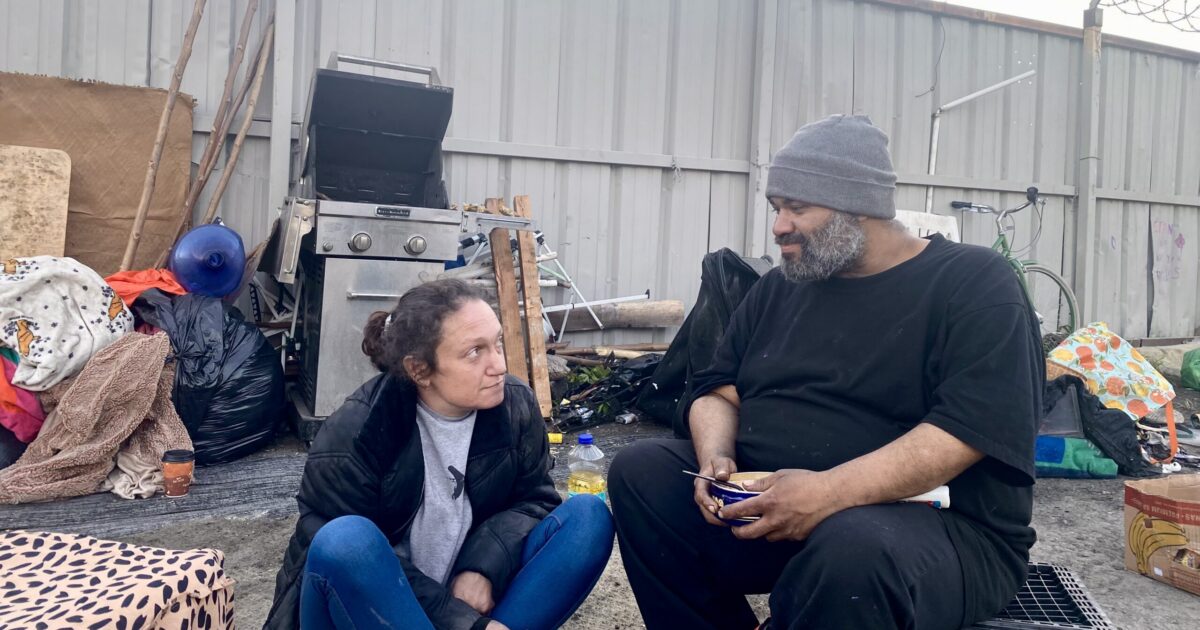
In San Jose, how you get treated as a homeless person depends on where you end up on the streets.
The city appears to be giving preferential treatment to homeless residents living in large encampments like Columbus Park and the reestablished Jungle in East San Jose, when it comes to outreach and offers of temporary housing. The fallout from the city bypassing offers of housing to people living in smaller camps could result in longer periods of homelessness, leading to mental and physical issues, advocates said.
While the city prepares to clear the Jungle with promises of housing for the roughly 100 people living there, homeless people encamped near The Plant shopping center in South San Jose have been ignored and even arrested.
Homeless residents said they have been traumatized by recent encounters with the San Jose Police Department. The city swept an encampment there in January, but some people returned and set up a new camp nearby. When San José Spotlight spoke to homeless residents last week, they were preparing to be swept again with nowhere to go. They said they have received no offers of housing.
“It really sucks, because it’s like, where do I go? Where’s the help?” Mario Nogueras, a homeless resident living near the shopping center, told San José Spotlight.
Sarah Fields, spokesperson for the San Jose Housing Department, told San José Spotlight while the city has contracted with nonprofit People Assisting the Homeless (PATH) for outreach, the railway near The Plant where homeless people have encamped is under Union Pacific Railroad’s jurisdiction and outreach workers aren’t sent there.
Nogueras said police arrested him for trespassing, as well as other people, during a sweep on Jan. 15. He said police showed up with no advance notice, handcuffed him and others and did not allow him to take his backpack, with his insulin medicine inside.
Nogueras said he is diabetic and spent several days in jail without medication. He was told he could call a number to retrieve his belongings once released, but no one ever answered. Earlier this month, the San Jose City Council updated its policy of retaining belongings during sweeps. The city will default to treating items as personal property when it’s not clear if the item is trash or abandoned property. In addition, the policy reiterates that all stored items must be documented with pictures.
“I’m really not myself right now either,” Nogueras said. “A part of me shut down.”
Nogueras also lost his phone in the sweep, making it nearly impossible for someone at the Here4You shelter hotline to contact him when a bed became available.
Nogueras said officers from SJPD’s Neighborhood Quality of Life team were the ones who arrested him. San José Spotlight reviewed pictures of paperwork signed by SJPD detailing the arrest. On Nogueras’ paperwork where it lists if he has certain physical or mental issues, including diabetes, police marked a box that said “no.”
When asked why Nogueras’ paperwork did not list him as diabetic, a police spokesperson said it was unclear what report San José Spotlight was referring to.
“In general, we wouldn’t document medical history in a police report unless it is relevant to the investigation,” the spokesperson told San José Spotlight.
San José Spotlight sent a picture of the paperwork to the department and did not receive further response.
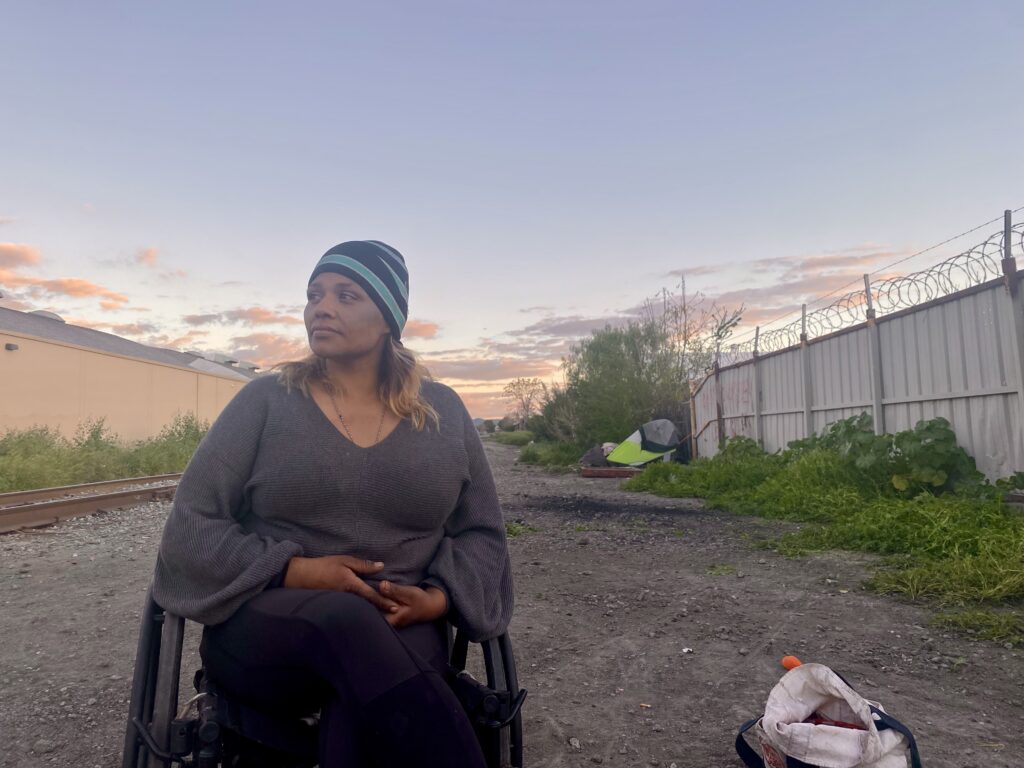 Jackie Nogueras, sister of Mario Nogueras, was also detained by the police on Jan. 15. She said the encounter was traumatizing. Photo by Joyce Chu.
The police spokesperson said officers assisted the Union Pacific Railroad Police Department to clear the encampment near the railroad tracks on Jan. 15. The spokesperson said they were not targeting one area, despite homeless residents saying police visited the area multiple times within the past couple months.
Police detained 31 people in January, including some who had warrants, were on probation or had an outstanding felony, a police spokesperson said.
“Arrest decisions were based on individual circumstances and applicable law, not on a person’s housing status,” the spokesperson told San José Spotlight. “Officers are trained to offer available services during contacts, including referrals to housing resources, veteran services and other supportive programs when appropriate.”
The city formed the Neighborhood Quality of Life unit last year to address homeless encampments impacting neighborhoods and to restore public spaces. The team was also created to reinforce Mayor Matt Mahan’s policy to cite and arrest homeless people who repeatedly refuse offers of shelter.
However, Mahan’s hardline approach to ending homelessness could create less trust of the city’s outreach efforts.
“It has just been a lot of havoc and unnecessary ticketing and alienating people from any possibility of housing,” homeless advocate Shaunn Cartwright told San José Spotlight. “It’s made things much worse for people’s mental health.”
The San Jose City Council allocated $514,249 to fund equipment for the Neighborhood Quality of Life unit this fiscal year, which includes new vehicles. The team is composed of one sergeant and six officers.
The mayor’s office deferred to SJPD when asked if arrests without offers of housing was how Mahan intended the team to operate. His office did not respond to questions about why preferential treatment is being given to residents at larger camps such as the Jungle.

A city audit last year showed people residing in hot spots often received offers of housing first, whereas people outside of those areas were ignored.
“These are missed opportunities to engage with unhoused residents and may undermine trust in the city,” the audit said. “Additionally, (the targeted outreach program) … may create unintended incentives for unhoused individuals to move into these areas to access housing referrals and supportive services, whereas the city is actively trying to reduce the impacts of homelessness in these locations.”
The audit showed the San Jose Housing Department did not request outreach workers make contact with these areas prior to a sweep. When the City Auditor’s Office examined outreach cases submitted by Parks, Recreation and Neighborhood Services, it found outreach requests were closed without being assigned, or there was no action taken on the request for months.
San Jose has 6,503 homeless residents. About 60% of that population is unsheltered, or 3,959 people, and 2,544 are sheltered, according to a point-in-time count conducted January 2025. Since the count, the city has added more than 1,000 beds across a dozen new or expanded temporary housing sites.
Jackie Nogueras, sister of Mario Nogueras, was also detained by police at the homeless camp near The Plant shopping center in January. She said San Jose needs to change its approach to arrests and sweeps.
“It’s traumatizing for me and many others, and I believe that there definitely needs to be changes,” she told San José Spotlight. “Until then, I don’t believe (the Neighborhood Quality of Life unit) should do what they’re doing, because we’re losing (our belongings) and we’re impacted and it’s setting us back tremendously.”
Contact Joyce Chu at [email protected] or @joyce_speaks on X.
Story updated March 9 at 2:45 p.m. Original story published March 9 at 2:30 p.m.