
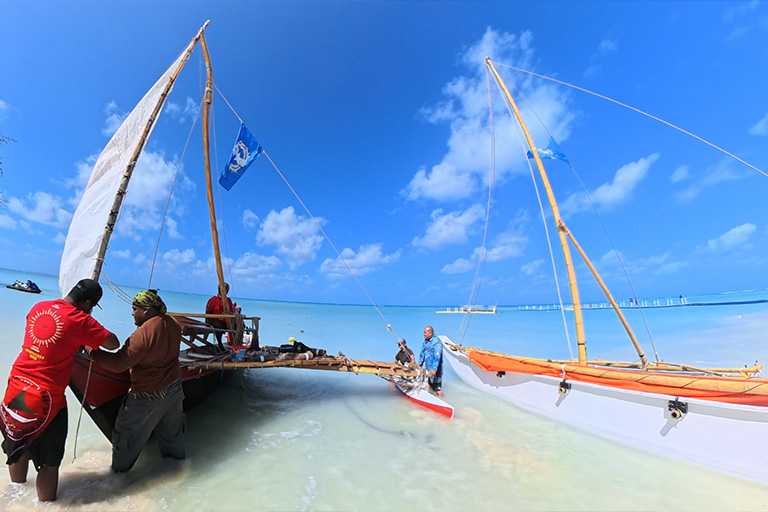
Organized by Sophia Perez, Indigenous Technologies Coordinator for the Berkeley Center for New Media, a weeklong series of public workshops beginning March 9 will feature master navigators teaching everything from traditional canoe technology to ancient star-mapping.
Sophia Perez thought her 2018 visit to Saipan, in the Pacific Ocean’s Northern Mariana Islands, would only last a few weeks.
She’d graduated from UC Berkeley with a double-major in rhetoric and ethnic studies in 2014, and went on to work in commercial film and media production in Los Angeles and Brooklyn. After a while, she felt a pull toward a different kind of storytelling. She thought visiting Saipan — one of the primary homes of the Indigenous Chamorro and Carolinian people, and her own ancestral homeland — would be the right place to ground her new creative direction in her family’s history.
Sophia grew up hearing stories of the Mariana Islands from her Chamorro grandfather, Herman Perez, who survived the Japanese occupation of Guam during World War II. When she arrived in the Marianas, it felt like home.
She stayed with her aunt and uncle, Emma and Pete Perez, who a few years earlier had opened a nonprofit organization called 500 Sails, which is dedicated to the revitalization of Indigenous seafaring. Sophia spent a lot of time at the Guma Sakman (canoe house), learning the history and mechanics of traditional proas — the legendary, high-speed sailing vessels of the ancient Chamorro. A month went by, and Sophia decided to stay.
“I went back to my apartment in Brooklyn, sold all my stuff, then moved to Saipan,” she says. “It changed my life forever.”