
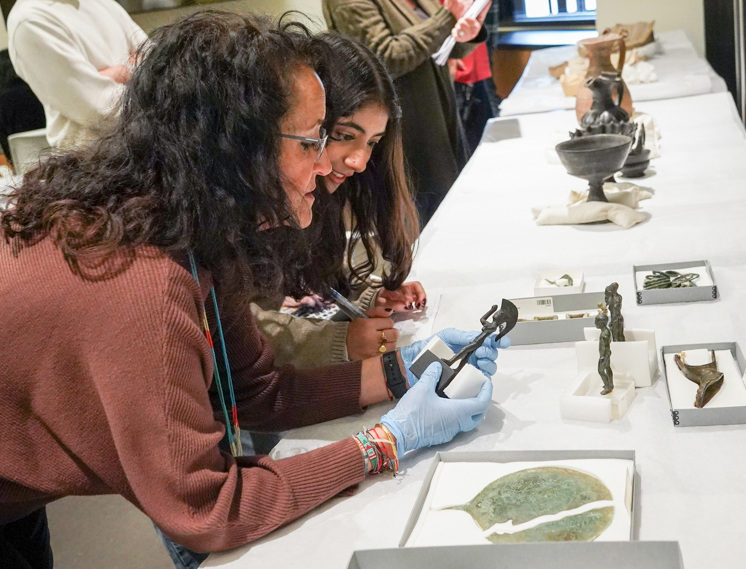
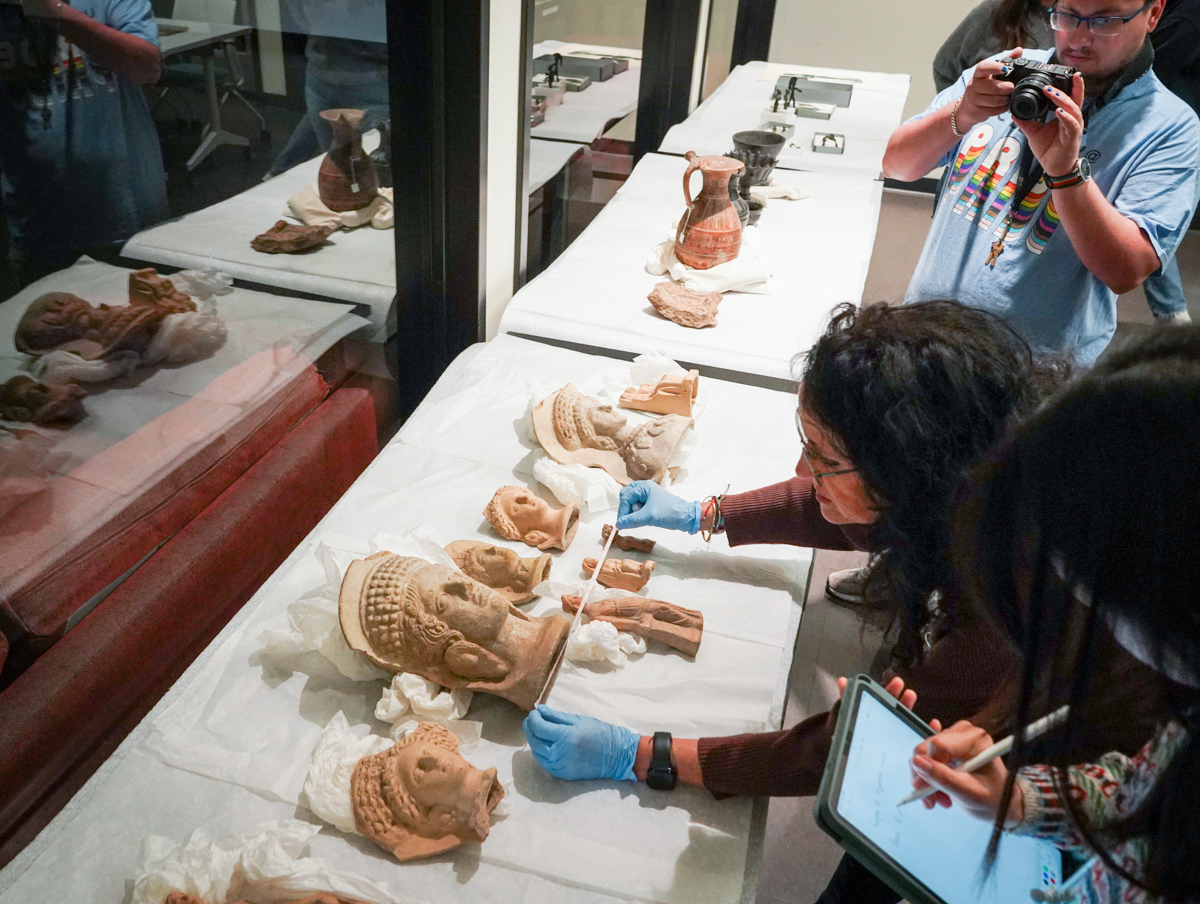
Students look at Etruscan terracotta figurines from the Phoebe A. Hearst Museum of Anthropology in preparation for a new exhibit in the Brown Gallery at Doe Library. A student takes notes on an iPad while lecturer Lisa Pieraccini makes measurements. (Phoebe A. Hearst Museum of Anthropology, University of California, Berkeley, Etruscan terracotta votives from the Vignaccia sanctuary at ancient Caere [Cerveteri]; Photos by Jami Smith/UC Berkeley Library)
The students leaned in to get a closer look at the object on the table: a small terracotta figurine of a woman cradling a baby, her features softened by time.
On the back, pressed into the clay more than 2,000 years ago, was a fingerprint — a trace of the maker’s hand and a link to the worshipper who once carried the statuette as an offering to a goddess. For the students gathered in the quiet classroom that day, the ancient world felt suddenly close.
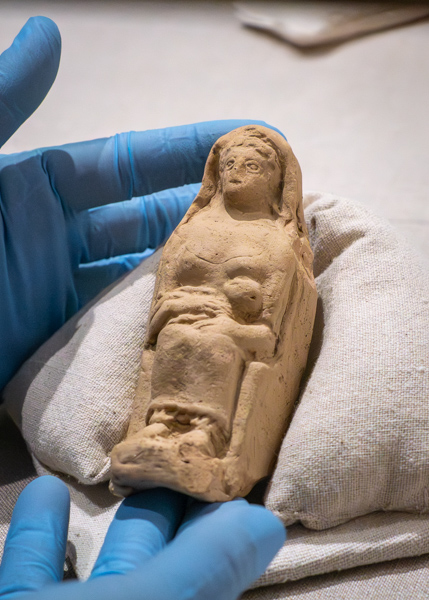
Fingerprints of its creator are pressed into the back of this terracotta figurine of a woman with an infant. (Phoebe A. Hearst Museum of Anthropology, University of California, Berkeley, 8-2543)
“Pressing the clay inside the mold, where you actually see those fingerprints, is really the most poetic time-traveling you can do,” said Lisa Pieraccini, a continuing lecturer in the Department of History of Art.
The students in Pieraccini’s seminar, “The Etruscans: Pasts, Present, and Futures,” spent a semester traveling deep into history, examining artifacts from a civilization that thrived in central Italy long before the rise of Rome. They worked alongside Pieraccini and Art Librarian Lynn Cunningham to co‑curate a new exhibition at the UC Berkeley Library.
Their research forms the foundation of The Etruscans Uncovered: The Phoebe A. Hearst Collection at UC Berkeley, which opens this week in Doe Library. Drawing on materials from the Phoebe A. Hearst Museum of Anthropology and The Bancroft Library, the exhibition showcases artifacts — from bronze belt buckles to clay wine pitchers — that illuminate Etruscan daily life, artistry, and religious practice.
Pieraccini, who also serves as the interim director of the Mario Del Chiaro Center for the Study of Ancient Italy and the Roman World, hopes visitors will slow down and let the objects speak.
“Take the time to read the labels, look at the artifacts, look at the photographs and images,” she said, “and see an amazing culture from ancient Italy that provided so much artistic, religious, and cultural impulse for the people who came after them, the Romans.”
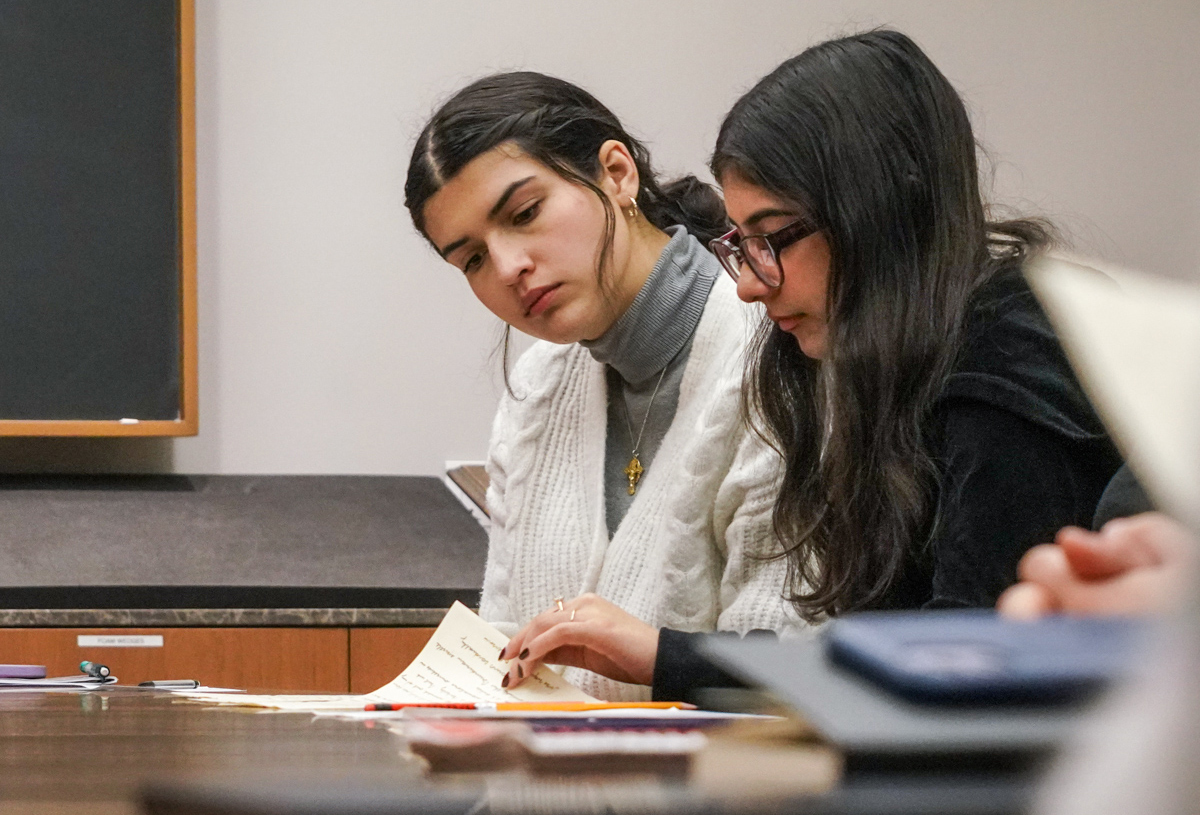
Students in History of Art 192B look over letters to and from Phoebe Hearst, held by The Bancroft Library, to prepare for the exhibit.
Teaching collection
The exhibition is rooted in a collection that still astonishes Pieraccini. With more than 4,000 artifacts, the Etruscan collection at the Hearst Museum is one of the largest of its kind in North America. It was built through the early 20th‑century partnership between Phoebe Apperson Hearst and her art adviser, Alfred Emerson.
“(Hearst) wasn’t collecting these artifacts to showcase in her private home,” Pieraccini said. “She was giving them to a research institution — the University of California at Berkeley — specifically so that students could learn more about this culture and … do hands-on research.”
That forward-thinking philosophy was reflected in the structure of Pieraccini’s spring 2025 seminar. After delving into Etruscan history, the students worked to envision a public exhibit, selecting and analyzing the objects and developing themes to guide their display.
Cunningham helped the students navigate the research process. She accompanied the class to the Hearst Museum to see the artifacts up close and to The Bancroft Library, where the students learned how to work with primary sources — including Hearst’s correspondence with Emerson. A letter from that time (1902) is displayed in the exhibit.
For many of the students, the endeavor was formative.
Kate McGuirt, a double major in ancient Greek and Roman studies and art history, appreciated the opportunity to get practical experience in her field.
“It’s always been my dream to work in a museum and do the research and curate exhibits,” she said. “I never thought I’d be able to do that as an undergrad.”
For Sofia Huff, an art history major considering a future in art law, the class offered a rare look at the nuances of decision-making when preparing to display artifacts.
“Seeing professor Pieraccini having to just sift through objects, see what’s getting approved … what we can use and why we can’t do certain things — I think that’s definitely been interesting for me to see behind the scenes,” Huff noted.
Pieraccini said she found it deeply fulfilling to watch the students grow excited about sharing Etruscan culture with others. Their hard work — now more than nine months ago — will pay off this week.
“I can’t wait to see the students’ faces when they see the exhibit open,” she added.
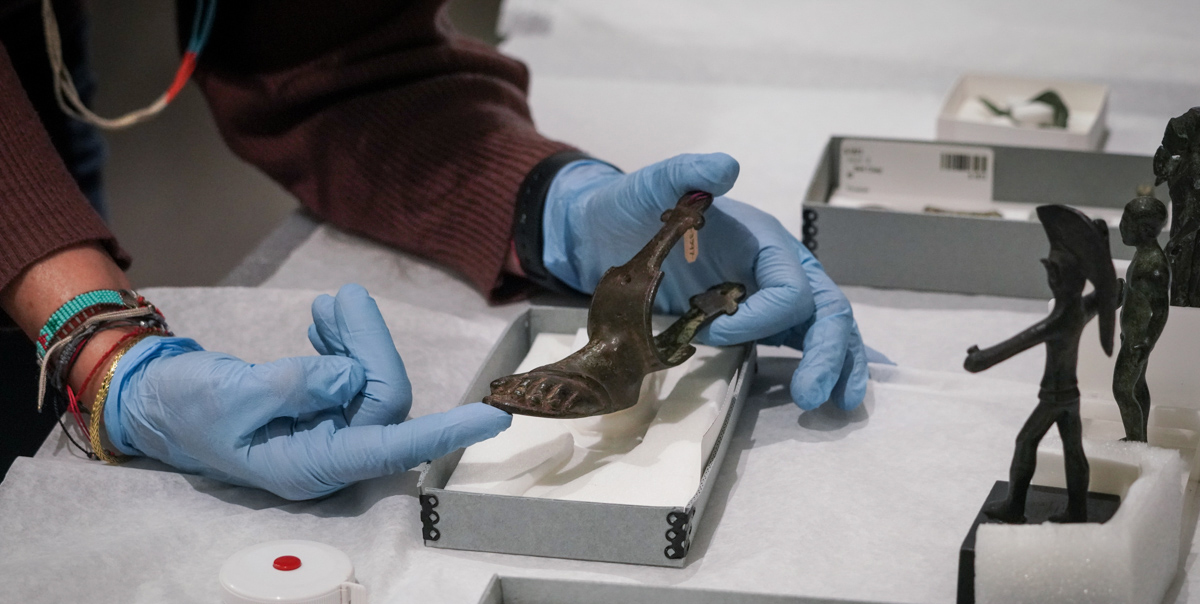
Pieraccini holds a bronze item believed to be a furniture foot, shaped like a human foot. (Phoebe A. Hearst Museum of Anthropology, University of California, Berkeley, 8-3397)
A culture worth rediscovering
What can visitors expect? The exhibition highlights a range of artifacts that reveal the richness of Etruscan artisanship, communal life, and religious customs.
One standout is a bronze belt buckle from the seventh to sixth centuries B.C.E., found at Poggio Buco in southern Etruria. (Ancient Etruria comprised most of modern Tuscany and parts of Umbria and Lazio.) The buckle’s prongs are decorated with stylized horse heads, and though its surface is now green from oxidation, it would once have gleamed, a clear marker of the wearer’s high status.
“Bronze was expensive in Etruscan times,” Pieraccini noted. “And it’s shiny, so this would have had a lot more bling to it back then.”
Another object — believed to be a bronze furniture foot — is fragmentary but unmistakably Etruscan in its decorative flair. Pieraccini loves how it captures the culture’s instinct to embellish even the most functional items.
A poster in the exhibit shows an item that was too precious to display. The fifth‑century B.C.E. bronze mirror is engraved with a helmeted warrior and a winged youth, possibly Eros (the god of love), holding a hare. The mirror underscores the Etruscans’ skill in metalwork and their rich visual vocabulary.
For Pieraccini, however, the exhibit is about more than objects — it’s about rebalancing how we understand the ancient Mediterranean.
“Academic departments in our country … have been built on a Greco-Roman model, placing those civilizations at the top … while other cultures have been grossly marginalized,” Pieraccini said. “The Etruscans are one of those cultures. So just shedding light on the Etruscans for me is a decolonial act … because it’s saying, ‘Hey, the ancient Mediterranean was full of a lot of different people and a lot of different cultures.’ And those people are worth understanding, too.”
This exhibition complements two other Etruscan shows in the Bay Area: Encountering the Etruscans, at the Phoebe A. Hearst Museum (through May 2026), and The Etruscans: From the Heart of Ancient Italy, at the Legion of Honor in San Francisco (May 2 through Sept. 20).