
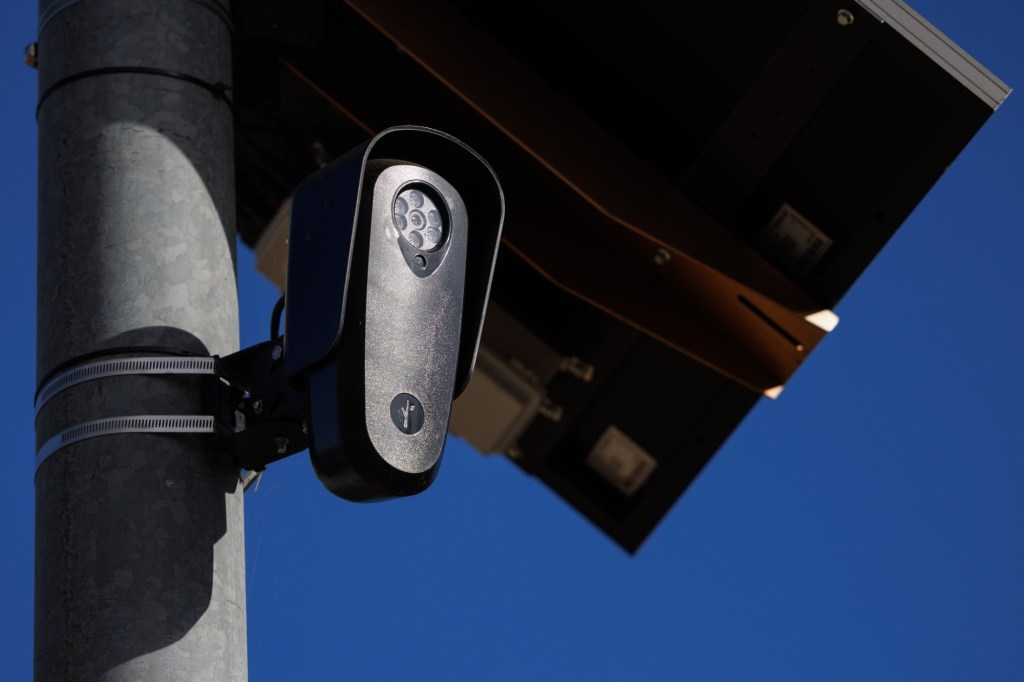
SAN JOSE — The City Council looks poised to move ahead with new restrictions on data retention and access regarding its vast network of automated license-plate reader cameras, a strong nod toward preserving the polarizing technology as other Bay Area jurisdictions have sought to curtail them.
Council members are scheduled to vote Tuesday on limits instituted and proposed by the San Jose Police Department, aimed at shrinking the period it keeps plate images recorded by the 474 Flock Systems cameras installed throughout the city and restricting access to federal and immigration agencies. The council’s backing came as civil-liberties groups maintain their opposition — including suing the city — to what they call the normalization of warrantless surveillance of citizens.
In a memo released late last month, Police Chief Paul Joseph informed the council that his department had revised internal protocols to require California police to provide detailed reasoning for their data requests, and require a police commander to approve requests from agencies that don’t already have access agreements with SJPD. He added that the department disabled a “Federal Sharing” setting in its data portal to block requests from federal agencies.
Joseph asked the council Tuesday to codify into city law his department’s proposals to shrink the retention period for plate data from one year to 30 days, and ban cameras from recording vehicles entering and leaving houses of worship and reproductive health clinics. Most of the city’s elected leadership has held up the ALPR cameras as a vital crime-fighting tool that needs strong oversight rather than reduction.
After reviewing Joseph’s memo, council members Domingo Candelas, Pamela Campos, David Cohen, Michael Mulcahy and George Casey issued a joint memo co-signing Joseph’s proposed changes and requesting that Consulate General offices — particularly the Mexican Consulate — be included in the category of protected spaces. The joint memo also asked the city to explore “alternative” plate-reader vendors, mandate disclosures to council of any unauthorized data access, ban future integration of facial recognition and biometric software, and ensure that generative AI models are not training on the plate data.
Councilmember Peter Ortiz endorsed his colleagues’ supplemental memo, and requested that “health care facilities that primarily offer gender-affirming care” also be protected from surveillance by the plate readers.
The changes appear to be, at least in part, a response to concerns about plate reader access by agencies from out of state, which are not subject to California law that prohibits local police from participating in immigration-related actions.
A security analyst, who requested anonymity out of fear of professional retaliation, conducted research for this news organization indicating that as recently as June 2025, San Jose police fulfilled plate data searches requested by other California agencies in instances the analyst described as tied to federal authorities, including inquiries related to ICE protests. Civil liberties groups argue that such “side-door” searches could conflict with state laws and First Amendment protections.
Both SJPD and the city have denied that any of its data was accessed by immigration officials, and maintain that searches that included terms “DEA,” “ICE” and “HSI,” while troubling at first glance, were not actually conducted on behalf of federal agencies.
“We have a responsibility to ensure the technology we use to support our police department are held to the same high standard as our officers,” Mayor Matt Mahan said in a statement ahead of Tuesday’s council meeting. “I applaud Chief Joseph for putting forward safeguards that ensure we can continue to leverage this technology responsibly and for its intended purpose — keeping San Joseans safe.”
The Electronic Frontier Foundation and ACLU of Northern California contend that ALPR cameras facilitate unconstitutional, warrantless searches given officers have no requirement to prove probable cause of a crime when searching the plate data. The two heavyweight civil-rights organizations are suing the city on behalf of the immigrant-rights organization SIREN and the Bay Area chapter of the Council on American-Islamic Relations.
The plaintiff groups and their allies point to several instances where local Bay Area governments have decided to stop using the cameras after revelations of federal access to the corresponding plate data. In a statement Tuesday, SIREN and 16 other groups that advocate for causes including reproductive, immigration and privacy rights called for ending San Jose’s contract with Flock, and failing that, aligned with the council members’ supplemental requests for routine auditing, and mandated disclosure policies when unauthorized access occurs.
“No matter how perfect the policy, the current federal government has proven that there are no bounds to their campaign of terror on immigrants and dissenters,” Kimberly Woo, a community organizer with SIREN, said in the statement. “We must refuse any AI mass surveillance weapon that has already been used against our communities.”
In the past three months, several Bay Area cities and municipalities have moved to terminate or disable their contracts with Flock Systems, one of the preeminent vendors of ALPR technology. The Mountain View City Council voted last month to end its contract with Flock after the police chief said federal agencies had unauthorized access to a city camera in 2024, owing to a “nationwide” search setting unwittingly enabled. Santa Cruz leaders voted in January to stop using the cameras under similar circumstances. Richmond did the same in December.
Santa Clara County supervisors voted last month to prohibit the sheriff’s office — which carries out policing contracts in Cupertino and Saratoga — from pulling data from the Flock cameras, setting the stage for potential new vendor to step in.
In Oakland, approved in December a two-year, $2.25 million Flock contract, with the Oakland chapter of the NAACP supporting the cameras as a useful crime-fighting tool, pitting them against privacy advocates who initially convinced city leaders to turn it down. El Cerrito police acknowledged last month that ALPR data was errantly made available to federal agencies, but the cameras remain with pledges of new safeguards to prevent unauthorized access.
A Flock spokesperson has said on several occasions that individual cities and municipalities should be self-determining with regards to their use of the cameras. The company has also responded to worries about facial recognition and other surveillance technologies creeping into the system by emphasizing the cameras only record vehicles’ license plates.
This is a developing story. Check back for updates.