
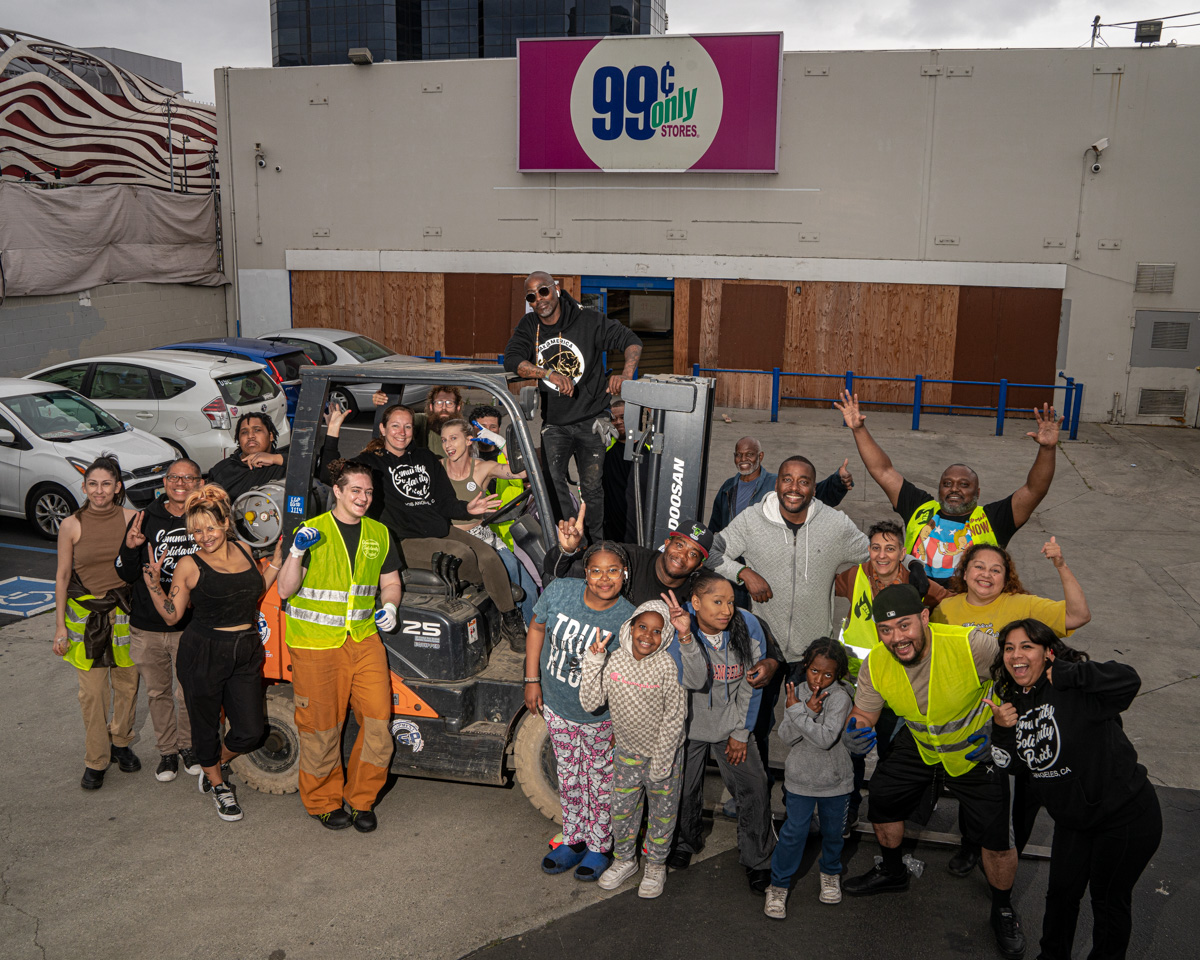
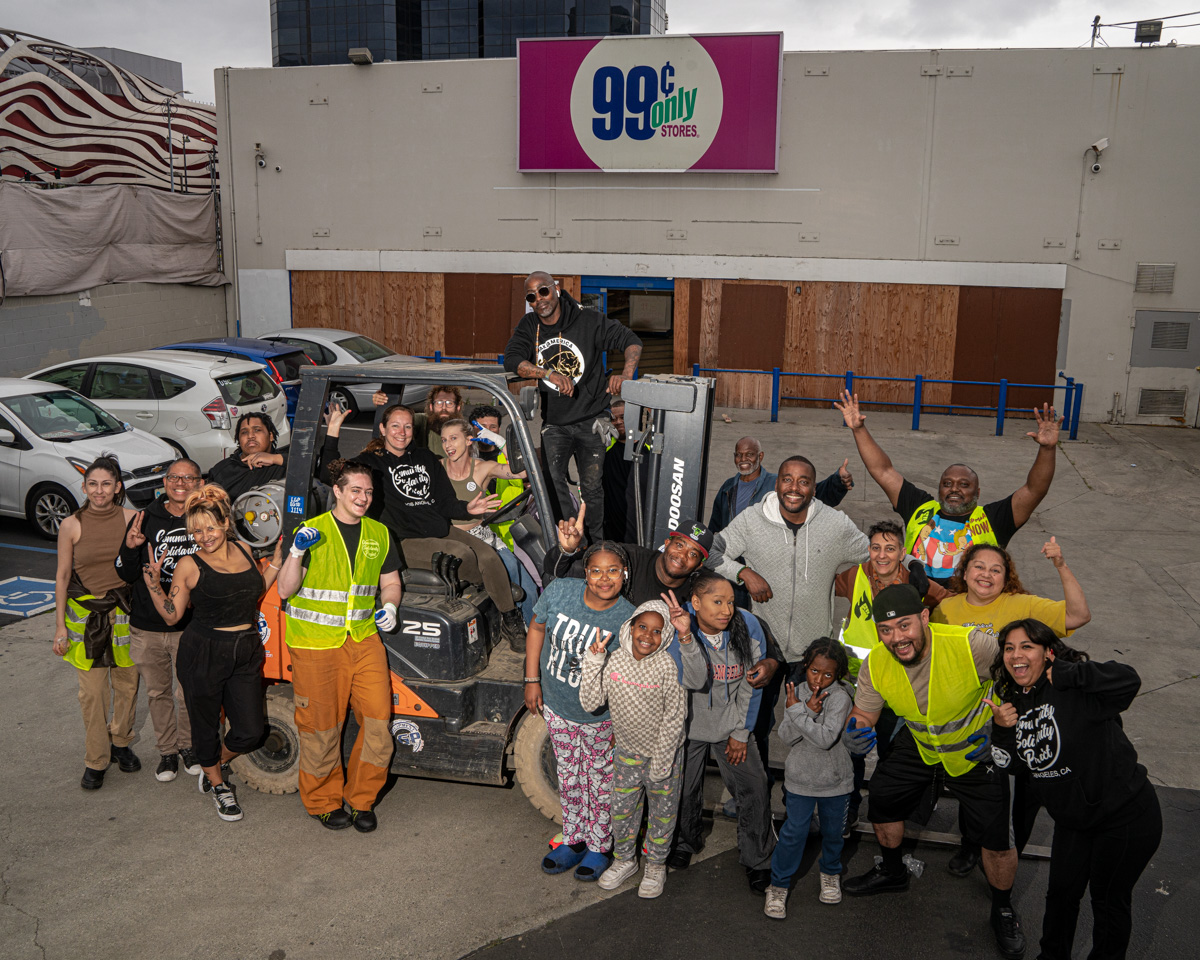
 The Community Solidarity Projects team and volunteers pose for a photo during a distribution at the Free 99. (Photo: Mykle Parker)
The Free 99, a free store located in an abandoned 99 Cents Store building in Miracle Mile, has shut down its operations after one year of mutual aid work. On Thursday, February 12, the Free 99 held its final distribution for the foreseeable future. The store was run and operated by the Los Angeles-based grassroots organization Community Solidarity Project. Although the project started out of pure coincidence, it quickly snowballed into something bigger.
“I think we all learned we are capable of so much more than we realized,” Michelle Manos, the founder and Executive Director of Community Solidarity Project, told Knock LA. “This is what we call a ‘solidarity project’ — when our organization sees a need and decides to take action, when we see a resource and decide to bring it back to the community, when we build logistics to meet the moment. The 99 was an opportunity to share a multi-layered blessing, and to create something purposeful.”
The Free 99 grew out of a grassroots donation and distribution operation that began in Bernie’s Coffee Shop on January 7, 2025, when the Eaton and Palisades Fires ignited. The fires, which destroyed over 16,000 structures and displaced thousands of residents, burned for three weeks before firefighters contained them. The resulting devastation left thousands of people without homes to return to.
In response, LA community organizations rose to the occasion with gusto. Autonomous distribution and donation collection hubs sprang up all over the city. Online communication networks buzzed as neighbors sourced the needs from their areas, connected donors to distribution operations, and sent caravans of supplies out to burn areas. The city hummed with activity as thousands volunteered their time and labor to support evacuees.
In Altadena, the unincorporated area at the foot of the San Gabriel Mountains, the Eaton Fire tore through predominantly Black neighborhoods and either displaced residents who evacuated or permanently destroyed their homes. In the weeks that followed, the Red Cross set up an evacuation shelter at the Pasadena Convention Center but failed to provide displaced Altadena residents with basic necessities like clean clothes, shoes, water, or blankets. As a result, community groups, including Community Solidarity Project, loaded cars and started a pop-up distribution center just outside the Convention Center to make sure evacuees had their needs met.
As time went on and the fires came to an end, many volunteers returned to their 9-to-5 jobs and regular responsibilities. Media outlets moved on. Donors eased up on their contributions. However, the work of repairing the lives of evacuees was just beginning. Manos and Community Solidarity Project decided it was time to pivot.
“Everything changed for us when a multi-national, Swedish-based charity called Distribute Aid reached out and asked if we could receive and distribute tractor-trailer-sized donations on a regular basis for the foreseeable future,” Manos said. “Our philosophy of saying ‘yes’ to resources and ‘making it happen’ was put to the test. Our operations had already outgrown Bernie’s Coffee Shop, and this was not a one-off donation. We needed more room. I’d had my eye on the empty 99 Cents Store next door for a while, and now there was a need to be met.”
The expansion into the old 99 Cents Store building was at first meant to be for storage. However, when it became clear that the property owners were willing to donate the space for much longer than a few weeks, the “Really Really Free 99” took form.
The store officially opened its doors to displaced fire victims in late January. Community Solidarity Project volunteers stocked the empty shelves with donated toothpaste, hair products, clothes, water, and other essential items.
According to Manos, one of the defining factors of the Free99 was the intentional lack of means testing. Visiting shoppers were not asked to provide proof of address, income level, or any other personal details besides the amount of people they were picking up items for. Some shoppers were even inspired to stay and volunteer by stocking the shelves and sorting donations after they picked up items for themselves and their families.
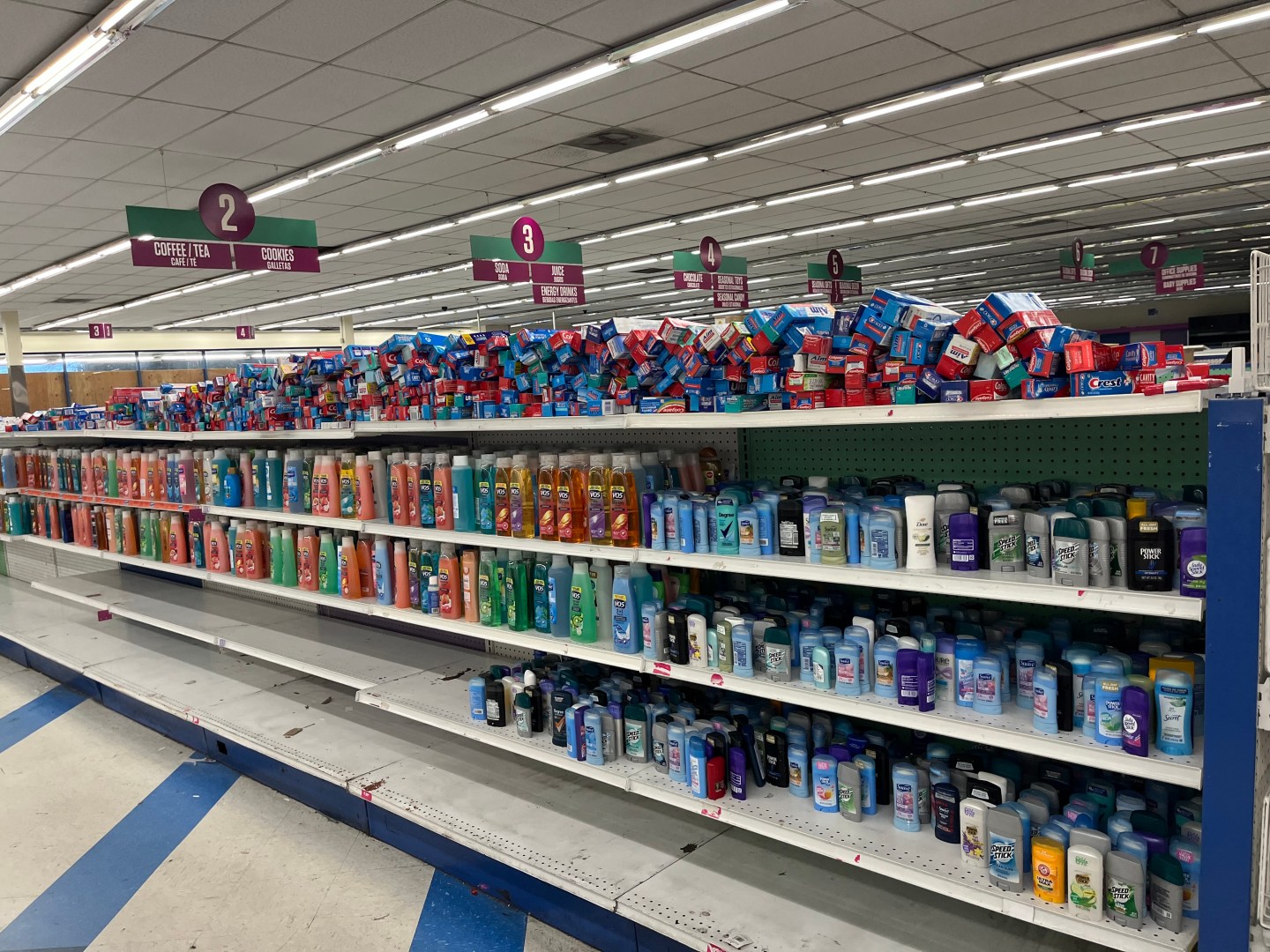 The hygiene aisle at the Free 99. (Photo: Community Solidarity Project)
The store’s opening drew intrigue from community members. One volunteer, Yvette, said she showed up after seeing the opportunity to help out on the Solidarity Project’s Instagram. She remained involved for the rest of the Free99’s tenure.
“I had only dipped my toes into volunteering the month prior as a New Year’s resolution,” Yvette said. “I showed up to the Free99 in a blazer! Lauren, one of the site leads, took me under her wing. I took off the blazer and put on some work gloves.”
As 2025 dragged on, the political landscape of Los Angeles shifted. June brought an explosion of activity as federal agencies launched violent immigration raids across the city. ICE and Customs and Border Patrol began conducting “roving patrols,” abducting anyone they felt matched the characteristics of a migrant or immigrant. Many Black and Brown families grew fearful of visiting grocery stores due to the targeting of those spaces by federal agents.
In response to the escalated state violence, the Free99 doubled down on its commitment to distributing resources to families and individuals despite the inherent risks.
“We had to wrestle with big questions,” Manos told Knock LA. “[For instance] what will I do if ICE shows up unexpectedly on a regular Thursday afternoon and we have 30 seconds to act? What are my individual community safety responsibilities? Am I capable of keeping someone else safe — even if we don’t speak the same language?”
As the summer continued, the economic consequences of immigration raids tightened their grip on LA. When fall arrived, SNAP benefits came under fire due to the federal government shutdown and the partisan fights for a funding bill. In response, the Free99 added new programs to meet the evolving needs of community members. Internal data from Community Solidarity Project shows that the store was supporting between 100 to 200 people per week throughout its tenure.
“Housed within the Free 99 project were various elements and sub-projects such as hot meal giveaways sponsored by AIDS Healthcare Foundation, furniture distribution to families in transition — many of whom were fire-affected families referred by Altadena-based My Tribe Rise, biweekly produce distribution through our partnership with Heart of Compassion, and many other things along the way,” Manos said. “I consider this to be an extraordinary blessing.”
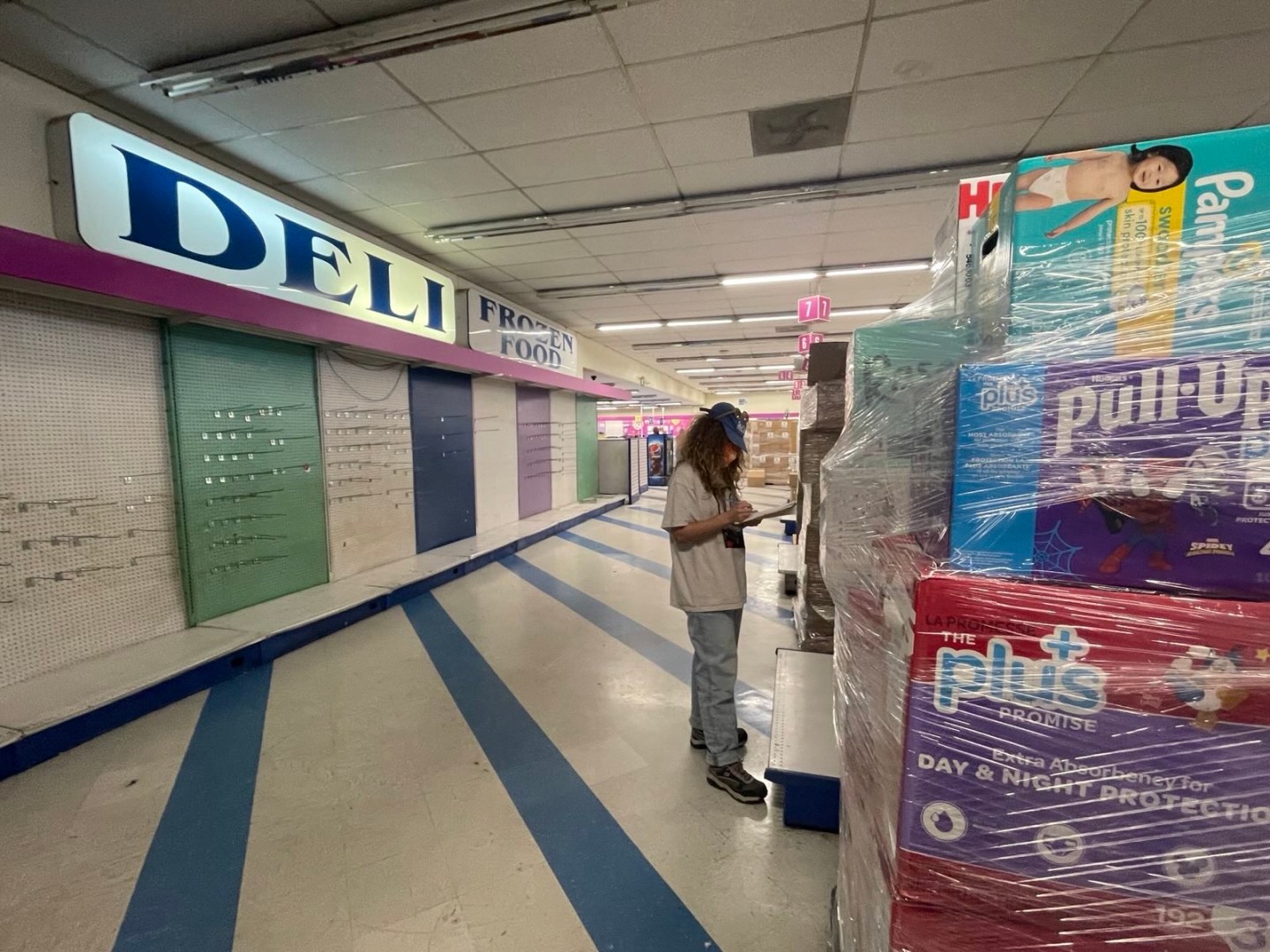 A Free 99 volunteer labels pallets of diapers for distribution. (Photo: Community Solidarity Project)
For Community Solidarity Project team members, the Free 99 was also deeply personal. Volunteer Coordinator Karla Estrada shared that the store reminded her of a similar distribution project called Charlene’s Closet in her hometown of Chino, CA.
“I grew up undocumented and poor,” Estrada said. “My parents benefited from food and clothing distributions like the Free 99. Some Christmases, the only Christmas presents my parents gave us were from the donation drives.”
Volunteers with Community Solidarity Project remarked that the Free 99 was a welcome addition to the mutual aid landscape of LA. The culture of the project was defined by compassion and identifying any excess that could be redistributed out to others.
“As an organization, we believe that we are not above or in a better position than those that receive from us,” Estrada told Knock LA. “We are equally poor. We don’t receive a salary for our work in the 99 or any activities we organize. To take care of our communities, we need to take care of ourselves as well. This is real and true mutual aid. To take care of one another.”
According to organizers, Community Solidarity Project received notice from the property owners on February 9, 2026, that a lease would be coming into the old 99 Cents Store building. The group was given six days to pack up their items from the building and vacate the space. The Free 99’s last distribution was the following Thursday.
A statement posted to the organization’s Instagram said, “It is with a heavy heart that we announce Community Solidarity Project is ending our longest running solidarity project yet. What started as an extension of our crisis response turned into so much more. We will always carry love for the folks that stood with us on this journey. We are far from done.”
As Community Solidarity Project looks ahead to future projects and collaborations, the Free 99’s impact on the organization and its community members is undeniable. What started out as a storage solution became a living, breathing project of unrelenting hope and faith in the fundamental principles of mutual aid: when you show up to support others with your time and labor, the blessings will come back around and support you too.
When asked about the future of her organization, Manos’ answer was clear-eyed and passionate.
“I know one thing: we will keep building — building community, building spaces of radical love and care, and building from gardens of ideas into a solid foundation for change using the strength of our dedication and the wisdom we have gained along the way. It’s just what we do.”
Related